

Wellness Economy 2026: What Growth Means for Spa Jobs
The wellness economy reached $7.5 trillion in 2025, according to research released this November. For spa professionals and employers, the useful question is how that expanding market translates into credible career opportunities, stronger skills and sustainable recruitment.
Published on 16 November 2026. This article separates newly reported market estimates from forecasts and offers HiSoLife’s practical interpretation for spa teams. It does not treat consumer spending as a count of available jobs.

What the new wellness economy report says
The Global Wellness Institute released its Global Wellness Economy Monitor 2026 announcement on 11 November. Its latest estimate puts worldwide wellness spending at $7.5 trillion in 2025, up 8.9% from 2024. Within that picture, spa revenues increased 12.8%, while wellness tourism grew 11.4%.
The report’s research overview projects a $10.9 trillion wellness economy by 2030. That figure is a forecast. The historical spending estimate concerns 2025, even though the publication carries a 2026 date. Keeping those dates separate matters when preparing investment presentations, recruitment advertisements or career plans.
Why Thailand deserves particular attention
A separate GWI Thailand release dated 12 November values the country’s wellness economy at $46.5 billion in 2025, an 8.8% annual increase. Thailand’s spa market reached $2.3 billion, growing 19.6%. Wellness tourism was the country’s largest wellness sector at $14.5 billion.
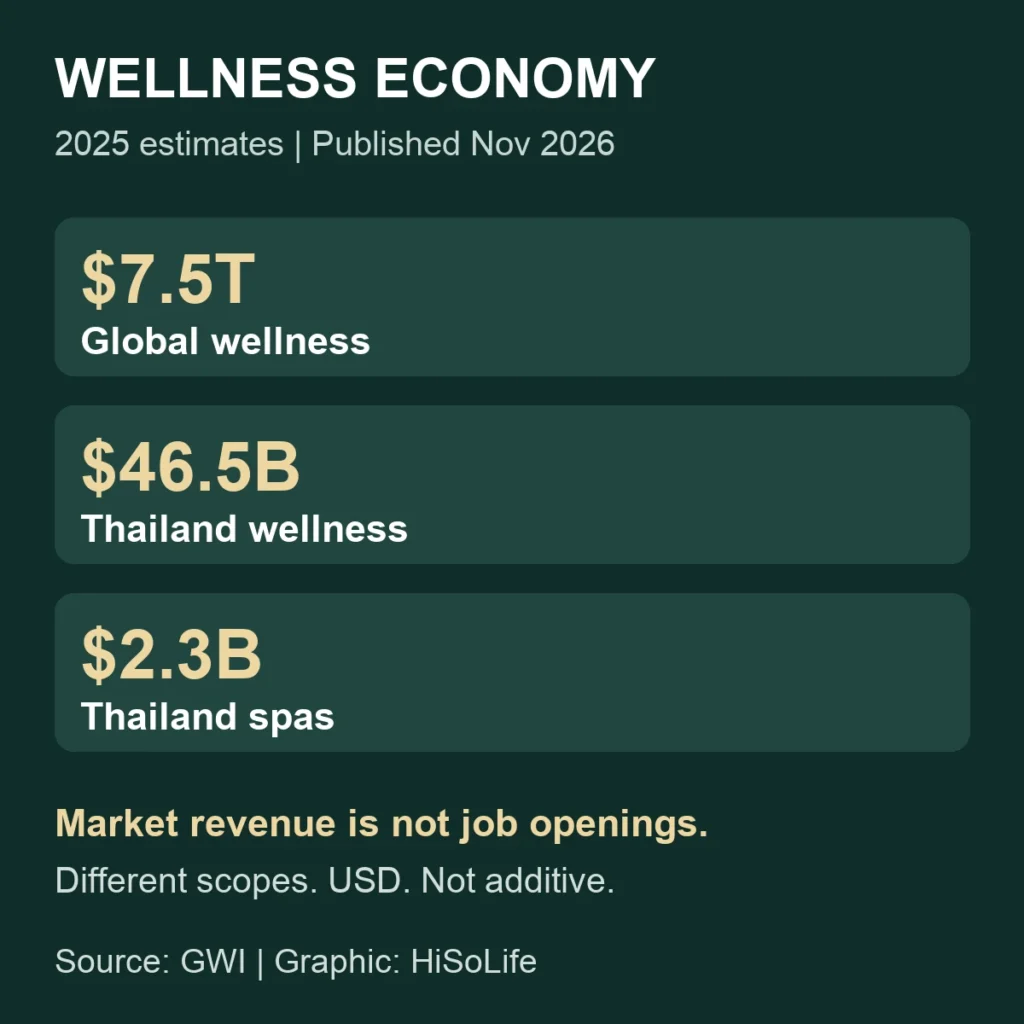
Those figures make Thailand a relevant market to investigate for professionals considering resort spas, urban wellness businesses and hospitality careers. They do not establish how many employers are hiring today. A Bangkok facial therapist and a Phuket resort supervisor still need to assess the particular business, contract, location and responsibilities behind each vacancy.
For employers, our interpretation is to connect recruitment to demonstrable service demand. Examine actual bookings, repeat visits and treatment availability before adding shifts. A strong national headline should prompt a closer look at your own operation, followed by a specific staffing decision.
Market growth and job growth measure different things
Revenue can rise because of prices, treatment mix or higher spending per guest. It can also rise when existing teams serve more customers. None of these changes automatically produces the same percentage increase in jobs. Avoid describing the global spa revenue increase as an employment growth rate.
For a separate employment indicator, O*NET’s US massage therapist projections, sourced from the Bureau of Labor Statistics, show 15% projected employment growth from 2025 to 2035 and about 20,400 annual openings. These openings include replacement needs. They concern the United States and should not be applied to Thailand or the global spa workforce.
Three capabilities to make visible in spa applications
1. Treatment quality and client communication
A useful starting point is the O*NET massage therapist occupation profile, which includes client consultation, maintaining treatment records and sanitizing equipment. Use it as an occupational reference, alongside the requirements applicable to your role and destination. Different countries regulate practice differently.
In your application, explain what you can deliver confidently: treatment modalities, training completed, consultation approach and professional boundaries. Describe a real example of adapting communication to a client’s needs. Keep portfolios free of identifiable client information unless you have appropriate permission to share it.
2. Dependable daily operations
Show how you support the whole guest journey. Relevant examples might include preparing rooms consistently, handling appointment changes calmly or making clear handovers. Name the booking systems you have actually used. Specific experience gives an employer something concrete to explore during an interview and practical assessment.
3. Readiness to develop
Choose training that addresses an identifiable gap in your intended role. An aspiring supervisor might prioritize coaching and scheduling; a therapist might need deeper practice in an established modality. Compare course content, assessment, cost and recognition before enrolling. A fashionable wellness label alone does not establish professional competence.
How employers can turn the news into a hiring decision
Start with a short review of your service diary. Which treatments are repeatedly unavailable? When do guests abandon bookings? Which shifts depend on one person’s specialist knowledge? These questions help define the actual vacancy. HiSoLife’s spa skills audit framework can structure that review.
Write the role around those findings. Include the location, essential skills, working pattern, pay structure, reporting line and training arrangements. Explain any commission separately from guaranteed compensation. Use the wellness salary guide as a starting reference, then check the local market and the responsibilities of the actual position.
Assess applicants against consistent criteria and allow them to understand the practical assessment in advance. The guide to recruiting spa therapists provides a fuller process. Once the offer and responsibilities are clear, publish your spa vacancy with those details visible.
Consider a hypothetical resort with strong weekend demand but empty weekday appointments. Recruiting a full team immediately could increase costs without fixing the mismatch. Reviewing opening hours, existing staff preferences and booking patterns may reveal a narrower requirement. This is an illustrative management example, not a finding from GWI. The same discipline applies when introducing a new service: establish who can deliver it safely, how it will be supervised and whether demand supports the operating cost before advertising a specialist position.
A practical next step for wellness job seekers
Choose a target role before rewriting your CV. List the essential requirements from several genuine vacancies, then compare them with your evidence: qualifications, languages, treatment experience and supervisory work. This creates a focused application and helps distinguish a manageable training gap from a role that requires substantial additional preparation.
When you browse wellness jobs, compare total working conditions as well as the advertised rate. Ask about scheduled hours, breaks, accommodation where relevant, training, probation and how variable earnings are calculated. For overseas opportunities, verify the employer and the destination’s work authorization requirements before making commitments.
During interviews, ask what success looks like after the first three months and who supports new staff. A clear answer helps you judge whether the opportunity fits your experience. Market growth is useful context; the quality of the individual position determines whether the move makes sense for you.
Prepare a small evidence file before applying: a concise CV, verifiable training details, references you have permission to share and a short explanation of your preferred role. If an advertisement combines massage, reception and sales, ask how time is divided and how each responsibility is assessed. This helps both sides discuss the same job. It also reduces the chance of accepting a position whose everyday duties differ from the title that first attracted your attention.
Watch: understand the wider wellness development context
For background, GWI’s archived Wellness Real Estate Webinar explores another part of the wellness economy. The official webinar archive lists it under September 2024. This older recording provides context; it is not a presentation of the November 2026 report or evidence of current job vacancies.
A 30-day plan for acting on the opportunity
During the first week, record your starting point. Employers can review vacancies, booking constraints and team capabilities; candidates can shortlist roles and identify missing evidence. During the second week, refine the job description or application materials. Use the third week for focused interviews, reference checks and relevant skills discussions. In the final week, review what you learned and decide whether to hire, apply further or invest in targeted development. This is a suggested working plan, not a prediction about recruitment timelines.
Keep a few useful measures: suitable applicants, interview attendance and reasons for declining offers for employers; relevant applications, responses and unresolved questions for candidates. Review the quality of the match alongside the speed of the process. That turns a broad industry headline into actions you can evaluate within your own circumstances.
Frequently asked questions
How big is the wellness economy in the 2026 report?
GWI estimates it at $7.5 trillion for 2025 and forecasts $10.9 trillion by 2030. The report year, measurement year and forecast year describe different things.
Does spa market growth guarantee more therapist jobs?
No. Revenue growth and employment growth are different measures. Check actual vacancies, employer demand and local occupational information before drawing conclusions about career prospects.
What should a spa professional do next?
Choose a target role, update your evidence of relevant skills and compare current vacancies. Ask detailed questions about pay, working conditions and development before accepting an offer.
Editorial note: Market figures come from the linked research releases; the recruitment and application recommendations are HiSoLife’s editorial guidance. Sources checked on 16 November 2026. The team illustration is AI-generated; the accompanying graphic is an original visualization of attributed figures.