

Youth Hiring for Hotel Spas: From Work Experience to Paid Jobs
A hotel spa can offer a powerful first step into wellness work. It can also offer a disappointing week of passive observation, unclear duties and no route forward. The difference is not the prestige of the property. It is whether the employer has designed a real hiring pathway.
The question is timely in the United Kingdom. On 15 October 2026, the government announced a hospitality partnership targeting 100,000 paid jobs over three years for people aged 18 to 24 who are not in education, employment or training. The commitment includes major hospitality employers and combines employment, work experience and training.
That national announcement is not a promise of spa jobs, funding or eligibility for every business. It is a useful signal: hospitality employers are being asked to turn first exposure to work into credible employment. Hotel spas can contribute when they offer supported, safe and skill-building entry routes rather than use placements as substitute labour.
The practical test: every placement should have a named supervisor, observable learning outcomes, protected feedback time and an honest next step—even when no job is available.
Why hotel spas should build an entry pathway now
Entry-level hiring can widen the talent pool, but it does not remove the need for qualified practitioners. A young person with limited work history may be ready to learn reception, guest communication, stock control, room preparation or booking administration. They should not be treated as competent to deliver a regulated, licensed or high-risk service without the qualifications and supervision required in that location.
A pathway helps employers separate trainable work behaviours from credentials that must already exist. HiSoLife’s spa skills-audit framework can identify which gaps belong in induction, structured practice, formal training or recruitment. That distinction protects guests, candidates and the existing team.
Current hospitality evidence also supports closer links between workplaces and training. An ILO assessment published on 29 September 2026 found that hospitality qualifications and training in Kosovo did not always reflect changing employer needs. It called for clearer arrangements between schools and businesses, stronger work-based learning, quality assurance and better outcome tracking. The geography matters, but the operating lesson travels: workplace learning needs shared expectations and evidence.
Start with a pathway, not a spare pair of hands
Define the destination before advertising a placement. Is the intended outcome a realistic job preview, a reference, evidence toward a qualification, an interview for a paid vacancy, or an offer subject to assessment? Put the answer in writing. Do not imply that a permanent role is guaranteed if it is not.
The official Jobcentre Plus employer guide, updated in April 2026, describes placements lasting one to eight weeks, with a possible extension to twelve weeks when linked to an apprenticeship offer. That programme is UK-specific. Elsewhere, employers must check local rules, education-provider contracts, insurance, working-time limits and employment status before adopting any duration.
A useful role card should name the purpose, dates, hours, location, supervisor, learning outcomes, permitted tasks, excluded tasks, expenses or pay, support available, feedback points and final evidence. It should also explain who handles a concern and what happens if the placement is unsuitable for either side.
Do not hide a vacancy inside “work experience”
If the person is expected to perform regular productive work, follow fixed duties and contribute like a worker, the label “intern” or “placement” may not determine their legal status. UK government guidance on employment rights and pay for interns says an intern who is classed as a worker is normally due the National Minimum Wage, subject to specific exceptions. Status tests and pay rules differ by country, so obtain local advice before launch.
Even where an unpaid educational or government-arranged placement is lawful, accessibility still matters. Be explicit about travel, meals, uniforms and other costs. If support is available, explain how it is claimed and when it is paid. A pathway that candidates cannot afford to attend will exclude talent before assessment begins.
Choose tasks that teach without crossing safety boundaries
Map tasks into three groups: observe, practise with supervision and perform independently. Observation can include the guest journey, team handovers or stock routines. Supervised practice can include greeting scenarios, booking-system exercises in a training environment, safe linen handling or preparing a room to a documented standard. Independent tasks should be low-risk, clearly taught and checked.
Exclude any treatment, equipment, chemical, data or cash-handling activity until the employer has confirmed the person’s competence, authority and required supervision. Never let a placement participant improvise a wellness service on a guest. Protect client privacy by using fictional scenarios and training records rather than live health information.
The UK Health and Safety Executive’s work-experience guidance states that an employer taking a young person on work experience has the main responsibility for their health and safety. Its guidance calls for suitable risk review, induction, clear instruction and supervision. That is a UK legal context, not a universal summary. In any country, employers should verify the rules that apply to the candidate’s age, tasks and workplace.
Build a realistic spa learning map
- Guest service: professional greetings, listening, boundaries, escalation and inclusive communication.
- Operations: opening checks, room-readiness standards, stock rotation, hygiene routines and handovers.
- Digital basics: booking logic, privacy, accurate notes and when to ask for help, using training data where possible.
- Team practice: punctuality, briefings, respectful communication, feedback and reporting concerns.
- Career awareness: role families, qualifications, progression options and the difference between clinical, beauty, fitness and hospitality responsibilities.
An ILO tourism skills assessment published on 17 September 2026 in three Kenyan counties identified gaps in digital, green and other hospitality skills, alongside weak links between training and industry needs and some short, weakly supervised attachments. Those findings should not be generalised to every market. They do reinforce why a placement needs deliberate learning outcomes rather than a list of errands.
Give the supervisor time and a simple method
A named supervisor is not a name on a form. The person needs enough schedule space to prepare tasks, demonstrate standards, observe practice, answer questions and document progress. If the supervisor is fully booked with guests, the learning plan will be displaced by operations.
The ILO’s competency-based training material for in-company trainers, published on 27 July 2026, organises the job into four stages: understand roles, plan and prepare, implement and deliver, then conclude and evaluate. It was developed for apprenticeship trainers, not as a hotel-spa placement rulebook, but the cycle is a useful discipline.
Use the demonstrate–practise–observe–reflect loop
First explain the outcome, why it matters and what good work looks like. Demonstrate the task at normal pace, then break it into steps. Let the participant practise within the permitted boundary while the supervisor observes. Finish with two questions: what went well, and what will change next time?
Feedback should be specific enough to act on. “Be more confident” is vague. “Pause, confirm the guest’s name, then explain who will help with the request” is observable. Record evidence against the learning outcome, not against the supervisor’s impression of whether the person “fits the culture.”
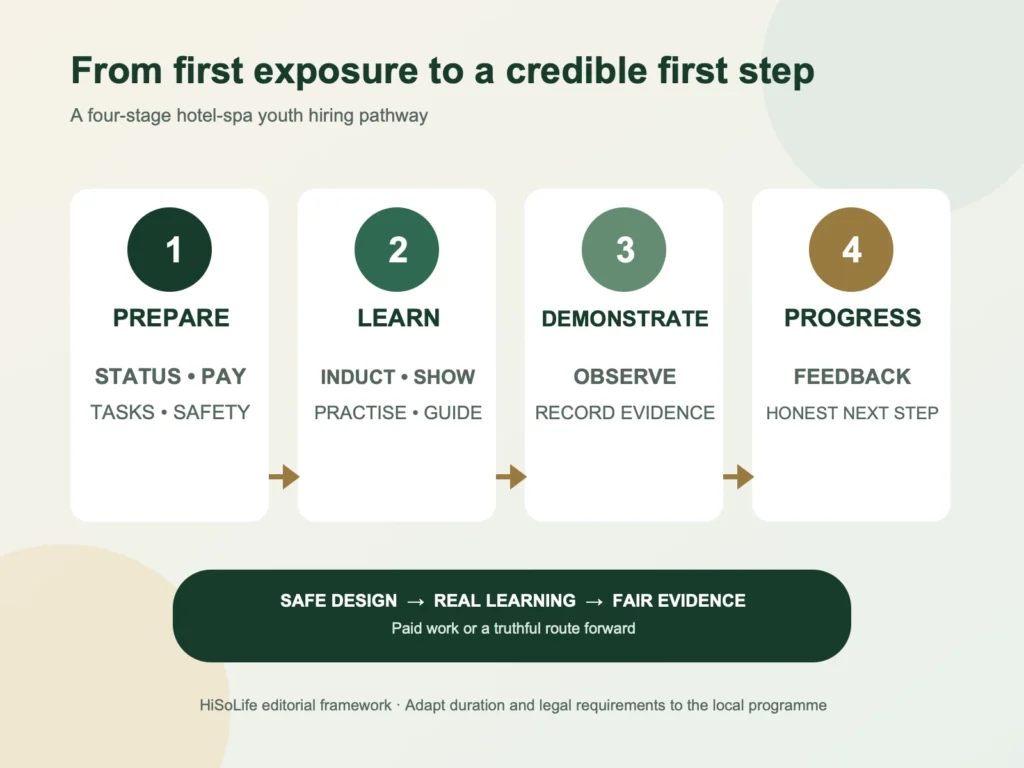
Design a four-stage hotel-spa pathway
The framework below can be scaled to a short placement or a longer work-based programme. The dates are not universal. Keep the sequence, then adapt the pace to local law, provider agreements, the person’s needs and the complexity of the role.
- Prepare: agree status, pay or expenses, tasks, exclusions, adjustments, supervision, risk controls and learning evidence before day one.
- Learn: provide induction, realistic role observation and structured practice against a small set of outcomes.
- Demonstrate: let the participant complete safe tasks with decreasing prompts, while maintaining the required supervision.
- Progress: give written feedback, evidence of skills and a truthful next step: paid interview, training referral, future application route or reference.
Keep the number of outcomes manageable. Four well-observed capabilities are more valuable than twenty boxes ticked after one demonstration. A participant should leave able to describe what they learned and show evidence that another employer or training provider can understand.
Employers planning a genuine paid opening should define the job separately. HiSoLife’s guide to candidate-safe spa hiring covers truthful role information, structured assessment and follow-up. When the vacancy is approved, employers can publish a spa or wellness job rather than keep extending an informal placement.
Assess potential fairly and consistently
People with little work history should not be scored as if they already know hotel language, spa etiquette or corporate systems. Assess the behaviours that the pathway was designed to teach: preparation, learning from instruction, safe judgement, respectful communication, reliability and improvement after feedback.
Use the same core evidence for every participant. A short rubric might rate whether the person clarifies instructions, follows a sequence, protects privacy, escalates uncertainty and reflects on feedback. Add adjustments where needed without lowering essential safety standards. Document what was observed instead of inferring personality from eye contact, accent or familiarity with luxury settings.
Separate suitability for one current vacancy from long-term potential. Someone may not yet meet a language, schedule or qualification requirement but may have demonstrated strong learning behaviour. Give a reference or skills record that describes actual evidence and the conditions under which it was observed.
Make candidate safety visible
Before the first shift, give the participant a contact route outside the immediate supervisor. Explain working hours, breaks, dress requirements, privacy, anti-harassment expectations, emergency arrangements and how to stop a task that feels unsafe. Do not wait for a concern before explaining the process.
In guest-facing wellness work, boundaries need special attention. A participant should know they can escalate sexualised comments, discriminatory behaviour, unwanted contact or requests outside their role. They should never be asked to “be accommodating” at the expense of safety. Supervisors need an immediate response plan that protects the person without blaming them for a guest’s conduct.
For formal apprenticeships, the ILO guide to the Quality Apprenticeships Recommendation, 2023 emphasises structured programmes, inclusion and the protection of apprentices’ rights, including fair remuneration, safe working conditions and access to social protection. It is implementation guidance for an international labour recommendation, not a substitute for the law or agreement governing a specific placement.
Convert learning into a paid opportunity honestly
A conversion decision should begin with an approved business need. Do not create pressure by suggesting that unpaid availability will improve a person’s chance of employment. If a paid role exists, publish its status, hours, base pay, variable pay, duties, qualifications and process. Use the placement evidence as one input, not as permission to skip a fair selection process.
Tell participants when decisions will be made and how they will hear the result. Give unsuccessful applicants a useful explanation tied to the criteria. Where appropriate, offer a future application route, a training referral or a role in another department. Candidates can compare current wellness job opportunities and submit a wellness resume for suitable openings; approved employers can review spa and wellness candidate profiles.
If several sites are involved, track whether selection standards and supervision quality are consistent. A brand-wide promise is only credible when each location can deliver the agreed experience.
Measure the pathway, not just attendance
Attendance is an input. The outcomes are skills, confidence, progression and safe delivery. Track completion, learning outcomes demonstrated, participant feedback, supervisor time, concerns raised and resolved, references issued, paid interviews, paid offers, starts and retention at locally meaningful checkpoints.
Read conversion rates carefully. A high rate can be positive, but it may also mean the employer accepted only people who were already job-ready. A lower rate may still represent value if participants gained evidence and progressed elsewhere. Ask whether the pathway opened access, taught something useful and produced honest next steps.
Share results with participants, supervisors and training partners. The September 2026 ILO Kosovo assessment emphasised the importance of outcome data and graduate tracking for improving training decisions. A hotel spa does not need a complex research system; it needs consistent definitions, permission-aware records and regular review.
Hotel-spa youth hiring pathway checklist
- The business outcome and candidate outcome are written before recruitment.
- Employment status, pay, expenses and local legal advice are documented.
- A risk review, induction and concern route are ready before day one.
- Tasks are separated into observe, supervised practice and independent work.
- Treatment, privacy, equipment and cash boundaries are explicit.
- One named supervisor has protected time to teach and give feedback.
- Learning outcomes are observable, limited and relevant to real jobs.
- Every participant receives feedback and portable evidence of learning.
- A paid vacancy is advertised and assessed as a separate, truthful job.
- Progression, safety, inclusion and participant experience are reviewed together.
Frequently asked questions
Must every hotel-spa work placement be paid?
It depends on the country, programme and the person’s legal status. In the UK, an intern who qualifies as a worker is normally entitled to the National Minimum Wage, while specific exceptions exist. A label does not settle status. Employers should obtain local advice and state pay, expenses and duties clearly before the placement.
Can a placement participant perform spa treatments?
Only when the activity is lawful, appropriate to the programme, within the person’s verified competence and qualifications, and delivered with the required consent and supervision. A general entry placement should not use unqualified participants to provide services to guests.
How long should a work-experience pathway last?
There is no universal duration. The UK Jobcentre Plus programme described in current guidance usually runs from one to eight weeks, with a limited extension in a specific apprenticeship situation. Other programmes and countries differ. Choose enough time to meet defined outcomes without using repeated placements to cover normal staffing.
What should a participant receive at the end?
They should receive a structured conversation, written evidence of the skills observed, a truthful reference where appropriate and a clear next step. If a paid role exists, explain the separate assessment and decision timeline. If it does not, say so directly.
Turn first exposure into a credible first step
Youth hiring is not solved by increasing the number of placements. It improves when employers design a safe bridge between limited experience and paid, accurately described work. For hotel spas, that means protecting service boundaries while teaching the operational, digital and interpersonal skills that make wellness hospitality function.
Start with one role, one trained supervisor and a small set of observable outcomes. Review the evidence before expanding. Employers that have a genuine, approved vacancy can use HiSoLife’s wellness recruitment support; candidates can use the pathway questions above to judge whether an opportunity offers real learning and an honest route forward.