

Spa Workforce Planning for 2035: A Practical Hiring Framework
Workforce planning is not the same as adding names to a rota. A spa can appear fully staffed and still lack coverage for peak periods, specialist treatments, leave, training, consultation, cleaning or supervision. It can also respond to demand by adding appointments faster than its therapists can deliver them sustainably.
New U.S. occupational projections make this a timely management question. The U.S. Bureau of Labor Statistics massage-therapist outlook, updated on 27 August 2026, projects 15% employment growth from 2025 to 2035 and about 20,400 openings a year on average. Those figures do not forecast vacancies in any individual country or spa. They do signal that employers should plan earlier and more precisely for a role with growing demand, substantial replacement needs and a large self-employed segment.
This guide turns external evidence into a practical spa workforce plan. It shows employers how to connect demand, paid capacity, job design, recruitment lead time and review. Candidates can use the same logic to test whether a vacancy describes a credible job or merely an ambitious booking target.
Planning principle: forecast the paid work required to deliver safe, consistent service—not only the number of treatment slots you hope to sell.
What the 2025–35 massage-therapist projections say
The detailed BLS occupational projections table estimates 155,400 massage-therapist jobs in the United States in 2025 and 179,100 in 2035. That is a projected increase of 23,700 jobs, or 15.3%. The same table estimates 20,400 openings a year on average and reports that 35.6% of massage therapists were self-employed in 2025.
For context, BLS projected total U.S. employment to grow 3.5% over the same decade. Massage therapy therefore has a faster projected growth rate than the economy-wide rate, but the comparison is directional. It does not show that every spa market will grow at 15%, that all openings are newly created jobs or that any employer will fill a role easily.
The Occupational Outlook Handbook records a May 2025 U.S. median annual wage of $58,450. Treat that as one national reference point, not as a global salary, a budget recommendation or an earnings promise. Employers should compare like with like: location, employment status, paid and unpaid duties, hours, benefits, commission rules, tips, leave, tax treatment and locally applicable wage requirements all change the meaning of an offer. HiSoLife’s massage-therapist pay benchmarking guide explains those boundaries in more detail.
Read projections without turning them into promises
Long-range projections are planning inputs, not booking forecasts. The annual openings estimate includes workers needed to replace people who transfer to other occupations or leave the labour force, as well as openings associated with growth. A spa cannot multiply a national percentage by its current headcount and call the result a hiring plan.
Geography also matters. These are U.S. data, while HiSoLife serves an international audience. Licensing, qualifications, employment categories, pay structures, migration rules, seasonality and customer demand differ across markets. Use the figures to ask better questions, then replace them with local evidence wherever possible.
Separate market evidence from business evidence
Market evidence describes the environment: occupational growth, replacement openings, pay benchmarks, training pipelines and the balance between employed and independent work. Business evidence describes your operation: appointments requested, treatments denied, room use, cancellations, therapist availability, absence, turnover, service quality and future menu changes. A defensible plan uses both, but never substitutes one for the other.
Keep three confidence levels
Label inputs as verified, estimated or assumed. A completed payroll report is verified. Next quarter’s hotel occupancy may be estimated. A new treatment’s likely demand may be assumed. Record the owner and review date for each input. This prevents a convenient assumption from quietly becoming a permanent staffing commitment.
Start with demand in units the spa can observe
Begin with twelve months of demand where available. Count completed treatment hours, requests that could not be booked, waiting-list activity, late cancellations, peak-period gaps and the service mix by day and time. Add known changes such as new rooms, altered opening hours, a hotel refurbishment, a membership launch or a service being removed.
Do not treat every denied booking as proof of a vacancy. Some demand can move to another time; some depends on a credential the team lacks; some disappears when the price, duration or cancellation terms change. Segment the gap by time, skill, location and persistence before choosing a response.
Build three scenarios instead of one forecast
Create a base case, a high-demand case and a disruption case. The base case should reflect the most credible operating plan. The high-demand case can test a sustained increase, seasonal peak or successful launch. The disruption case can test absence, slower recruitment, delayed credentials or the loss of a key specialist. Give each scenario a trigger rather than pretending to know one exact future.
For example, a spa might approve recruitment only when unserved demand remains above its locally chosen threshold for several review periods and existing workload indicators stay within agreed limits. The threshold is a management decision, not a universal industry statistic. Document it, test it and change it when evidence changes.
Calculate paid capacity, not theoretical treatment time
A therapist’s paid hours are not interchangeable with hands-on treatment hours. Capacity also needs consultation, room reset, hygiene, records, preparation, team communication, training, breaks, leave and other duties in the role. Travel or multi-site work adds another layer. If the model ignores these activities, it overstates capacity before the rota is even published.
The BLS handbook says part-time work is common among massage therapists, schedules vary with appointments, and many therapists cannot perform massage services for eight hours a day, five days a week because of the strength and endurance required. That is not a medical rule or an individual limit. It is a clear warning against equating opening hours with sustainable hands-on capacity.
Broader U.S. occupational-requirements data for personal care and service work reinforce the job-design issue. In 2025, 53.7% of workers in that broad group had variable schedules, only 26.1% could take brief unscheduled pauses, and they spent an average of 70.9% of the workday standing. These category-wide figures are not massage-therapist rates, but they are useful prompts when testing roster control, break access and physical demands.
Use a transparent capacity equation
For each role and planning period, start with paid hours. Subtract planned leave, training, meetings, preparation, documentation, cleaning, protected breaks and a locally evidenced absence allowance. Then apply treatment-specific constraints and the individual arrangements that managers have agreed lawfully and safely. The remaining number is an estimate of deliverable service capacity, not a quota to impose regardless of conditions.
Compare that capacity with scenario demand by skill and time block. A monthly total can hide a Saturday shortfall or a lack of one qualified modality. Keep the model simple enough for spa managers and therapists to challenge; a complex spreadsheet that nobody trusts is weaker than a small model with visible assumptions.
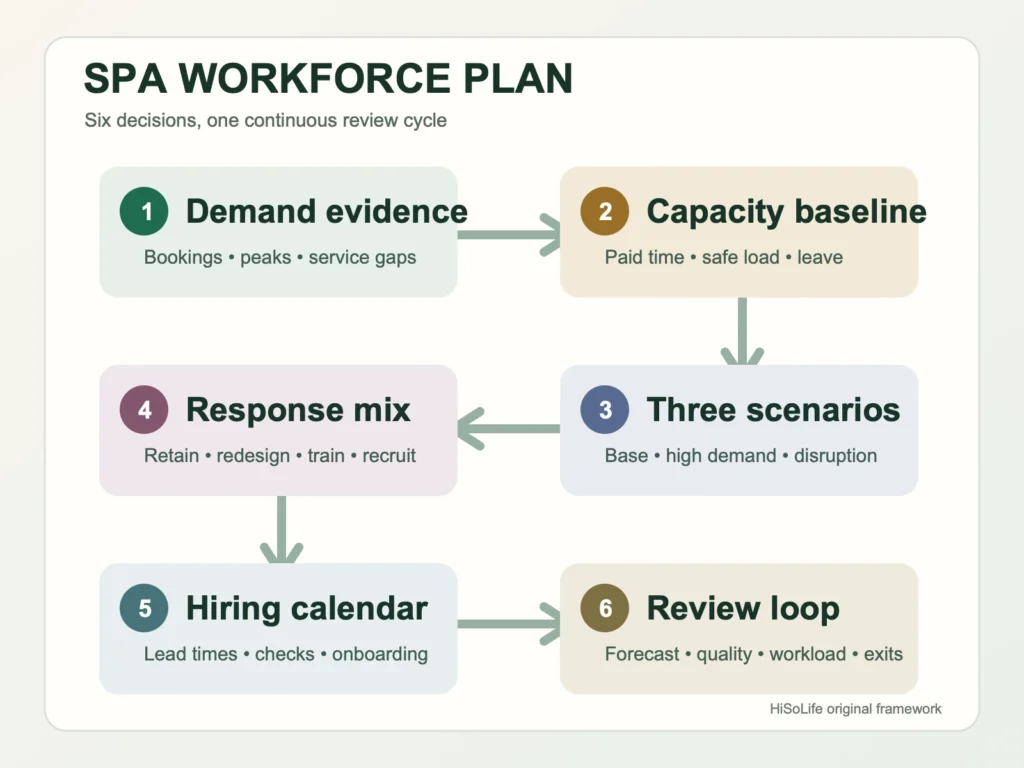
Use the six-step spa workforce planning cycle
The CIPD workforce-planning factsheet defines the discipline as balancing labour supply and demand, identifying gaps and implementing solutions. It also stresses that planning is iterative and should combine numerical evidence with strategy. For a spa, that can become a six-step operating cycle.
- Demand evidence: map bookings, peaks, service mix, denied demand, attrition and known business changes.
- Capacity baseline: calculate paid availability after leave, non-treatment duties, breaks and locally validated workload constraints.
- Three scenarios: model base, high-demand and disruption cases with named triggers.
- Response mix: choose among retention, redesign, training, recruitment and carefully governed external partnerships.
- Hiring calendar: work backward from the need date through approval, sourcing, assessment, checks, notice and onboarding.
- Review loop: compare forecast with actual demand, quality, workload, starts and exits; then refresh the assumptions.
The cycle deliberately puts recruitment after diagnosis. A vacancy may be real, but the best response could still include schedule redesign, development of an existing employee, a narrower service menu or stronger retention alongside hiring.
Choose a response mix before opening a vacancy
First protect the capacity you already have. Review avoidable exits, unreliable rosters, unclear duties, unpaid work, weak supervision and the concentration of difficult treatments on a few people. HiSoLife’s spa-therapist retention playbook can help identify operating changes that belong in the plan rather than in a recruitment advert.
Next test whether a process or menu change solves part of the gap. Better booking rules, clearer treatment durations, cross-location visibility or removing persistently unviable services may improve coverage. Do not call this productivity if it simply transfers more physical load to the same therapists.
Then decide which capabilities to build internally. The ILO’s September 2026 hospitality skills assessment highlights the value of labour-market-informed training and collaboration among employers, training providers and social partners. Its Kosovo findings are not a global spa benchmark, but the partnership principle travels well. Use HiSoLife’s spa skills-audit framework to distinguish trainable gaps from credentials or experience that must be present on entry.
Recruit when the remaining gap is persistent, approved and attached to a defined job. External or independent capacity may also be relevant, but applicable classification rules vary. Obtain local employment and tax advice before choosing a contract form, define quality and safeguarding controls, and avoid vague arrangements.
Compete with a credible job, not only a vacancy
The reported 35.6% self-employed share in the 2025 U.S. BLS matrix matters because employed spas may be competing with autonomy, not just with another employer’s pay. A credible employee proposition should explain schedule input, paid non-treatment time, demand stability, benefits, supervision, equipment, client acquisition, learning, progression and how cancellations affect earnings.
The 2026 O*NET profile for massage therapists shows that the role extends beyond hands-on treatment. Listed tasks include consulting clients, maintaining treatment areas, documenting information and developing treatment plans. A job description that prices only the session but expects all the surrounding work will undermine both budgeting and trust.
Publish the working pattern and employment status accurately. Explain which earnings are guaranteed, variable or dependent on bookings. Avoid presenting maximum commission as normal pay or promising a full diary. Employers with an approved role can publish a spa or wellness vacancy using descriptive terms that candidates can compare.
Work backward through the hiring calendar
Set the date by which the person must be independently ready, then work backward through onboarding, role-specific training, qualification or reference checks, notice, offer review, assessment, sourcing and internal approval. Do not set a start date that assumes every candidate is immediately available and every check completes without questions.
Assign an owner and expected duration to each stage. Record which steps may run in parallel and which are hard gates. If international recruitment is in scope, add lawful migration, recognition and relocation stages without guaranteeing outcomes. If the timeline no longer fits, change the operating plan rather than pressuring a candidate to bypass notice or checks.
A practical 90-day planning rhythm
- Days 1–15: validate demand, paid capacity, workload and the scenario trigger with operations, finance and therapist input.
- Days 16–30: approve the response mix, role card, budget, assessment method and sourcing route.
- Days 31–60: recruit or train, give candidates realistic information, and monitor whether demand assumptions change.
- Days 61–90: complete checks and onboarding, protect supervision time, and compare early capacity with the plan.
This is a review rhythm, not a promise that every role can be filled in 90 days. Specialist supply, notice, credentials and location may require more time. Start earlier when the risk is visible.
Measure whether the plan improved the work
Track a small chain of measures: forecast and actual treatment demand, deliverable paid capacity, peak-period coverage, unserved requests, time to fill, offer acceptance, start completion, early exits, overtime or excess hours, absence, service quality and employee feedback. Define each measure, owner, frequency and decision rule before the dashboard is used.
A lower denied-booking count is not automatically success if complaints, fatigue signals or exits rise. A faster time to fill is not success if the job information was inaccurate. Read capacity, quality and workforce outcomes together, and involve workers in interpreting what changed.
Review the plan monthly during change and at a locally sensible cadence when operations are stable. Preserve dated assumptions so the team can learn whether demand, attrition or hiring lead time was misread. The goal is not perfect prediction; it is earlier, more transparent decisions.
Spa workforce planning checklist
- We separated national market evidence from local business evidence.
- We mapped demand by time, location, service and required capability.
- We calculated paid capacity after non-treatment work, leave and breaks.
- We built base, high-demand and disruption scenarios with triggers.
- Therapists and operational managers reviewed the workload assumptions.
- We tested retention, redesign and training before defaulting to recruitment.
- The approved role explains status, schedule, pay logic and paid duties.
- The hiring calendar includes checks, notice, onboarding and supervision.
- Metrics combine demand, quality, workload, hiring and retention outcomes.
- Every assumption has an owner and review date.
What candidates should ask about the plan
Candidates can ask how the spa calculates a normal working week, which duties are paid, how appointments and breaks are scheduled, how cancellations affect earnings, what supervision exists and why the role is open. Ask what must already be qualified and what the employer will train. Compare the written offer with the advert rather than relying on verbal estimates.
A projection that an occupation may grow does not prove that one vacancy is stable or well designed. Look for a clear reporting line, realistic start process, transparent status and a workload explanation that includes consultation, setup and records. Job seekers can review current wellness job listings and submit a wellness resume; employers can review spa and wellness candidates after the workforce need is defined.
Frequently asked questions
Does 15% projected growth mean my spa should increase therapist headcount by 15%?
No. The 15% figure is a U.S. occupational projection for 2025–35, not a target for an individual business. Build headcount from local demand, paid capacity, service mix, attrition, workload and strategy, then test scenarios.
Are the 20,400 annual openings all new massage-therapist jobs?
No. BLS says many projected openings arise because workers transfer to other occupations or leave the labour force. The average includes replacement needs as well as growth-related openings.
Should a spa count every paid therapist hour as treatment capacity?
No. A credible model includes consultation, setup, hygiene, records, training, meetings, breaks, leave and other paid duties. It should also reflect treatment mix and locally validated workload arrangements rather than impose a universal hands-on target.
When should recruitment begin?
Begin when a persistent, approved capacity gap is visible and work backward from the date the person must be ready. Include sourcing, assessment, checks, notice, onboarding, training and supervision. Specialist or international recruitment may require a longer lead time.
From projection to a better staffing decision
The 2025–35 outlook supports early attention to massage-therapist supply, but it does not remove uncertainty. The useful response is a repeatable cycle: observe demand, calculate paid capacity, test scenarios, choose a mixed response, build a realistic calendar and review outcomes with the people doing the work.
That discipline helps employers avoid two expensive errors—recruiting before the job is defined and selling capacity before it exists. When a genuine gap remains, HiSoLife can provide specialist wellness recruitment support for an approved, accurately described role.