

Massage Therapist Pay Benchmarks in 2026: How to Build a Credible Offer
A credible massage therapist offer cannot be reduced to one annual number. Employers need to show the guaranteed base, paid hours, realistic treatment volume, commission rules, tips, benefits and workload. Candidates need a way to compare those elements on the same basis. This guide turns current wage evidence into a practical offer-building and offer-checking framework.

The latest U.S. occupational wage release gives the discussion a useful reference point. In May 2025, the median hourly wage for massage therapists in wage-and-salary employment was $28.10, while the mean was $30.69. Those figures were published by the U.S. Bureau of Labor Statistics (BLS) on 15 May 2026. They are evidence, not a universal rate card.
Massage work varies sharply by country, city, licence, establishment, schedule, service mix and employment status. A benchmark can help identify an offer that deserves another look; it cannot replace local market research, current employment rules or a transparent conversation about how earnings are actually produced.
Why massage therapist pay is difficult to compare
Two vacancies can advertise the same monthly or annual figure while offering very different economic realities. One may guarantee paid preparation time, breaks, training and quiet periods. Another may pay mainly for booked treatments, assume tips or commission that are not guaranteed, and require unpaid opening, laundry or consultation work. The headline alone hides the difference.
Employment status also matters. An employee, a genuine independent contractor and a self-employed practitioner may all quote an hourly amount, but their costs and protections are not equivalent. A contractor may supply insurance, equipment, tax administration and unpaid leave. An employee may receive statutory benefits, employer contributions or paid training. Classification depends on the law and facts in the relevant location, not the label in an advertisement.
Start by comparing like with like: guaranteed compensation for all paid work, variable compensation under a realistic scenario, employer-funded benefits, required costs paid by the worker, and the physical load needed to earn the amount. This gives both parties a more honest basis for negotiation.
Read the 2026 BLS release correctly
The May 2025 Occupational Employment and Wage Statistics release estimated 98,790 massage therapist wage-and-salary jobs in the United States. It reported a mean hourly wage of $30.69, an annual mean of $63,830 and a median hourly wage of $28.10. The reference period is May 2025 even though the release date is May 2026.
The median is the midpoint: half of measured workers earned more and half earned less. The mean is an arithmetic average and can be pulled upward by higher earners. Neither describes a particular city, spa concept or therapist. Employers should usually begin with the median and local percentiles, then explain why the role sits above or below that comparison.
The annual figure is a standardised conversion
BLS calculates the annual mean for most hourly occupations by multiplying the hourly mean by 2,080 hours, a year-round full-time convention. That conversion is useful for comparison, but it does not prove that the typical massage therapist delivers or is paid for 40 hours every week. The BLS occupational profile notes that part-time work is common and schedules can vary considerably.
The survey has important boundaries
The OEWS survey excludes self-employed workers and owners or partners of unincorporated firms. Its wage definition includes base pay, guaranteed pay, commissions, production bonuses and tips, while excluding overtime, shift differentials and employer costs for supplementary benefits. A candidate should not assume the published hourly figure means base salary before variable earnings.
That boundary is especially important in massage. The BLS Occupational Outlook Handbook says 42% of U.S. massage therapist jobs in 2024 were self-employed. The new OEWS wage figure and the wider occupational employment estimate therefore answer different questions and should not be combined as if they describe the same population.
Build a seven-part massage therapist offer
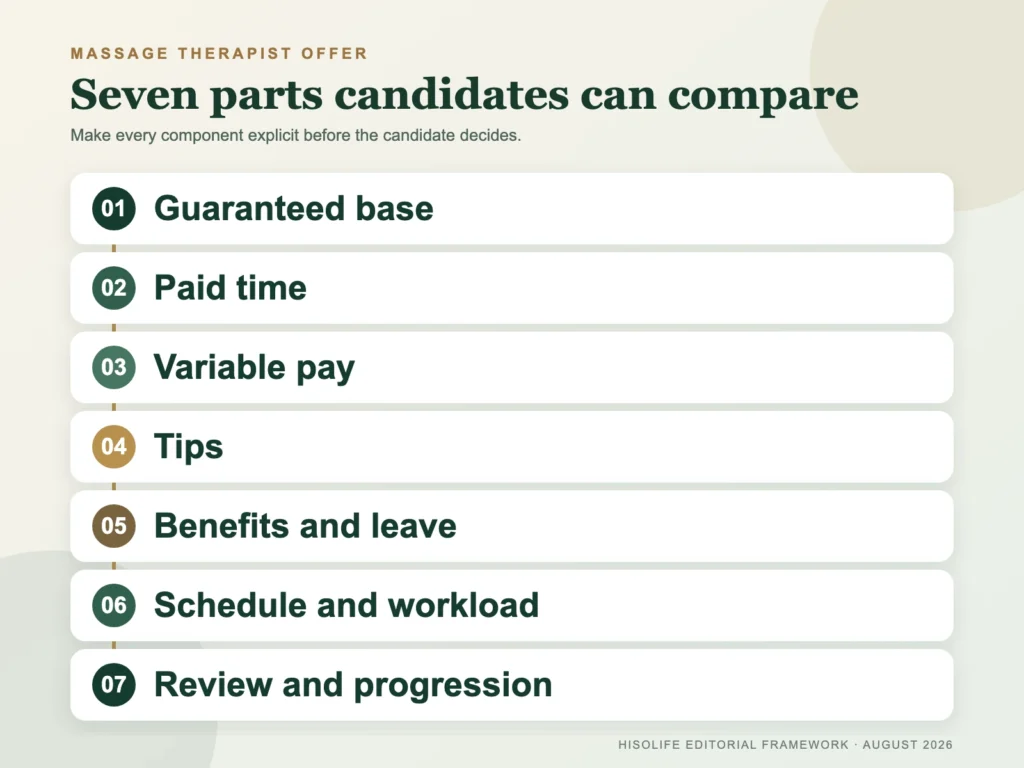
A strong offer makes each component visible. The goal is not to make every employer use the same compensation model. It is to let a candidate understand what is guaranteed, what is conditional and what work is expected in return.
The seven-part offer framework
- Guaranteed base: state the hourly, monthly or annual amount and the pay frequency.
- Paid time: define whether preparation, consultation, cleaning, laundry, meetings, training and gaps between bookings are paid.
- Variable pay: give the commission formula, eligible sales or services, thresholds, payment timing and treatment of cancellations or refunds.
- Tips: explain whether tips are permitted, pooled or individual, how they are distributed and that they are not guaranteed.
- Benefits and leave: list employer contributions, paid leave, healthcare, meals, transport, accommodation, uniforms, education or product allowances.
- Schedule and workload: show expected paid hours, shift pattern, weekend or holiday requirements, break policy and a realistic treatment range.
- Review and progression: name the probation terms, review date, performance evidence and path to senior therapist, trainer, supervisor or manager work.
Put the guaranteed base first. “Up to” earnings belong in a separate, labelled scenario. If commission varies with occupancy, retail sales or service type, provide at least a conservative and a typical example based on recent comparable operations. Do not present the highest month of the strongest performer as an ordinary outcome.
Pay every required part of the role correctly
A treatment does not begin when hands contact the client and end when the client leaves the table. Consultation, room setup, sanitation, notes, product control and reset are part of service delivery. Whether and how that time must be paid depends on local law and the working arrangement, but the offer should never make required work invisible.
Employers should map a complete shift before setting targets. Count opening and closing duties, team briefings, training, reasonable breaks and gaps created by the booking system. Then test whether the proposed client load is compatible with service quality and the physical demands of the role. HiSoLife’s spa therapist retention playbook provides a companion framework for workload, recovery and manager support.
Adjust the benchmark for role, place and business model
A national occupational estimate is a starting point. Build a comparison set using the same city or labour market, a similar licence or qualification level, comparable responsibilities and the same employment status. A resort therapist who receives accommodation and meals, a city day-spa employee and a mobile contractor should not be treated as interchangeable.
Role scope can justify differences when it is defined clearly. Advanced modalities, consultation responsibility, language requirements, team leadership, training duties, sales accountability or difficult shifts may add value. Prestige language, an elegant venue or an inflated list of preferred credentials does not by itself explain lower guaranteed pay.
Check the legal floor before the market benchmark
Market data cannot override minimum wages, awards, collective agreements, overtime rules, paid-leave rights or lawful classification. The ILO’s wages topic portal frames wage setting around two pillars: the needs of workers and their families, and economic factors. The rules and institutions that apply to an individual offer still differ by country and region.
For international hiring, identify the work location first, then verify the applicable rules through the relevant public authority or qualified adviser. Keep immigration costs, recruitment fees and relocation support separate from wages. No salary benchmark guarantees a visa, licence or right to work.
Publish a range candidates can understand
Pay transparency is becoming a stronger expectation as well as a legal requirement in some markets. An International SPA Association survey of 223 spa members in September 2025 found that 69% of spa respondents shared pay information before interview, even though 89% shared job descriptions. The gap suggests that many candidates still enter a conversation without the information needed to judge fit.
The European Commission’s 5 June 2026 pay-transparency explainer says employers under national rules implementing the EU directive must inform job seekers of the starting salary or range in the vacancy or before interview and must not ask about pay history. Employers should check the law in each hiring country because implementation and enforcement details are national.
A useful range has a real lower and upper bound. Explain what places a candidate within it: verified experience, relevant scope, responsibility, schedule or demonstrated capability. If every qualified new hire begins at the minimum, advertise the starting rate instead of a decorative maximum.
Use descriptive wording. “Guaranteed base of X–Y per paid hour, plus the commission formula below” is clearer than “competitive package.” State the currency, gross or net basis, pay period and expected paid hours. HiSoLife’s Wellness Salary Guide 2026 can help both parties prepare questions, but the final comparison should use current local evidence.
Model variable earnings without turning them into a promise
Commission can align reward with service or retail performance, but it becomes misleading when the candidate cannot see the inputs. Write the percentage, the calculation base, any threshold, exclusions, payment date, ownership of repeat clients and what happens after refunds, discounts or cancellations.
Show three scenarios using credible booking and sales assumptions: conservative, typical and strong. Separate employer-controlled inputs such as occupancy, pricing, marketing and room availability from therapist-controlled inputs such as attendance, service quality and appropriate retail recommendations. A worker should not carry all the risk for an empty appointment book they cannot control.
Tips deserve the same clarity. Explain local rules, whether the business deducts fees, whether the pool includes non-treatment staff and when money is distributed. Do not use tips to disguise a guaranteed base below a lawful floor. Benefits should be valued separately so that a candidate can compare cash compensation with the full package.
A worksheet for comparing two offers
Convert each offer to the same period—normally one month—without assuming maximum commission. Start with guaranteed gross pay for all scheduled paid hours. Add the conservative variable-pay scenario and employer-funded benefits that the candidate would otherwise buy. Subtract required worker-paid costs such as insurance, equipment, uniforms, transport or accommodation.
Candidate comparison checklist
- What is guaranteed if bookings are quiet?
- Which duties and gaps count as paid time?
- How many treatments are expected per shift and week?
- Which commission inputs can the therapist actually influence?
- What evidence supports the “typical” earnings example?
- Are tips, bonuses and benefits shown separately?
- Which licences, insurance, products or travel costs does the worker pay?
- When will pay and workload be reviewed, and what progression is available?
Calculate an effective guaranteed rate by dividing guaranteed pay by all required paid hours, not only hands-on treatment hours. Then compare the workload and uncertainty. A slightly lower guaranteed rate with paid training, sustainable bookings and dependable benefits may be stronger than a high “potential” rate built on continuous treatment and uncertain commission.
Ask for the written contract, compensation schedule and recent anonymised scenario before accepting. Save the vacancy and offer. If an employer pressures a candidate to decide before explaining deductions, status or paid duties, pause and seek local advice. Candidates can compare current wellness vacancies and submit a professional profile to HiSoLife when ready.
Red flags employers and candidates should resolve
Watch for ranges with no placement criteria, annual figures that silently assume full-time hours, tips described as guaranteed salary, commission with no written formula, unpaid required duties, contractor labels with employee-style control, unexplained deductions, or treatment targets that leave no room for reset and recovery.
For employers, a red flag is any pay model that only one manager understands. Payroll, recruiters and supervisors should give the same answer. Test the offer with a new hire’s eyes: can a person calculate the minimum payable amount, understand the typical scenario and identify the conditions for progression without relying on a verbal promise?
For candidates, a high rate does not compensate for unsafe expectations, unclear boundaries or unlawful terms. Review professional scope, client-safety procedures and the hiring process alongside pay. HiSoLife’s spa therapist hiring checklist shows the evidence a structured employer should assess.
A 30-day pay-benchmark audit for spa employers
Week 1: map every pay element
List base pay, paid hours, commission, tips, bonuses, benefits, deductions and worker-funded costs for each role. Compare contracts, payroll settings and what recruiters say. Correct contradictions before advertising again.
Week 2: collect matched benchmarks
Use current official data, local vacancy evidence and reliable recruitment insight. Match geography, status, qualification and scope. Record the source date and limitations. Do not convert a U.S. national wage directly into another country’s offer using exchange rates alone.
Week 3: test workload and scenarios
Model quiet, typical and strong months. Include all required duties and realistic breaks. Ask current team members whether the assumptions describe their work. Investigate any gap by location, shift, role or other relevant group using lawful and appropriately protected data.
Week 4: publish, explain and review
Update the vacancy, offer template and recruiter script. Give candidates the range, formula and interview process before they invest in tests or travel. Set a review date triggered by legal changes, significant inflation, service-price changes or persistent recruitment and retention problems.
Employers can publish a transparent wellness vacancy or discuss a market-calibrated search through HiSoLife’s wellness recruitment service. Clear pay architecture does not guarantee a hire, but it reduces avoidable mismatch and gives both sides a defensible place to start.
Conclusion: benchmark the offer, not just the headline
The May 2025 BLS figures are valuable because they are current, documented and comparable. They are also limited to a defined U.S. wage-and-salary population and a specific wage concept. Used responsibly, they prompt better questions rather than a single global answer.
A credible 2026 offer names the guarantee, pays attention to all required work, explains variable earnings, shows the schedule and workload, respects local rules and provides a review path. Candidates can then compare opportunities on evidence. Employers can recruit with fewer surprises and build compensation around the role people will actually perform.
Frequently asked questions
What is the 2025 U.S. median hourly wage for massage therapists?
The BLS reported a median hourly wage of $28.10 for massage therapists in wage-and-salary employment in May 2025. It is a U.S. national estimate, excludes self-employed workers and should not be treated as a universal starting rate.
Is the BLS annual mean of $63,830 a typical therapist salary?
Not necessarily. It is based on the mean hourly wage multiplied by 2,080 hours. Actual paid hours, part-time work, location and compensation structure vary, so the hourly estimate and local evidence are usually more useful for an individual offer.
Should commission and tips be included in an advertised pay range?
Show guaranteed base pay separately from commission, bonuses and tips. Explain the formula and provide realistic scenarios. Never present uncertain variable earnings as guaranteed compensation or use them to bypass applicable wage rules.
How can candidates compare employee and contractor offers?
Compare guaranteed pay for all required time, benefits, paid leave, taxes, insurance, equipment, unpaid administration and business risk. Employment classification and entitlements depend on local law and the real working arrangement, so obtain local advice when unclear.
Principal sources and scope
This article uses the BLS May 2025 OEWS release and Occupational Outlook Handbook, the European Commission’s June 2026 pay-transparency explainer, the ILO wage-setting portal and ISPA’s September 2025 member survey. U.S. and EU examples are jurisdiction-specific. The framework is general information, not legal, tax or immigration advice.