
How to Use HiSoLife’s Salary Simulator for Wellness Pay
Salary expectations are one of the hardest parts of a wellness career decision. A massage therapist, facial therapist, spa manager or wellness coach may know their technical level, but still struggle to answer a practical question: what target salary is realistic for this country, this role and this type of employer? Employers face the same issue from the other side. A spa can have a strong brand and a clear role, but if the compensation range is unclear, too low for the market or poorly explained, good candidates may never apply.
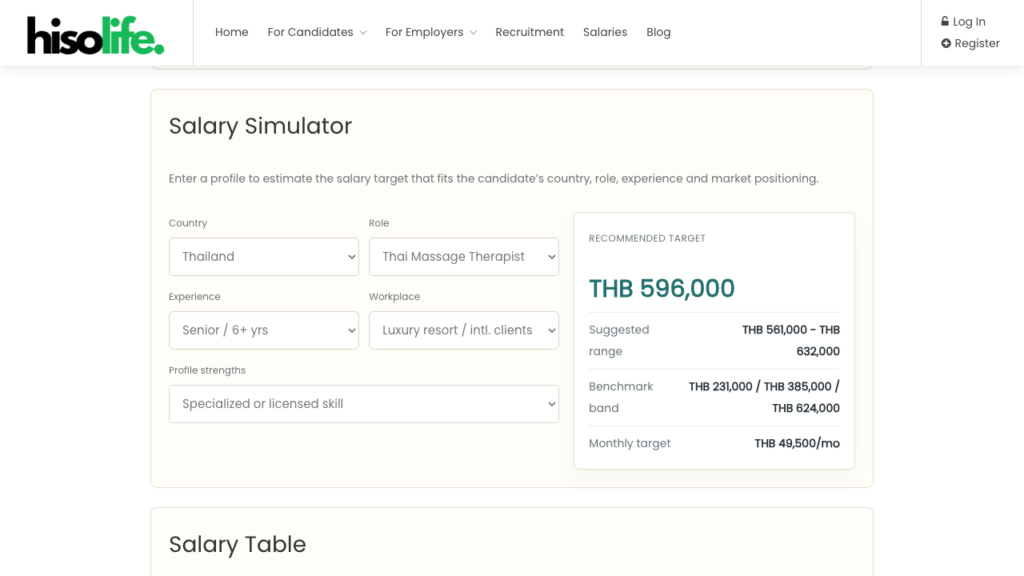
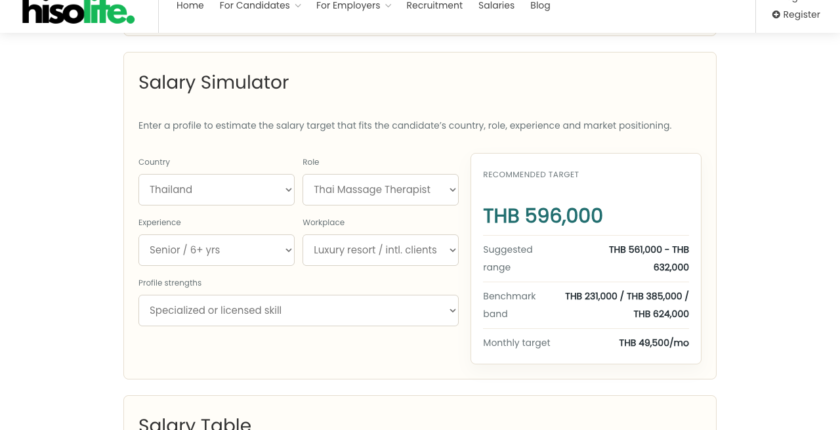
That is why HiSoLife has added a new salary simulator inside the Wellness Salary Guide 2026. Instead of looking at a single generic number, users can model a profile by country, role, experience level, establishment type and profile strengths. The simulator then returns a recommended target, a suggested negotiation range, a low/median/high benchmark and an estimated monthly salary. It turns salary research into a more practical planning step for spa, beauty, fitness, hospitality wellness and clinical wellness careers.
Why A Salary Simulator Matters In Wellness Careers
Wellness pay is rarely simple. The same job title can mean very different things depending on the country, the setting and the service standard. A massage therapist in a high-volume urban spa may work with different booking pressure, guest expectations and earning structure than a therapist in a five-star hotel. A facial therapist in a luxury skincare clinic may need consultation, device knowledge and retail confidence, while another role with the same title may focus on classic hands-on treatments. A spa manager in a boutique studio may be close to daily operations, while a director of wellness may manage strategy, teams, revenue and guest experience across a larger property.
Because the work is varied, salary planning should be more nuanced than a simple average. Candidates need to understand whether they are aiming at an entry, mid-market or premium target. Employers need to know whether their offer is competitive enough to attract the profile they actually want. A simulator helps both sides move from vague expectations to a clearer conversation based on role, location and professional strengths.
What The HiSoLife Simulator Takes Into Account
The simulator starts with the country because pay levels, currencies, labor markets and cost structures differ widely. A wellness professional comparing Thailand, France, Germany, Australia or the United States should not use one global figure as a decision point. Country context helps make the result more grounded and easier to interpret.
The second input is the role. HiSoLife’s salary guide covers spa operations, front office, beauty, bodywork, fitness, coaching, clinical wellness, holistic therapies and management. That means a candidate can compare roles such as spa receptionist, beauty therapist, massage therapist, Thai massage therapist, personal trainer, physiotherapist, spa manager or director of spa and wellness. For employers, this also helps separate roles that are often grouped together too loosely in job ads.
Experience is another key factor. A junior therapist who is still building confidence should not be measured in the same way as a lead therapist who trains colleagues, handles complex clients and protects service standards during busy periods. The simulator also includes establishment type, because a neighborhood salon, destination resort, luxury hotel spa, wellness clinic or high-volume massage center may support different salary logic. Finally, profile strengths allow the user to signal value beyond years of experience, such as specialist techniques, guest communication, retail ability, training capacity, multilingual service or leadership.
What The Simulator Shows
The result is designed to be practical. The recommended objective gives the user a clear salary target rather than leaving them with a broad table of numbers. The suggested range gives room for negotiation, because salaries are not fixed by a calculator alone. A range is often more useful than a single figure when discussing role scope, benefits, commissions, tips, training and schedule expectations.
The low, median and high benchmark helps the user understand the market shape. Low does not automatically mean unfair, and high does not automatically mean realistic for every profile. The benchmark is a reference point for context. A candidate can see whether their target is conservative, typical or ambitious. An employer can see whether a proposed offer may sit below the market, near the middle or closer to a premium expectation.
The estimated monthly salary makes the annual result easier to understand. Many wellness professionals plan their decisions around monthly living costs, relocation needs, family support, rent, transport and training expenses. A monthly estimate gives the result a more concrete feel, especially for candidates comparing jobs across countries or deciding whether a move is financially realistic.
How Candidates Can Use It Before Applying
For candidates, the simulator is useful before sending applications through HiSoLife’s wellness job listings. A candidate can test a realistic profile, compare the result with available job offers and decide which roles deserve attention. This is especially helpful when the same person could apply for more than one title, such as spa therapist, massage therapist, facial therapist, lead therapist or wellness consultant.
The tool can also improve interview preparation. Instead of entering a salary conversation with a random number, a candidate can explain their target with more confidence. They can say that their expectation reflects the country, the role, the type of establishment and the strengths they bring. That does not guarantee the employer will accept the number, but it makes the conversation more professional. It also helps candidates avoid two common mistakes: asking far below their value because they lack confidence, or asking above the role level without explaining the evidence behind the request.
Before using the simulator, candidates should be honest about their profile. Strong salary planning depends on realistic inputs. Experience should reflect real treatment hours, service environments and responsibility level, not only time since first training. Strengths should be specific and defensible. For example, “advanced facial consultation and retail conversion” is more useful than a vague claim of being passionate. Candidates who still need to build evidence can use the result as a development map, then strengthen their profile through training, references and clearer presentation on their resume.
How Employers Can Use It Before Posting A Job
For employers, the simulator can support better job design. Before posting a vacancy through HiSoLife’s employer job posting page, a spa or wellness business can model the type of person it wants to hire. If the role requires hotel standards, premium guest communication, weekend availability, specialist techniques and training support, the salary target may need to reflect that higher expectation. If the role is entry-level and includes significant training, the range may be different, but the offer should still be clear and respectful.
A transparent salary range can improve applicant quality. Serious candidates often avoid job posts that hide compensation completely or use unclear promises. A realistic range does not remove the need for negotiation, but it signals that the employer understands the market. It can also reduce wasted interviews because candidates can decide earlier whether the opportunity fits their needs.
The simulator is also useful for retention. If a business repeatedly loses strong therapists, estheticians or managers, compensation may not be the only reason, but it should be reviewed. Workload, scheduling, management quality, training, product targets and guest pressure all matter. Still, salary benchmarks help managers identify whether pay is part of the problem. Combined with spa and wellness recruitment support, the simulator gives employers a more structured way to align role expectations, salary and candidate profile.
A Better Way To Discuss Salary
The best salary conversations are specific. “What do you expect?” is often too broad. A better conversation asks what the role includes, what skills are essential, what the schedule requires, how commissions or tips work, whether training is included, and how performance will be measured. The HiSoLife simulator supports that kind of discussion because it connects salary to the role context rather than treating pay as a number in isolation.
For example, a massage therapist with strong Thai massage, deep tissue and guest communication skills may justify a different target from a beginner who needs close supervision. A spa receptionist who can handle bookings, guest recovery, retail support and multilingual communication may sit differently from a junior front-desk profile. A spa manager who controls scheduling, service quality, hiring and revenue needs a different benchmark from a shift supervisor. The simulator helps turn these differences into a clearer planning conversation.
Use Benchmarks As Guidance, Not A Contract
Salary tools are decision aids, not legal advice and not guaranteed offers. Local labor law, visa rules, tax treatment, benefits, commission structures, tips, service charge, accommodation, health insurance and contract type can all change the real value of a package. A monthly estimate should therefore be read as a planning signal. Candidates should always confirm details in writing, and employers should adapt offers to local employment rules.
External market context can also be useful when researching pay. Industry sources such as the Global Wellness Institute’s wellness economy research and occupation resources such as O*NET’s massage therapist profile can help readers understand how wellness work connects to broader labor-market and industry trends. HiSoLife’s role is to make this type of market thinking easier for wellness professionals and wellness employers, especially in a sector where roles often blend service, skill, hospitality and client trust.
Try The HiSoLife Salary Simulator
The new simulator is built for practical career decisions. Choose a country, select the role, add experience, choose the establishment type and mark the strengths that make the profile more valuable. Then review the recommended objective, suggested range, low/median/high benchmark and estimated monthly salary. Within a few moments, a candidate can prepare a smarter application strategy, and an employer can pressure-test whether a role is being positioned realistically.
To use it now, open the HiSoLife Wellness Salary Guide 2026 and salary simulator. Candidates can then compare the result with current spa and wellness jobs or build a stronger profile through HiSoLife’s resume submission page. Employers can use the same insight before creating a new role, reviewing an offer or searching for qualified candidates through HiSoLife’s candidate discovery tools.
Conclusion
Good salary planning helps everyone. Candidates make better decisions when they understand the market before applying. Employers attract stronger applicants when compensation is transparent and aligned with the role. The HiSoLife salary simulator gives both sides a shared starting point: country, role, experience, establishment type, profile strengths and a clear benchmark result. It does not replace judgment, but it makes the first salary conversation much more useful.
For a wellness industry built on skill, trust and service quality, clearer compensation is not just an administrative detail. It is part of professionalizing the market. With the new HiSoLife salary simulator, wellness careers can be planned with more confidence, and wellness hiring can become more precise, transparent and fair.