
Where to Find Qualified Massage Therapists for a Growing Spa
Finding qualified massage therapists is rarely a question of posting one job ad and waiting. Good therapists are often already working, referred quietly through professional networks or connected to schools, spas and training communities. A growing spa needs a sourcing strategy that reaches the right candidates before competitors do. This is especially true when the business needs specific techniques, authentic Thai massage experience, hotel service standards, multilingual communication or therapists willing to relocate.

The challenge is not only candidate volume. Many employers receive many applications but still struggle to hire. Some candidates do not match the treatment menu. Some are not available for the schedule. Some have limited practical skill despite years on a CV. Others may be technically strong but weak in guest care, hygiene or reliability. The real goal is to find qualified massage therapists who fit the role, the environment and the long-term business plan.
Define What Qualified Means For Your Spa
Before choosing sourcing channels, define what qualified means. A therapist can be qualified for one setting and wrong for another. A neighborhood massage studio may need a friendly therapist who can handle repeat local clients and steady foot traffic. A five-star resort may need polish, language ability, grooming standards and quiet confidence with international guests. A wellness clinic may need stronger anatomy knowledge, consultation discipline and caution around contraindications.
Create a qualification matrix with must-have skills, preferred skills and trainable skills. Must-have skills might include a valid work status, core massage technique, punctuality and ability to perform the main treatment menu. Preferred skills might include aromatherapy, foot reflexology, facial massage support, English communication or hotel experience. Trainable skills might include brand-specific SOPs, product knowledge or a signature treatment sequence. This matrix prevents emotional hiring and helps compare candidates fairly.
Use Specialized Job Platforms
General job boards can produce applications, but specialized wellness and hospitality platforms often create better relevance. A candidate browsing a focused spa career platform is already closer to the industry. The job ad can use specific terms such as spa therapist, massage therapist, Thai massage therapist, wellness therapist, reflexology therapist or hotel spa therapist. These terms help the right candidates recognize the role quickly.
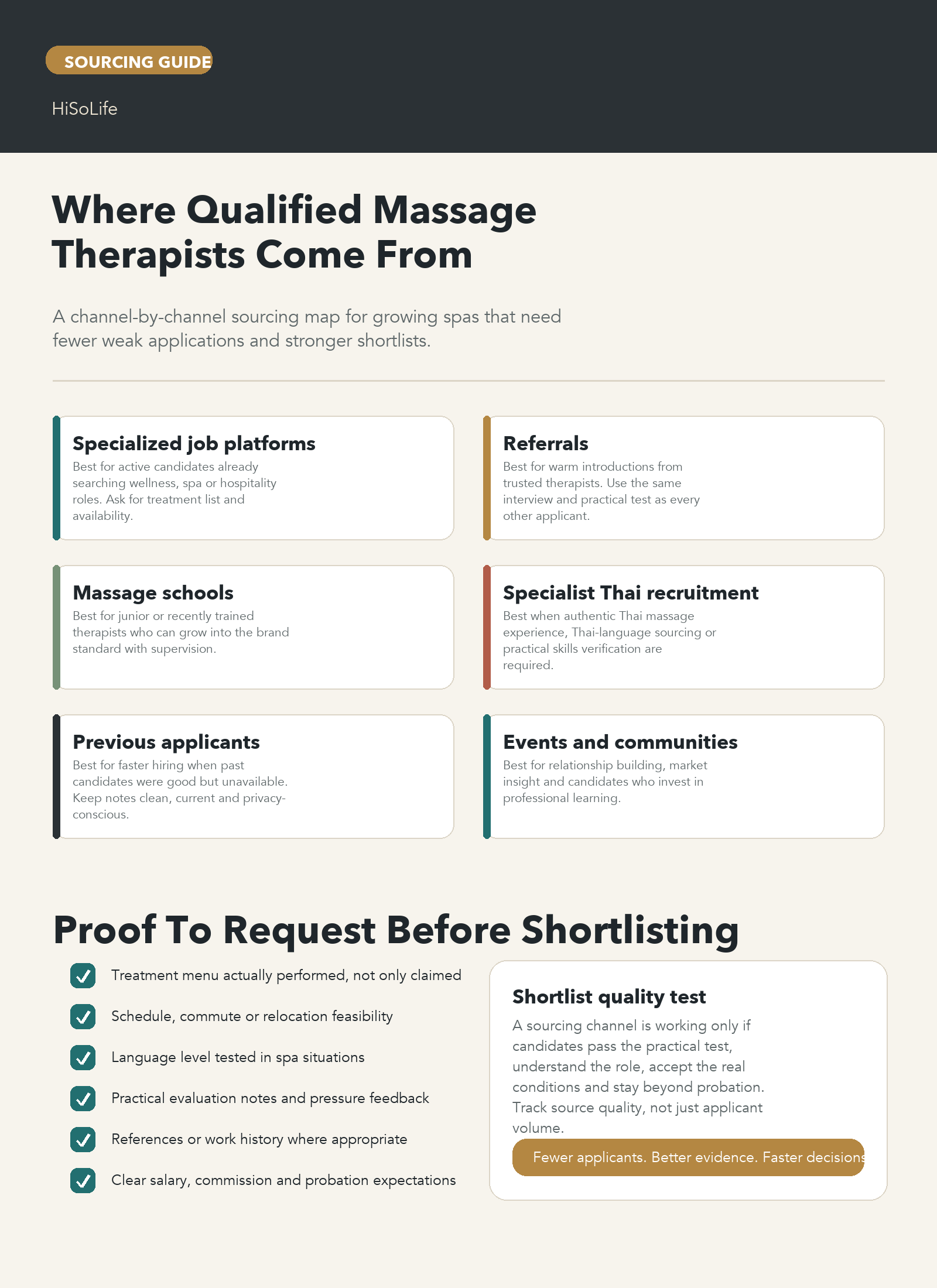
When using a job platform, write for both search and trust. Put the role, location and specialty in the title. Mention the employment type, schedule and salary range where possible. Include the treatment menu and the level of experience required. A vague job post may attract casual applicants, while a precise post attracts candidates who understand what the business needs. Add a simple application instruction, such as submitting a CV, treatment list, availability and preferred interview time.
Improve The Careers Page Before You Advertise
Many candidates will look at the employer’s website before applying. If the careers page is empty, outdated or difficult to understand, good therapists may hesitate. A clear careers page should show the business type, treatment philosophy, team environment, application contact, current openings and the kind of therapist the spa wants to meet. It does not need to be elaborate, but it should feel real and maintained.
For a growing spa, this page can become a quiet recruitment asset. Add photos of treatment rooms, explain training standards and describe how new therapists are supported. Avoid language that sounds like a generic corporate promise. Therapists want to know whether the rooms are clean, the schedule is organized, the team is respectful and the manager understands massage work. Practical details create more trust than slogans.
Build Referral Channels Inside The Industry
Referrals remain one of the strongest ways to find massage therapists. Therapists often know former classmates, colleagues and friends who are looking for a better opportunity. Spa managers know trainers, product representatives, hotel contacts and freelance therapists. A simple referral request can uncover candidates who would never answer a public advertisement.
However, referrals need structure. Tell your team exactly what profile you need. For example: “We are looking for a full-time massage therapist with Thai massage and oil massage experience, weekend availability and basic English.” This is much more useful than saying “Do you know anyone?” Offer a fair referral bonus only after the candidate passes probation, not immediately after hiring. That encourages quality recommendations rather than random names.
Partner With Massage Schools And Training Centers
Massage schools can be valuable sourcing partners, especially when the spa is open to junior therapists who can be trained into the brand standard. Schools may know which students are serious, disciplined and naturally service-minded. They can also help employers understand realistic expectations for new graduates. A fresh graduate may not be ready for a full premium menu, but with the right supervision can become loyal and well aligned with the business.
When approaching schools, present a professional employer brief. Include the business type, treatment menu, working conditions, location, pay structure and growth opportunities. Schools are more likely to refer good candidates when they trust the employer. If possible, offer a practical observation day, guest lecture or training collaboration. This creates visibility among students before they enter the job market.
Use Local Communities Without Lowering Standards
Local community groups, social media pages and messaging apps can help reach therapists quickly. Many spa workers rely on these channels because they are fast and familiar. The risk is that informal sourcing can become messy. Employers may receive incomplete messages, unclear experience claims or candidates who apply without understanding the role. The solution is to keep the first message short but structured.

For example, a good community post can list the role, location, schedule, required techniques, salary range and application contact. It can ask candidates to send their CV, treatment list, years of experience and earliest start date. This small structure makes informal channels more manageable. It also signals that the employer is professional, which helps attract serious therapists.
Consider A Specialist Thai Therapist Recruitment Partner
For employers who specifically need Thai massage profiles, one discreet route is to work with a specialist training and recruitment partner. Nuad Thai School, a Bangkok massage academy, offers a Thai therapist recruitment service that can help spas, hotels and wellness centers source, screen and shortlist candidates according to the role. It is not a replacement for the employer’s own interview process, but it can reduce noise when the brief requires authentic Thai massage experience, practical skill verification or international hiring support.
This kind of partner can be useful when the employer does not have a direct network in Thailand, does not speak Thai or needs help presenting the opportunity clearly to candidates. The employer still remains responsible for legal hiring requirements, visas, contracts, destination-country employment rules and final selection. The advantage is more targeted sourcing and a process built around massage skill rather than generic CV forwarding.
Search Among Freelancers Carefully
Freelance massage therapists can be excellent candidates for full-time roles, especially if they want more stable income, fewer administrative tasks or a more premium working environment. They may already understand clients, scheduling and self-presentation. At the same time, some freelancers prefer independence and may struggle with fixed procedures or team hierarchy. The interview should explore why they want employment and how they feel about brand standards.
Ask freelancers about the treatments they perform most often, how they manage client feedback, how they handle difficult bookings and what kind of schedule they want. A freelance background is not automatically better or worse than spa employment. It simply tells you the candidate has been operating in a different structure. The question is whether they can adapt to your system.
Reconnect With Previous Applicants
Many spas forget the candidates they already met. A therapist who was unavailable six months ago may be available now. A candidate who was slightly junior then may have gained experience. A previous applicant who liked your brand may still be interested if approached respectfully. Keeping an organized candidate database is one of the simplest ways to improve recruitment speed.
Record the candidate’s name, contact details, treatments, language ability, availability, interview notes and reason for not hiring at the time. Do not store unnecessary personal data, and follow local privacy rules. When a vacancy opens, review this list before publishing a new ad. Warm candidates often respond faster than cold applicants because they already know the business.
Attend Industry Events And Training Workshops
Workshops, product training events, wellness fairs and hospitality networking sessions can reveal serious professionals. Therapists who invest time in learning often care about their craft. Managers can use these spaces to build relationships, not to recruit aggressively. A brief conversation, business card exchange or follow-up message can create future hiring opportunities.
Industry events also help employers understand market conditions. You may learn which treatments are becoming more popular, what therapists expect in compensation, which schools are respected and what competitors are offering. This information improves job offers and helps avoid unrealistic hiring plans. Recruitment is easier when the employer understands the labor market from the therapist’s perspective.
Screen Every Channel With The Same Process
Different sourcing channels can produce candidates, but screening must stay consistent. A candidate from a referral should complete the same interview and practical test as a candidate from a job board. A school graduate should still be assessed for attitude and reliability. A therapist found through a specialist partner should still meet the employer’s service expectations. Consistency protects quality and reduces bias.
A simple process works well: application review, short screening call, interview, practical massage test, reference or background check where appropriate, written offer and structured onboarding. Each step should answer a different question. Does the candidate match the role on paper? Are they available and motivated? Can they communicate professionally? Can they perform the treatment? Are the working conditions clear? This sequence prevents rushed hiring.
Make The Employer Brand Visible
Qualified massage therapists are more likely to apply when they can understand the employer brand. Show the treatment rooms, team culture, training philosophy and guest profile where appropriate. A sterile job ad with no personality may fail to attract candidates who care about environment. Photos, clear descriptions and honest language help therapists imagine themselves in the role.
Employer brand is not only marketing. It is the reality of how therapists are treated. If your spa offers clean rooms, organized booking, respectful management, training and reliable pay, say so. If your business is still growing and needs flexible team members, say that too. Honest employer branding attracts candidates who fit the stage of the business. Over-polishing the offer can create disappointment after hiring.
Track Source Quality Over Time
A sourcing channel is only useful if it produces candidates who pass the real process. Track where each applicant came from, whether they attended the interview, whether they passed the practical test, whether they accepted the offer and whether they stayed beyond probation. After a few months, patterns will appear. One school may send fewer candidates but better ones. One social group may create many messages but few qualified therapists. One referral source may produce strong long-term hires.
This tracking does not need expensive software. A simple spreadsheet is enough for a small spa. The point is to stop guessing. When managers know which channels produce qualified, reliable therapists, recruitment spend and time become easier to control. The business can then invest in the channels that build the strongest team, rather than repeating the same emergency posting cycle whenever someone resigns.
Conclusion
Finding qualified massage therapists requires more than a job ad. Employers should combine specialized platforms, referrals, school partnerships, local communities, previous applicants, industry events and, when relevant, specialist recruitment partners. The strongest sourcing strategy is targeted, transparent and respectful. It reaches candidates where they actually are and gives them enough information to decide whether the role fits.
Once candidates are found, the same disciplined screening process should apply to everyone. Define qualification, test practical skill, verify motivation, communicate compensation clearly and onboard with care. A growing spa does not need endless applicants. It needs the right shortlist. With a better sourcing system, employers can spend less time filtering noise and more time building a stable, professional massage team.
2026 SEO update: Where to Find Qualified Massage Therapists for a Growing Spa
Updated for 2026, this guide on Where to Find Qualified Massage Therapists for a Growing Spa should be read against a faster-moving wellness market. Recent industry data shows that skills-based hiring is becoming central to quality hiring and talent gap management, while related research notes that tourism businesses continue to face labour shortages, skills gaps and retention pressure. For spa owners, hotel wellness directors and recruitment teams, that means the topic is no longer just an editorial trend; it affects hiring, training, client trust, pricing and how people choose premium wellness experiences in Thailand and beyond. The practical takeaway is to connect the article’s original advice with sharper evidence: define the skill or service clearly, explain how it improves guest outcomes, and make the next step easy through spa and wellness recruitment support, browse qualified wellness candidates and Wellness Salary Guide 2026. Thailand is also receiving more wellness attention, with current tourism and wellness news showing that the global wellness economy reached $6.8 trillion in 2024 and is projected to keep growing toward 2029. A stronger SEO-friendly version of this article therefore needs useful internal links, credible references, and clear answers to the questions readers are likely to search before they apply, hire, book or compare options.
HiSoLife internal update
HiSoLife update: employers can now move from reading about massage therapist recruitment and retention directly into action. Use browse qualified wellness candidates to review talent, post a spa or wellness job to publish a role, and Wellness Salary Guide 2026 to benchmark compensation before making an offer. This internal pathway is important for SEO because it connects informational content with commercial intent: a reader who searched for hiring advice can continue to a relevant employer page instead of leaving the site.
Related HiSoLife resources
- spa and wellness recruitment support
- browse qualified wellness candidates
- post a spa or wellness job
- Wellness Salary Guide 2026
- browse spa and wellness jobs
References and further reading
- LinkedIn, Future of Recruiting 2025 — skills-based hiring is becoming central to quality hiring and talent gap management.
- OECD, strengthening the tourism workforce — tourism businesses continue to face labour shortages, skills gaps and retention pressure.
- Global Wellness Institute, 2025 Global Wellness Economy Monitor — the global wellness economy reached $6.8 trillion in 2024 and is projected to keep growing toward 2029.
- U.S. Bureau of Labor Statistics, Massage Therapists outlook — massage therapist employment is projected to grow 15 percent from 2024 to 2034.
Mini FAQ: Where to Find Qualified Massage Therapists for a Growing Spa
What should employers update first for massage therapist recruitment and retention in 2026?
The first update is to turn massage therapist recruitment and retention from a broad idea into a clear decision framework. For this article, that means reading Where to Find Qualified Massage Therapists for a Growing Spa as practical guidance for what a reader should do next. The 2026 context matters because wellness is no longer a narrow luxury category: LinkedIn, Future of Recruiting 2025 notes that skills-based hiring is becoming central to quality hiring and talent gap management; OECD, strengthening the tourism workforce notes that tourism businesses continue to face labour shortages, skills gaps and retention pressure. A reader should therefore ask what outcome the topic supports: better hiring, stronger guest retention, safer treatment choices, clearer compensation, or a more credible career path. The SEO-friendly answer is to make that outcome explicit. Instead of saying that wellness is important, the article should explain how this topic affects consultation, service standards, skill proof, job descriptions, client communication and follow-up. On HiSoLife, the next step should also be visible. A candidate can use spa and wellness recruitment support or browse qualified wellness candidates; an employer can move toward post a spa or wellness job; and both sides can use Wellness Salary Guide 2026 to make expectations more concrete.
How can a spa avoid weak hires when recruiting around massage therapist recruitment and retention?
The main risk is treating massage therapist recruitment and retention as a phrase instead of a capability. Search readers usually arrive with a problem: they want to hire someone, get hired, compare a service, understand a skill, or decide whether an experience is worth their time. A weak article answers that problem with generic claims. A stronger article gives criteria. For a spa employer, that may mean checking hands-on technique, consultation language, punctuality, hygiene habits, retail ethics, rebooking behavior and the ability to match a service to a guest’s real needs. For a candidate, it may mean showing certificates, before-and-after case notes where appropriate, training logs, client communication examples and evidence of reliability. Current references support the wider point: LinkedIn, Future of Recruiting 2025 notes that skills-based hiring is becoming central to quality hiring and talent gap management; Global Wellness Institute, 2025 Global Wellness Economy Monitor notes that the global wellness economy reached $6.8 trillion in 2024 and is projected to keep growing toward 2029. HiSoLife can support that decision path with spa and wellness recruitment support, post a spa or wellness job and browse spa and wellness jobs. The practical SEO gain is that the page becomes useful for long-tail searches rather than only repeating the title.
Which skills should be checked before making an offer?
The most important skills depend on the angle of massage therapist recruitment and retention, but the same principle applies across spa, beauty, massage, facial therapy, wellness sales and management: the reader needs proof. Technical knowledge is only one layer. A strong professional also needs consultation skills, client boundaries, product or modality literacy, hygiene discipline, time management and the ability to explain recommendations without pressure. For management and recruitment topics, employers should add structured interviews, practical tests, reference checks and onboarding milestones. For skincare or wellness experience topics, readers should look for credible training, transparent claims and realistic aftercare guidance. This matters in 2026 because OECD, strengthening the tourism workforce notes that tourism businesses continue to face labour shortages, skills gaps and retention pressure, and because LinkedIn, Future of Recruiting 2025 notes that skills-based hiring is becoming central to quality hiring and talent gap management. Inside HiSoLife, the article should guide readers toward concrete pages: spa and wellness recruitment support for opportunity discovery, Wellness Salary Guide 2026 for compensation or expectation checks, and browse spa and wellness jobs for deeper exploration. That internal structure helps users and search engines understand the topic cluster. For search intent, the useful angle is not only the definition of massage therapist recruitment and retention; it is the practical decision a reader needs to make next. A candidate may need to compare roles, update a profile, or understand which training signals credibility. An employer may need to separate a polished CV from a reliable service professional who can protect guest trust over time. That is why this answer connects the topic to measurable actions rather than broad lifestyle language.
How does HiSoLife help employers turn massage therapist recruitment and retention into a shortlist?
HiSoLife helps by connecting the informational part of massage therapist recruitment and retention with the marketplace action that usually follows. A blog article can explain the concept, but the reader often needs somewhere to go next. If the reader is a candidate, the useful path is to review open roles, prepare a stronger resume, compare salary expectations and return to the article’s checklist before applying. If the reader is an employer, the useful path is to define the role, publish the job, compare candidates and keep the article as a standard for interviews or onboarding. The internal links in this refresh are designed for that behavior. They point to pages such as spa and wellness recruitment support, browse qualified wellness candidates, post a spa or wellness job and Wellness Salary Guide 2026 with descriptive anchors rather than vague words like “here” or “learn more.” That is better for SEO and for people. It also keeps older articles useful by connecting them to current site assets, including the salary guide and recruitment pages. References such as LinkedIn, Future of Recruiting 2025 and OECD, strengthening the tourism workforce give the article external context, while the internal pathway gives it commercial relevance. For search intent, the useful angle is not only the definition of massage therapist recruitment and retention; it is the practical decision a reader needs to make next. A candidate may need to compare roles, update a profile, or understand which training signals credibility. An employer may need to separate a polished CV from a reliable service professional who can protect guest trust over time. That is why this answer connects the topic to measurable actions rather than broad lifestyle language.
What metrics show that a massage therapist recruitment and retention strategy is working?
Success should be measured by whether the article helps a reader make a better decision after searching for massage therapist recruitment and retention. For an employer, useful metrics include higher-quality applicants, fewer unsuitable interviews, faster shortlist creation, better retention after onboarding and clearer compensation conversations. For a candidate, useful metrics include profile completeness, applications to better-matched roles, interview readiness and confidence explaining skills. For a wellness or skincare reader, useful metrics include safer expectations, better questions during consultation and a clearer understanding of what evidence supports a treatment or service. The article should therefore avoid exaggerated promises and focus on practical outcomes. It should link to references like LinkedIn, Future of Recruiting 2025 and Global Wellness Institute, 2025 Global Wellness Economy Monitor when discussing market trends, and it should link internally to spa and wellness recruitment support, Wellness Salary Guide 2026 and browse spa and wellness jobs when guiding the next step. That combination is what makes the refresh SEO friendly: it improves topical relevance, adds authority signals, creates descriptive internal links and gives the reader enough depth to stay on the page longer. For search intent, the useful angle is not only the definition of massage therapist recruitment and retention; it is the practical decision a reader needs to make next. A candidate may need to compare roles, update a profile, or understand which training signals credibility. An employer may need to separate a polished CV from a reliable service professional who can protect guest trust over time. That is why this answer connects the topic to measurable actions rather than broad lifestyle language.