

How to Recruit a Spa Therapist: Complete 2026 Hiring Checklist
Hiring a spa therapist is not the same as hiring for a conventional service role. The person you select will work one-to-one with guests, handle private health information, make physical contact, adapt pressure and technique in real time, and represent your brand in a treatment room where a manager cannot continuously observe the service. A polished CV or a pleasant interview is therefore not enough. The safest decision comes from a structured process that verifies legal eligibility, training, practical skill, ethics, communication, physical sustainability and genuine fit with the operation.

This guide explains how to recruit a massage or spa therapist from the first role brief to the first 90 days of employment. It is designed for day spas, hotel and resort spas, wellness clinics, massage businesses and international employers sourcing Thai therapists. Use it as a practical framework, then adapt every legal, licensing and immigration step to the country where the therapist will work.
Why therapist recruitment deserves a specialist process
Demand is expanding. The Global Wellness Institute’s 2025 monitor valued the wellness economy at $6.8 trillion in 2024 and projects it to reach about $9.8 trillion in 2029. In the United States alone, the International SPA Association reported 187 million spa visits in 2024 and 376,200 spa employees in January 2025. Meanwhile, the U.S. Bureau of Labor Statistics projects massage therapist employment to grow 15% between 2024 and 2034, much faster than the average for all occupations.
Growth does not make the right candidate easier to find. Technique is only one part of the job, and the title “therapist” can cover very different profiles. A high-volume massage-shop therapist, a five-star hotel spa therapist, a facialist and a clinically oriented massage practitioner may all be excellent, but they are not interchangeable. Your process must test the profile required by your treatment menu, guest promise, local regulations and working conditions.
Step 1: Define the role before looking at candidates
Start with a one-page scorecard, not a generic job advertisement. List the treatments the new hire must perform independently on day one and those that can be taught after joining. Specify the service environment, average treatment length, realistic number of appointments per shift, guest languages, consultation duties, retail expectations, documentation, cleaning tasks and team responsibilities. Separate requirements from preferences. If every item is “essential,” the brief will either exclude good candidates or encourage applicants to overstate their abilities.
The offer must be equally precise: base pay, commission formula, tips, probation, schedule, rest days, paid leave, training, insurance, uniform, meals, accommodation, transport, visa support and contract length. For an international role, state who pays for each authorized travel, document and relocation cost. A transparent role attracts stronger candidates and gives the interviewer an objective standard against which to score them.
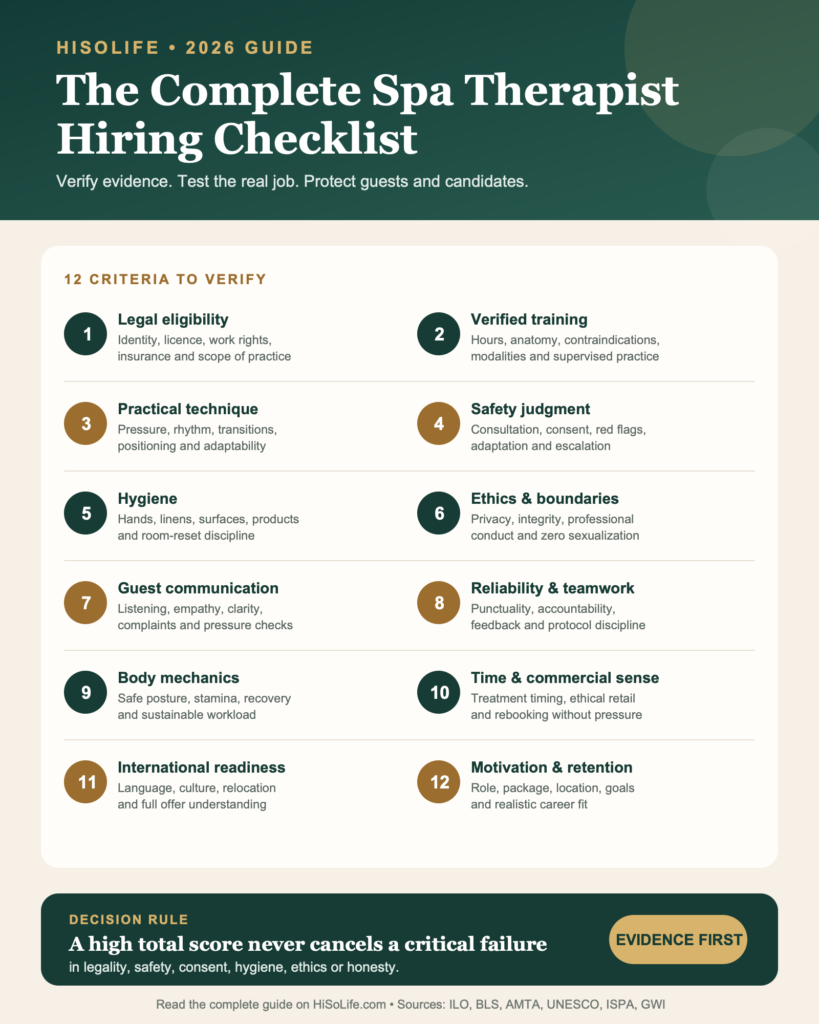
The 12 criteria every spa should verify
1. Legal eligibility, licence and scope of practice
Verify the candidate’s identity and right to work, then check the rules applying to massage, beauty or therapeutic services in your jurisdiction. Requirements may include an approved qualification, professional registration, a licence, insurance, health checks, first-aid or CPR certification, continuing education and a background check. The BLS notes that standards vary by U.S. state; the same principle applies internationally. Never assume that a certificate accepted in the candidate’s home country automatically authorizes practice in the destination country.
Also confirm scope. A therapist should not diagnose conditions, promise medical outcomes or perform restricted techniques unless appropriately qualified and legally authorized. Record the verification date, issuing body, credential number and renewal date rather than keeping an unexplained photocopy.
2. Education and relevant treatment training
Look beyond the school name. Ask how many supervised hours the program included, which subjects were covered and how competence was assessed. Anatomy, physiology, contraindications, hygiene, ethics and hands-on practice are stronger signals than a short attendance certificate. The American Massage Therapy Association’s professional membership criteria, for example, use a supervised 500-hour education program or an accepted equivalent as one route to qualification. That is a useful benchmark, not a universal legal rule.
Map each verified modality to your menu: traditional Thai massage, Swedish or oil massage, deep tissue, sports, foot reflexology, prenatal work, hot stone, facial treatments or body scrubs. A candidate may be highly capable in one discipline and unsafe in another. Ask for course dates, provider details and evidence of recent practice.
3. Practical technique and adaptability
A practical test is non-negotiable. Observe preparation, consultation, draping or clothing protocol, positioning, transitions, rhythm, pressure control, therapist posture, timing and room reset. Ask the model to request a pressure change and mention a common contraindication. A good candidate pauses, clarifies and adapts without becoming defensive. Test only techniques required for the role; do not ask a candidate to perform unfamiliar work simply to see whether they will improvise.
Use the same scenario, model and scoring sheet for shortlisted candidates. This reduces bias and makes comparisons meaningful. Obtain the model’s informed consent, limit the assessment to a reasonable duration and never use unpaid candidates to deliver commercial treatments to paying guests.
4. Consultation, contraindications and safety judgment
Present short scenarios: a guest reports fever, recent surgery, pregnancy, anticoagulant use, acute pain, skin infection or numbness. The candidate does not need to act as a doctor, but must gather relevant information, recognize when treatment should be modified or postponed, and escalate appropriately. Strong therapists know the boundary between wellness service and healthcare.
Listen for a safe reasoning process rather than memorized phrases. Can the person explain the proposed treatment in plain language, confirm consent, protect privacy and document relevant information? If unsure, do they seek a supervisor or confidently guess? Sound judgment protects both the guest and the business.
5. Hygiene and treatment-room discipline
Check hand hygiene, clean-linen handling, product dispensing, surface sanitation, waste separation, laundry procedures and cross-contamination awareness. Ask the candidate to set up and reset a room. Small habits are revealing: touching a phone after washing hands, returning used product to a container or mixing clean and used linens should lower the score. Hygiene is an operating system, not a rehearsed interview answer.

6. Ethics, boundaries and confidentiality
Massage depends on trust. The AMTA Code of Ethics emphasizes professional quality, nondiscrimination, privacy, integrity, lawful scope and avoiding harm. Ask candidates how they obtain consent, respond to inappropriate behavior, protect guest information, handle a request outside scope and maintain professional boundaries. Any sexualized service, discriminatory attitude, casual disclosure of client details or willingness to misrepresent credentials is a critical red flag.
7. Communication, empathy and guest care
Role-play the full first five minutes of an appointment. Does the therapist greet the guest warmly, listen without interrupting, confirm goals and explain what will happen? Can they check comfort without breaking relaxation? Test how they respond to a late guest, a complaint, a silent guest and a client who wants more pressure than is safe. Accent and perfect grammar matter less than clear, respectful communication and the confidence to ask for clarification.
8. Reliability, teamwork and professional conduct
Review punctuality, attendance history, notice periods and reasons for leaving previous roles. Ask for an example of receiving difficult feedback and helping a colleague during a busy shift. Look for accountability rather than a flawless story. A strong therapist can follow protocols, prepare rooms, communicate delays, document issues and contribute to a calm team. Consistent behavior matters more than an interview personality.
9. Physical stamina and sustainable body mechanics
Massage is physically demanding. The BLS identifies repetitive-motion problems, extended standing and fatigue as occupational risks, and notes that many therapists cannot safely provide massage eight hours a day, five days a week. Observe stance, use of body weight, wrist alignment, table or mat positioning and transitions during the practical test. Ask how the candidate manages recovery and reports discomfort.
Do not turn this into a discriminatory fitness test. Assess whether the person can perform the essential duties with reasonable accommodation and whether your schedule is sustainable. The employer also has responsibilities: appropriate equipment, spacing between treatments, breaks, task variation and an early reporting culture. Good recruitment cannot repair a workload designed for burnout.
10. Time management and commercial awareness
Ask the candidate to explain how they would complete consultation, treatment and reset within the booked time without rushing the guest. If retail or rebooking is part of the role, assess ethical recommendation skills, not aggressive sales technique. The therapist should connect a suggestion to a stated guest need, avoid exaggerated claims and accept “no” gracefully. Review any commission plan for unintended pressure that could damage trust.
11. Language, cultural adaptability and relocation readiness
For international recruitment, test the language actually used with guests and managers. Discuss destination culture, climate, housing, cost of living, schedule, food, religious needs, family responsibilities and realistic start dates. Ask the candidate to restate the offer in their own words. This reveals misunderstandings before they become contract disputes.
Thai therapists are sought worldwide because Thailand combines a deep service culture with a living bodywork tradition. UNESCO inscribed Nuad Thai on its Representative List of Intangible Cultural Heritage in 2019. Heritage, however, is not a substitute for individual verification: every candidate still needs the same legal, technical and ethical assessment.
12. Motivation, package fit and retention risk
Ask why this spa, this location and this stage of the candidate’s career make sense. Compare expected income with the full package and local living costs. Explore preferred treatments, learning goals, management style and desired contract length. A candidate can pass every technical test and still be a poor hire if the schedule, earnings or destination do not match their expectations.
A seven-stage recruitment process that produces evidence
- Role scorecard: agree on essential duties, legal requirements, modalities, behaviors and package before sourcing begins.
- Targeted sourcing: use professional networks, reputable schools, referrals, industry communities and specialist recruiters rather than relying on one public job board.
- Structured screening: confirm availability, work eligibility, verified training, relevant experience, language level, package understanding and relocation readiness.
- Behavioral interview: ask every candidate the same core questions and require examples from real situations.
- Practical assessment: use a consented model, standardized scenario and qualified evaluator to score technique, safety, communication and hygiene.
- Verification: contact references using independently sourced contact details where possible; confirm dates, duties, conduct and rehire eligibility. Complete lawful background, credential and right-to-work checks.
- Written offer and onboarding: explain every material term in a language the candidate understands, allow questions, document acceptance and prepare a 30-60-90-day plan.
How to score candidates fairly
Use a 100-point matrix tailored to the role. A balanced example is: practical technique 25 points; safety and contraindications 15; consultation and communication 10; hygiene 10; ethics and boundaries 10; verified training and licence 10; reliability and teamwork 8; body mechanics and stamina 5; language and cultural adaptability 4; motivation and package fit 3. Set minimum thresholds for safety, ethics and legal eligibility. A high overall score must never compensate for a critical failure in those areas.
Two trained assessors are preferable for final candidates. Each should score independently before discussing the result. Record observable evidence, such as “confirmed consent before assisted stretch,” instead of impressions like “seems professional.” Provide reasonable accommodation, ask only job-related questions and follow local anti-discrimination and privacy law. Destroy unnecessary candidate data according to your retention policy.
Practical-test protocol
Brief the candidate and model separately. Explain the modality, duration, scoring criteria, consent process and stop signal. Use a healthy adult model suitable for the test and disclose no unnecessary medical data. A 30- to 45-minute assessment can include room setup, a short consultation, selected technique, one pressure adjustment, one safety scenario and room reset. The evaluator should not coach during the test unless safety requires intervention.
Score technique against the job, not personal taste. Observe sequencing, pressure consistency, pace, transitions, positioning, professional touch, adaptation, communication, hygiene and time control. End immediately if the candidate ignores pain, consent, boundaries or a material contraindication. Afterward, ask the candidate what they would change; self-awareness is a useful predictor of training potential.
International and Thai therapist recruitment
Cross-border hiring adds immigration, document authentication, translation, travel, housing and cultural integration. Build the timeline backward from the intended start date and use licensed legal or immigration professionals for destination-country requirements. Never hold a worker’s passport, substitute a different contract after arrival or hide deductions. The International Labour Organization’s fair-recruitment guidance states that workers should not be charged recruitment fees or related costs, directly or indirectly.
Local expertise is especially valuable when employers cannot interview in Thai or conduct practical tests in Thailand. For this specialist route, Nuad Spa’s therapist recruitment service provides an international reference point for employers seeking Thai massage, spa, facial and beauty professionals, combining access to the Thai therapist community with screening, practical assessment and credential checks. The link belongs naturally at the sourcing stage; the employer must still complete destination-specific legal and employment due diligence.

Red flags that should stop or slow the hire
- Credentials cannot be verified, dates conflict or the candidate misrepresents scope.
- The therapist begins treatment without consultation or consent.
- Pain, discomfort, hygiene or contraindication concerns are dismissed.
- The candidate sexualizes the service, ignores boundaries or shares client information.
- Pressure and technique cannot be adapted safely.
- There is repeated blame with no accountability for past conflicts or attendance.
- The candidate does not understand the pay, schedule, location or relocation conditions.
- A recruiter asks the worker for prohibited fees, withholds documents or changes the offer.
A red flag is a prompt to verify, not an invitation to make assumptions about a person’s nationality, age, gender, disability or background. Keep decisions job-related and evidence-based. Conversely, do not overlook a serious safety or integrity problem because the spa is understaffed.
Onboarding: turn a good hire into consistent service
Before the first guest, verify documents again and train the therapist on your consultation, consent, contraindication, emergency, hygiene, privacy, complaint and incident procedures. Calibrate every treatment on the menu with a trainer. Explain timing, room setup, product use, notes, rebooking and ethical retail expectations. Introduce escalation contacts and make clear that a therapist can stop an unsafe or inappropriate session.
During days 1-30, use observed practice, shadowing and frequent short feedback. By day 60, review guest feedback, punctuality, treatment timing, documentation, teamwork and physical workload. By day 90, decide whether competence and fit are confirmed, which training is still needed and whether the schedule remains sustainable. Never rely on tips or sales alone: they can reward charisma or guest mix while missing safety and team behavior.
Metrics that improve future hiring
Track time to shortlist, offer acceptance, pass rate at practical assessment, 90-day retention, six-month retention, training hours, complaints, treatment rework, schedule utilization and employee injury or fatigue signals. Segment carefully by role and source. If one channel generates many applications but few practical passes, it is not efficient. If strong hires leave within months, investigate package clarity, supervision and workload before blaming candidate quality.
The goal is not to build the longest selection process. It is to collect enough reliable evidence to protect guests, candidates and the business. For wider market context, see HiSoLife’s analysis of why recruiting quality spa therapists is difficult in 2026.
Frequently asked questions
What is the most important test when hiring a massage therapist?
A standardized practical assessment is the strongest test of hands-on competence, but it cannot replace licence, identity, reference, safety and ethics checks. Use all of them together.
How long should a therapist skills test last?
Usually 30 to 45 minutes is enough to assess consultation, setup, selected techniques, adaptation, safety and reset without asking for unpaid commercial work. Adjust the protocol to the modality and local rules.
Should a therapist be hired mainly for years of experience?
No. Relevant, recent experience matters more than the headline number. Verified training, practical quality, safe judgment, guest communication, reliability and fit should all contribute to the decision.
Who should pay international recruitment fees?
ILO fair-recruitment guidance says workers should not bear recruitment fees or related costs directly or indirectly. Employers should obtain country-specific legal advice and make every authorized cost transparent in writing.
Sources and further reading
- Global Wellness Institute — 2025 Global Wellness Economy Monitor
- International SPA Association — 2025 U.S. Spa Industry Study “Big Five”
- U.S. Bureau of Labor Statistics — Massage Therapists Occupational Outlook
- International Labour Organization — General Principles and Operational Guidelines for Fair Recruitment
- International Labour Organization — Global Study on Recruitment Fees and Related Costs, second edition
- American Massage Therapy Association — Code of Ethics and Core Documents
- UNESCO — Nuad Thai, traditional Thai massage