

International Spa Recruitment in 2026: A Skills-Recognition and Candidate-Safety Checklist
International spa recruitment works only when two questions are answered separately: can the candidate do the job safely and professionally, and is the route into that job transparent and fair? This guide turns current International Labour Organization guidance into a six-step skills-recognition and candidate-safety framework for spa employers, recruiters and wellness professionals.

A certificate can be important evidence, but its title may not translate neatly across borders. Training hours, assessed techniques, professional scope, language and local registration rules can differ. Employers who treat every unfamiliar qualification as invalid may lose capable candidates. Employers who accept a document without checking the underlying competence create a different risk.
The answer is not a promise that every qualification will be recognised. It is a documented process: define the destination role, verify evidence, assess only relevant skills, disclose terms and costs, prepare the candidate for the move, and keep a support route open after arrival. Immigration, licensing and employment requirements must still be checked with the competent authorities in the destination.
Why skills recognition is now a recruitment issue
On 8 July 2026, the ILO reported on a consultation about skills recognition and fair recruitment for Indian migrant workers. The India–Canada project is corridor-specific, so it should not be presented as a global spa rule. Its central recruitment lesson is wider: credible skills-recognition systems and fair employment pathways need to be designed together.
The ILO’s Human Resources Development Recommendation, 2004 (No. 195) calls for special measures to recognise and certify migrant workers’ skills and qualifications. Its skills and labour migration glossary describes portability as both employable skills usable across jobs and the certification or recognition of skills in national and international labour markets.
For spa and wellness work, portability is practical rather than automatic. A therapist may have strong hands-on experience in one service tradition but lack a licence required at destination. Another candidate may hold a recognised qualification yet need supervised orientation to a particular treatment protocol, consultation process or guest-safety standard. Recruitment should surface those gaps before relocation, not after the first shift.
Recognition, permission and competence are different
Recognition asks what a qualification or prior learning means. Permission asks whether local law, registration or scope rules allow the person to perform the role. Competence asks whether the candidate can demonstrate the job-relevant knowledge, technique, communication and judgment. One document rarely proves all three.
A spa should therefore avoid both extremes: rejecting unfamiliar training by name alone or treating a certificate as a complete safety check. The stronger approach combines documentary verification with a consistent, proportionate assessment. HiSoLife’s existing spa therapist hiring checklist provides the broader role-brief and interview sequence; this article concentrates on cross-border evidence and candidate protection.
Step 1: define the destination role before sourcing
Start with the work, not a preferred nationality or familiar school name. List the services the person will actually perform, the client groups they will serve, the decisions they will make independently and the activities that require supervision. Separate essential requirements at entry from skills that can be learned through paid onboarding.
Then identify the destination rules that govern the role. Depending on the location and service, these may include occupational licensing, professional registration, establishment permits, infection-control requirements, insurance conditions, recognised first-aid training or restrictions on protected titles. Verify them through the relevant public authority or qualified local adviser. A recruiter’s past experience is not a substitute for a current check.
The four-part role map
- Core services: name the modalities, duration, consultation duties and professional boundaries.
- Entry evidence: list qualifications, registrations, experience and language evidence genuinely required before hire.
- Demonstrated skills: define the practical and communication abilities that will be assessed consistently.
- Trainable gaps: record what the employer will teach, who will supervise it, whether training is paid and when competence will be reviewed.
This map prevents requirement inflation. “International experience,” a particular accent or an unnecessarily narrow certificate can exclude candidates without improving safety. Every criterion should connect to a real task, lawful requirement or documented business need. If the team cannot explain that connection, reconsider the criterion.
Step 2: verify qualifications and prior learning
Ask the candidate for the awarding organisation, course name, completion date, location, assessed modules and a way to verify the record. Where relevant, request an official transcript or skills statement rather than relying on a decorative certificate image. Obtain the candidate’s consent before contacting a school, previous employer or professional body.
Verification should establish authenticity and content, not rank entire countries or education systems. Record what was confirmed, by whom and when. If the issuer cannot respond, distinguish “not yet verified” from “false.” Give the candidate a reasonable chance to provide another official contact, certified copy or evidence of prior learning.
Build an evidence ladder
Use several layers: verified qualification or registration; detailed training content; employment references; continuing education; a structured practical work sample; and supervised onboarding evidence. The layers should complement each other. A live demonstration does not authorise work that requires a local licence, while a licence does not prove familiarity with every service protocol.
Translate evidence into the role map. For example, a transcript may confirm anatomy and hygiene instruction; a reference may confirm reliability and guest communication; a work sample may show consultation, pressure adaptation and professional boundaries. This produces a skills profile rather than a simple pass-or-fail judgement based on a title.
The selected ILO update explicitly links skills recognition with workforce mobility and international recruitment. It also points back to Recommendation No. 195, which supports transparent assessment, certification and recognition of skills, including prior learning. That does not create an individual right to recognition in every country; it provides a policy principle for building a more credible process.
Step 3: use a structured, job-relevant work sample
A practical assessment should mirror the essential work without becoming unpaid productive labour. Use the same core scenario, time allowance, safety conditions and scoring dimensions for candidates applying to the same role. Tell candidates in advance what will be assessed and what equipment, clothing or models will be provided.
Score observable evidence, not “fit”
A useful rubric may cover consultation and contraindication awareness, hygiene and setup, technique within the role’s scope, pressure or intensity adjustment, client communication, privacy, time management and post-service notes. Score each dimension against defined evidence. Reserve “not assessed” for elements that could not be tested instead of turning uncertainty into a low score.
Do not ask candidates to perform on paying guests during selection. Do not require invasive disclosure of health information. Use a suitable trained model, assessor or simulation, obtain consent for any recording, limit access to the evidence and set a deletion schedule. Adapt the assessment for disability or other legitimate access needs where required.
Where remote screening is necessary, use it to narrow evidence gaps rather than pretend it proves hands-on competence. A video discussion can test reasoning through a scenario and show how a candidate explains boundaries. A final in-person check or supervised probation may still be needed. The human-oversight checklist for AI-assisted spa hiring is relevant if software helps score, transcribe or rank any stage.
Step 4: disclose job terms and recruitment costs
Skills recognition is not safe if the candidate learns the real conditions after spending money or travelling. Provide the role, work location, employer identity, pay basis, expected hours, rest days, probation, benefits, accommodation terms, deductions, relocation support and exit conditions in clear language before commitment. Mark estimates as estimates and identify who controls each variable.
The ILO’s General Principles and Operational Guidelines for Fair Recruitment state that workers should not be charged recruitment fees or related costs directly or indirectly, in whole or in part. The guidance also calls for clear, transparent and comprehensible employment terms and written contracts, with migrant workers receiving the contract sufficiently before departure.
Audit the complete cost path
Map every payment and deduction from first contact through arrival: recruiter charges, advertising, document processing, skills tests, medical checks where lawful, translation, travel, insurance, training, deposits, accommodation and payroll deductions. Record the amount, payer, recipient, purpose, legal basis and refund rule. An employer cannot control candidate risk if it only audits the invoice issued to the business.
An ILO statement on fair recruitment in Malaysia published on 11 May 2026 reiterates that jobseekers, particularly migrant workers, should not be charged recruitment fees and related costs. Local laws may define obligations and limited exceptions differently, so employers need destination- and origin-specific advice while using the ILO principle as the baseline for their policy.
Give the candidate an itemised written schedule showing what the employer pays and whether any candidate-paid cost remains. Never request payment to a personal account, hide a recruiter behind an informal “coordinator,” or deduct an unexplained amount after arrival. A receipt is evidence of a payment, not evidence that the charge was fair or lawful.
Step 5: provide destination-specific preparation
Pre-departure information should be useful enough to change a decision. On 23 July 2026, the ILO reported on updated pre-departure guidance for Indian health and care workers moving to Germany. The workshop emphasised timely destination-specific information, language preparation, worker-rights awareness, local procedures and reliable support contacts.
That example concerns a specific care-work route, not spa recruitment. The transferable practice is to prepare a verified information pack rather than a sales presentation. Identify the issuing authority and last-checked date for immigration, employment, licensing and local-service information. Make clear which parts are employer policy and which come from public bodies.
Candidate pre-departure pack
- Signed job offer and contract in a language the candidate understands.
- Employer, recruiter and workplace contact details that can be independently verified.
- Pay, hours, rest days, benefits, deductions and accommodation terms.
- Current official links for permission to work, registration and local labour information.
- Arrival plan, initial transport, first-day contact and emergency arrangements.
- Workplace policies on client boundaries, harassment, complaints, privacy and safety.
- Who holds each document, where originals remain and how the worker can access copies.
- Internal and independent support channels, including contacts outside the recruitment chain.
Build comprehension checks into the process. Ask the candidate to explain the pay formula, location, accommodation, probation, scope and contact route in their own words. Treat confusion as a signal to clarify, translate or slow down—not as a reason to pressure the person to sign.
Step 6: protect agency after the candidate accepts
Fair recruitment continues after acceptance. The ILO guidelines say workers should have access to free or affordable complaint and dispute-resolution mechanisms and should be free to terminate employment and change employers where applicable, subject to contractual or legal obligations. They also state that workers should retain possession of contracts and identity documents.
In practical terms, do not hold a passport for convenience. If an original document is temporarily needed for an authorised process, use informed consent, document the handover, restrict access and return it promptly. Give the worker copies and a named escalation route. Check the exact local rules because administrative practices and legal duties differ.
Schedule private check-ins after the first week, first month and probation milestone. Ask separately about role accuracy, pay, accommodation, manager behaviour, client boundaries, workload and any unexpected costs. The person receiving the concern should have authority to act without routing every complaint through the recruiter or direct supervisor involved.
A two-sided six-step recruitment checklist
The strongest process gives both parties evidence. Employers can use the checklist before authorising relocation; candidates can use it before paying, resigning, travelling or handing over documents.
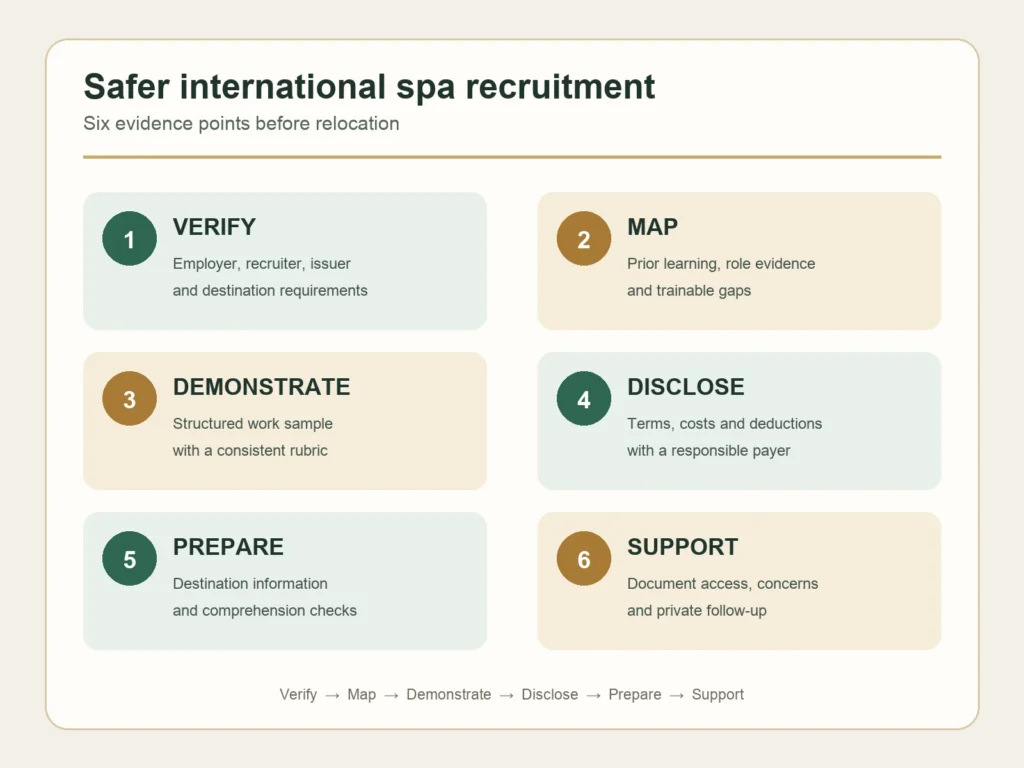
- Verify: confirm the employer, recruiter, qualification issuer and current destination requirements.
- Map: connect prior learning and experience to the actual role, noting both recognised evidence and gaps.
- Demonstrate: use a structured, safe and proportionate work sample with a consistent rubric.
- Disclose: put the job terms, recruitment costs, deductions and responsible payer in writing.
- Prepare: provide current destination-specific information, contacts and comprehension checks before travel.
- Support: protect document access, complaint routes, private follow-up and a lawful exit path.
Employers can document the six steps in one candidate file with appropriate privacy controls. Candidates should keep their own copies outside an employer-controlled device or account. Neither side should rely on messages that disappear, verbal changes or a chain of intermediaries whose responsibilities are unclear.
Red flags that should stop the process
Pause if the employer identity or worksite cannot be verified; the job changes after selection; the candidate is asked to pay an unexplained fee; a personal bank account receives recruitment money; a contract is missing, translated poorly or replaced; the pay formula conflicts with the advertisement; the recruiter promises a guaranteed visa or licence; or original identity documents will be retained.
Assessment can also become a red flag. Watch for requests to treat real clients without pay, sexualised or irrelevant appearance criteria, inconsistent tests, filming without consent, medical questions unrelated to lawful role requirements, or demands to demonstrate techniques outside professional scope. Safety and dignity are part of competence assessment, not obstacles to it.
A candidate should verify through independent channels rather than only the contact supplied by the recruiter. Compare the role with current listings on HiSoLife’s wellness jobs board, keep copies of the vacancy and contract, and seek help from competent public authorities, a recognised worker organisation or qualified adviser when terms or documents are unclear.
A 30-day implementation plan for spa employers
Week 1: map roles and authorities
Choose one international role. Complete the four-part role map, remove unsupported requirements and record the public authority or adviser used to check current work, registration and scope conditions. Name an owner for every unresolved requirement.
Week 2: standardise evidence and assessment
Create the qualification-verification log, consent wording, reference questions, work-sample scenario and scoring rubric. Test the process with an internal qualified assessor. Confirm that the sample is safe, relevant, time-bounded and not productive unpaid work.
Week 3: audit recruiters, costs and documents
Trace every intermediary and cost. Compare the vacancy, recruiter script, offer, contract, accommodation terms and deductions line by line. Require written correction of contradictions. Give candidates a named contact who is independent of the agency’s commercial incentive.
Week 4: prepare arrival and follow-up
Finish the destination pack, translation, first-day plan and private check-in schedule. Run a comprehension call before travel. Record what was delivered and when. Employers ready to recruit can publish a clearly documented wellness vacancy, review profiles through HiSoLife’s candidate search, or discuss a controlled search with the wellness recruitment team.
How candidates can build a portable skills file
Keep a secure portfolio containing qualification records, transcripts or module lists, current registrations, continuing education, dated references, an accurate service list and examples of professional learning. Add the issuer’s official contact or verification link. Do not include unnecessary personal health, family or financial data.
Create a one-page skills map for each role rather than sending every document. Show which evidence supports each essential requirement, which skills can be demonstrated and which destination requirement remains pending. Be honest about gaps. A clear gap with a training plan is safer than an inflated claim that fails during registration or probation.
Before accepting, ask who the legal employer is, where the work occurs, what is guaranteed, what may be deducted, who pays each recruitment cost, which approval remains outstanding, who keeps original documents and how to raise a concern. Candidates can submit a verified professional profile to HiSoLife when their evidence is ready.
Conclusion: make mobility evidence-led and two-sided
International spa hiring should neither dismiss unfamiliar experience nor wave it through. The defensible middle path recognises what has been learned, verifies what can be verified, assesses what the job genuinely requires and names what must still be approved or taught.
Candidate safety is part of that same system. Clear costs, written terms, timely information, control of personal documents, independent support and a route to raise concerns reduce avoidable harm and improve the quality of the match. A six-step record—verify, map, demonstrate, disclose, prepare and support—gives employers and wellness professionals a shared standard without pretending that one checklist replaces local law.
Frequently asked questions
Does a foreign spa qualification automatically transfer to another country?
No. Recognition, licensing, registration and permitted scope depend on the destination and service. Employers and candidates should verify current requirements with the relevant public authority and separately assess job-relevant competence.
Should a spa candidate pay a recruiter to secure an international job?
The ILO fair-recruitment principle is that workers should not be charged recruitment fees or related costs directly or indirectly. Local laws and limited exceptions may differ, so obtain location-specific advice and require an itemised written cost schedule before proceeding.
Can an employer use a practical massage test?
A proportionate, structured work sample can provide useful evidence when it is safe, relevant, consistent, consensual and not productive unpaid work. It does not replace any licence or registration required at destination.
What should a candidate receive before travelling?
At minimum, the verified employer and worksite details, signed terms in a language they understand, pay and deductions, accommodation and arrival information, current official links for required approvals, document-handling rules, and reliable internal and independent support contacts.
Principal sources and scope
This article draws on the ILO’s July 2026 skills-recognition consultation and pre-departure update, its 2019 General Principles and Operational Guidelines for Fair Recruitment, its skills-portability glossary and its May 2026 Malaysia statement. The ILO news examples concern specific migration routes; the six-step framework is an editorial application for spa recruitment. It is general employment information, not legal, immigration or licensing advice.