

Employee, Worker or Self-Employed? A UK Spa Staffing Checklist for 2026
A treatment professional can be called a freelancer, paid by commission and still have employment rights. Equally, a genuinely independent practitioner can work inside a spa without becoming an employee. The label is only a starting point: the real working relationship matters.
Employment status influences pay, holiday, documents, tax handling, flexibility and the responsibilities carried by both sides. It also shapes whether a vacancy is honestly described. A spa that gets the model clear before recruitment can write a better offer, price the role properly and avoid promising independence while managing the person like staff.
This guide translates current Great Britain guidance into a practical audit for spas, hotel wellness departments and treatment businesses. It covers England, Scotland and Wales; Northern Ireland has a separate framework. It is an editorial planning tool, not legal or tax advice. When the facts are mixed, changing or disputed, use qualified UK employment and tax advisers.
Why spa employment status needs attention in 2026
The UK government updated its employment-status checklist for employers on 14 October 2026. It says a business cannot simply choose whether someone is an employee, worker or self-employed. The correct classification follows from the facts of the relationship and should be reviewed when those facts change.
The same day, the government opened a consultation on employment-status reform and protections for the self-employed. The proposals include possible changes to worker status, compliance and protections for genuinely self-employed people. The government is seeking views on those changes. Current engagements still need to be assessed under the rules in force now.
Spa work creates classification questions because several models can operate under one roof: salaried managers, fixed-rota therapists, casual cover, visiting specialists, agency staff and practitioners who rent a room or provide services through their own business. Commission, tips or room rent may affect the economics, but none of them settles legal status by itself.
The three status categories at a glance
For employment rights in Great Britain, the main categories are employee, worker and self-employed. Employees also count as workers in the broader statutory sense. Here, “worker” means someone in the intermediate category who has worker protections without the full set of employee rights. A contractor or agency worker may fall into any of the three depending on the arrangement, so those labels should not be used as shortcuts.
Employee
An employee is more likely to have regular obligations on both sides: the spa provides work, the person is expected to perform it, and a manager exercises substantial control over when and how it is done. The person normally provides the service personally, has limited financial risk and uses the organisation’s systems or equipment. Employees receive the broadest set of employment rights, although some rights still depend on qualifying conditions or length of service.
Worker
A worker may have more freedom over when or how much they accept, yet still perform work personally within a relationship that is not truly a business serving a client. UK guidance lists core rights for workers and employees, including minimum-wage protection, paid holiday, protection from unlawful deductions and discrimination, and a written statement of particulars. “Casual” or “zero hours” does not automatically mean self-employed.
Self-employed
A genuinely self-employed practitioner is in business on their own account. Indicators can include meaningful control over when and how the service is delivered, the ability to work for several clients, active marketing, negotiation of fees, responsibility for business costs and a genuine ability to arrange a substitute. Self-employed people generally do not receive employee or worker rights, although contractual, discrimination and health-and-safety protections can still apply in some circumstances.
What happens during a normal working week?
A well-drafted agreement is important, but it must reflect the daily operation. Calling a therapist an “independent contractor” does not make that true if the spa fixes every shift, sets all prices, requires personal attendance, controls leave, disciplines performance and expects continuing availability. The opposite is also possible: a practitioner may use a treatment room inside a spa while genuinely running an independent business.
The current Acas employment-status guide points employers to the contract, what was agreed at the offer stage and the way the parties actually work together. For a spa audit, translate that into observable questions:
- Personal service: must this named person deliver every appointment, or is there a genuine and workable right to provide a qualified substitute?
- Control: who sets hours, service methods, uniform, pricing, breaks, location, client allocation and performance rules?
- Ongoing obligation: must the spa offer work, and must the person accept or remain available for it?
- Integration: is the practitioner presented as part of the spa team, included in rotas and procedures, or operating a visibly separate business?
- Financial risk: can the person make a profit through their own decisions, and do they carry meaningful costs or responsibility for correcting work?
- Business independence: do they market to other clients, negotiate fees, supply important equipment and decide how the service is organised?
No single item decides every case. A uniform, for example, may support an integrated service but must be read with the rest of the relationship. Record the full picture rather than counting indicators mechanically.
Assess each engagement, not only each job title. One massage therapist may be an employee on a regular team rota while another operates an independent mobile practice and accepts occasional bookings from the same venue. Copying one conclusion across every treatment professional can hide differences in substitution, control and commercial risk. If several sites use the same contract, sample actual practice at each location rather than assume managers implement it consistently.
Use evidence that can be checked: recent rotas, booking rules, price-setting records, invoices, product-purchasing arrangements, client communications and the way cancelled appointments or complaints are handled. Avoid collecting unrelated personal information. The aim is to understand the work relationship, not build a character file on the practitioner.
Keep employment rights and tax status separate
Employment-rights status and tax status use different legal tests. A person can be treated one way for tax and have a different status for employment rights. That is why one payroll decision should never substitute for the wider employment review.
For tax, HM Revenue & Customs provides the Check Employment Status for Tax tool. CEST gives HMRC’s view based on the answers supplied, and HMRC says it will stand by results when the information remains accurate and follows its guidance. Save the result and the underlying facts; a conclusion based on an inaccurate description is not useful evidence.
For employment rights, assess the current relationship using the government and Acas guidance. If the answer is unclear, do not force agreement between the two systems by changing labels. Escalate the facts to advisers who understand both employment law and tax.
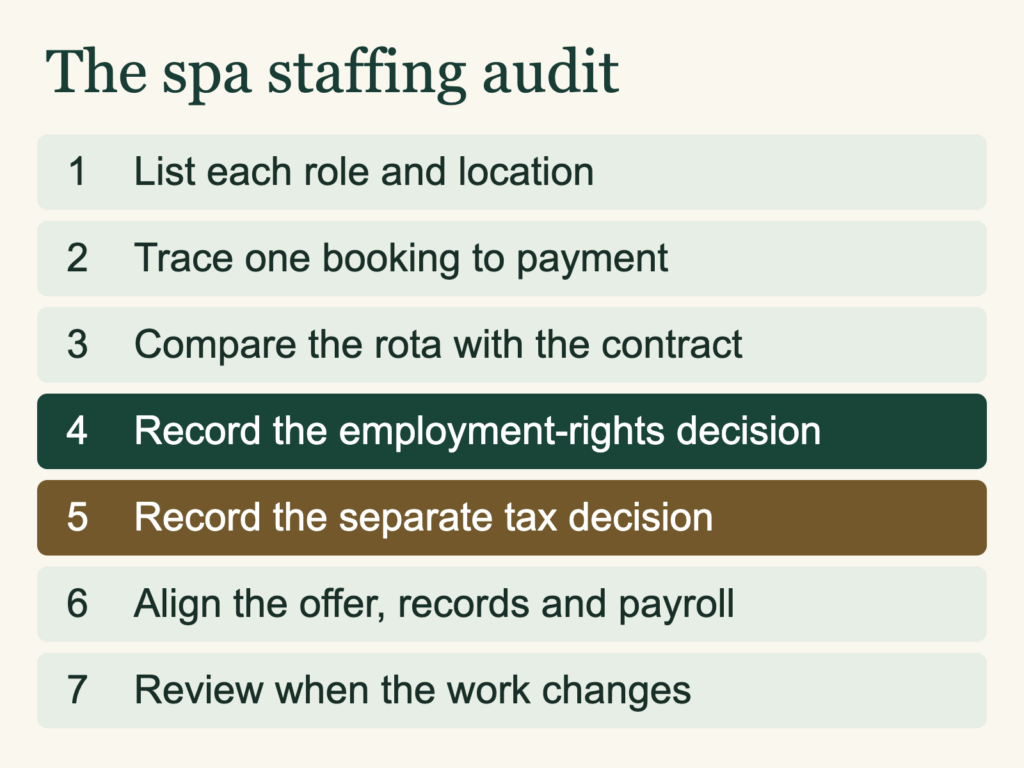
A seven-step spa staffing status audit
- Map every engagement. List employees, casual cover, agency staff, visiting practitioners, room renters and service companies by role and location.
- Capture operating facts. Record who sets hours, prices, methods, client allocation, leave, substitution, equipment, rework and payment. Interview both the manager and practitioner where possible.
- Compare documents with reality. Put the offer, contract, rota, handbook and invoices beside what happens during a normal week. Flag contradictions.
- Assess employment rights. Record the evidence for each possible status, any conflicting facts and who will resolve an outstanding question.
- Assess tax separately and cost the arrangement. Use the appropriate HMRC process and retain the facts behind your answers. Include pay, holiday, pension or payroll duties, administration, equipment, insurance and supervision where applicable. Use a credible wellness pay benchmark, then verify local legal minimums and market conditions.
- Correct the offer and records. Align the job advert, written terms, policies, payroll route and manager instructions with the intended and supportable relationship.
- Set review triggers. Reassess when hours become regular, exclusivity increases, a practitioner stops sending substitutes, prices become centrally fixed, duties expand or a temporary arrangement becomes permanent.
The output should be a dated decision record, not a one-word spreadsheet cell. State the facts considered, the conclusion for employment rights, the separate tax outcome, unresolved points, who approved it and the next review date.
Test common spa models without making assumptions
The fixed-rota treatment professional
A therapist who works recurring shifts, uses spa products and rooms, follows detailed service protocols, cannot send a substitute and is managed through the normal team process may show employee indicators. Variable commission does not erase the underlying control or personal-service requirement. The full arrangement still needs review.
The casual cover therapist
A person who can decline offered shifts may have genuine flexibility, but once they accept a shift the spa may still control the work and require personal service. That can point toward worker status rather than self-employment. Document what happens before, during and after an accepted shift.
The room renter or visiting specialist
A practitioner who sets their prices, markets their own brand, takes bookings directly, carries business costs, works for multiple clients and controls service delivery may be genuinely self-employed. If the spa gradually takes over the diary, prices, presentation and performance process, the original description may stop matching reality.
HMRC gives an example close to home in its tax guidance for hair and beauty businesses. A stylist rents a chair, sets the price, keeps the client records and collects payment. An empty diary means no income for the stylist. In another example the salon pays an hourly rate, supplies the bookings and decides how long each appointment lasts. Both people work on salon premises. Following a single booking from enquiry to payment reveals which business is actually selling the service.
Try that exercise with a treatment room. If a guest cancels at the desk, who decides whether to waive the charge? If the guest rebooks, can the practitioner set a different price? Ask reception and the practitioner to describe the same booking separately, then compare their accounts with the receipt. Record any disagreement as an open question for the review. These are ways to gather evidence for the tax assessment. The employment-rights decision needs its own record.
The agency or platform-supplied professional
Do not assume the agency or app owns every responsibility. Identify the contractual parties, who pays the person, who controls the assignment, who supplies the client and who handles safety. The government guidance notes that an agency worker can be an employee, worker or self-employed depending on the facts.
The Supreme Court’s account of Uber v Aslam illustrates why the booking system deserves scrutiny. The drivers in the case could choose when to log on. Once online, Uber set fares, constrained their choice of trips and used passenger ratings to manage performance. The Court upheld the finding that the claimants were workers. The decision concerned private-hire drivers. Its practical lesson for a spa is a question to investigate: if a practitioner declines an appointment, does the system quietly reduce their access to the next one?
These examples are prompts, not legal determinations. Two practitioners with the same job title can have different status because their actual relationships differ.
Make recruitment materials match the model
A status problem often begins in the advert. A vacancy may promise “freedom” while listing compulsory full-time availability, fixed pricing, exclusivity and extensive manager control. Candidates cannot compare opportunities fairly when the business model is hidden behind lifestyle language.
Before you publish a spa or wellness vacancy, state the proposed relationship, location, expected availability, guaranteed and variable pay, who supplies products and equipment, how bookings are allocated, and whether other clients or substitutes are possible. Do not promise a tax outcome or employment status that has not been assessed.
Employees and workers must receive a principal written statement on or before their first day, according to GOV.UK written-statement guidance. It should cover core details such as role, start date, pay, hours, place of work, holiday, probation and obligatory training. A written statement is not the whole contract, and neither document overrides the real arrangement.
Connect status decisions to decent work and retention
Correct classification is one part of a credible employment offer. The operating model must also provide clear pay, realistic capacity, safe work, useful training and a route for concerns. HiSoLife’s decent-work checklist for spa hospitality can help managers review those connected conditions.
Classification also affects recruitment quality. If a spa needs continuity, mandatory methods, integrated team duties and regular availability, it should cost and describe that need honestly. If it wants an independent business relationship, managers must be prepared to give up some control and let the practitioner operate with genuine commercial autonomy.
Employers can review spa and wellness candidate profiles after defining the model and evidence they actually need. Candidates can compare current wellness job opportunities more confidently when adverts separate guaranteed terms from variable earnings and explain how the work is organised.
A candidate checklist before accepting the role
Candidates should not have to diagnose the employer’s legal position alone, but they can ask practical questions before accepting:
- Who decides my shifts, prices, treatment methods and client allocation?
- Is there guaranteed work or pay, and can I decline individual assignments?
- Must I deliver the service personally, or can I arrange a genuinely qualified substitute?
- Who pays for products, equipment, insurance, training and corrections?
- Can I work for other businesses and market directly to my own clients?
- Which employment rights, holiday arrangements and written terms does the organisation say apply?
- How will tax be handled, and has the business assessed that separately?
Ask for important answers in writing and compare them with what managers say during onboarding. If the arrangement is unclear, a candidate can seek Acas, union, professional or legal advice. A therapist ready to approach employers can also submit a wellness resume with the type of engagement and availability they are prepared to consider.
What to do this week
Choose one role that mixes commission, casual hours or contractor language. Map the real operating facts with the seven-step audit, run the separate tax assessment, and compare the result with the advert, agreement and payroll treatment. Correct contradictions before opening the next vacancy or renewing the engagement.
Do not wait for the 2026 consultation to become legislation before fixing an arrangement that already fails to reflect reality. Equally, do not present consultation proposals as settled law. A dated, evidence-based review gives the spa a defensible starting point and gives the practitioner a clearer choice.
Outside Great Britain, use the same operational questions only as an internal fact-finding framework. Do not export the UK categories, rights table or CEST outcome into another country. Local labour, tax, social-security, licensing and agency rules may classify the relationship differently, especially where a practitioner works across borders or through an intermediary.
For a broader recruitment review or help defining the right engagement before sourcing, explore HiSoLife’s wellness recruitment support.
Frequently asked questions
Does commission pay make a spa therapist self-employed?
No. Commission describes how pay is calculated, not the legal status. Assess personal service, control, ongoing obligations, integration, financial risk and business independence across the whole relationship.
Can the contract simply say the practitioner is an independent contractor?
The contract is evidence, but the label does not decide the outcome. The written terms should match the real working arrangement. If daily practice shows worker or employee features, calling the person self-employed does not remove rights that may apply.
Is the HMRC CEST result also the employment-rights answer?
No. CEST addresses tax status. Employment-rights status is a separate assessment, so a spa should record both and obtain advice when the results or facts are difficult to reconcile.
How often should a spa review employment status?
Review before engagement and whenever the relationship materially changes. Useful triggers include regularised hours, new exclusivity, greater manager control, changed substitution practice, centrally fixed prices, expanded duties or a temporary model becoming ongoing.