

How to Refuse Sexual Requests and Handle Harassment in a Spa
A sexual request during a massage is a workplace safety issue, not a customer-service challenge that a therapist must quietly absorb. A spa should give every employee a clear way to refuse inappropriate demands, stop unwanted contact, summon help and leave a treatment room without having to negotiate their own protection.
Discretion means protecting privacy and avoiding unnecessary confrontation. It must never mean hiding an incident, discouraging a report or prioritising a valuable client over a worker. This guide gives spa owners, receptionists, managers and therapists a practical response framework, including original scripts and checklists.
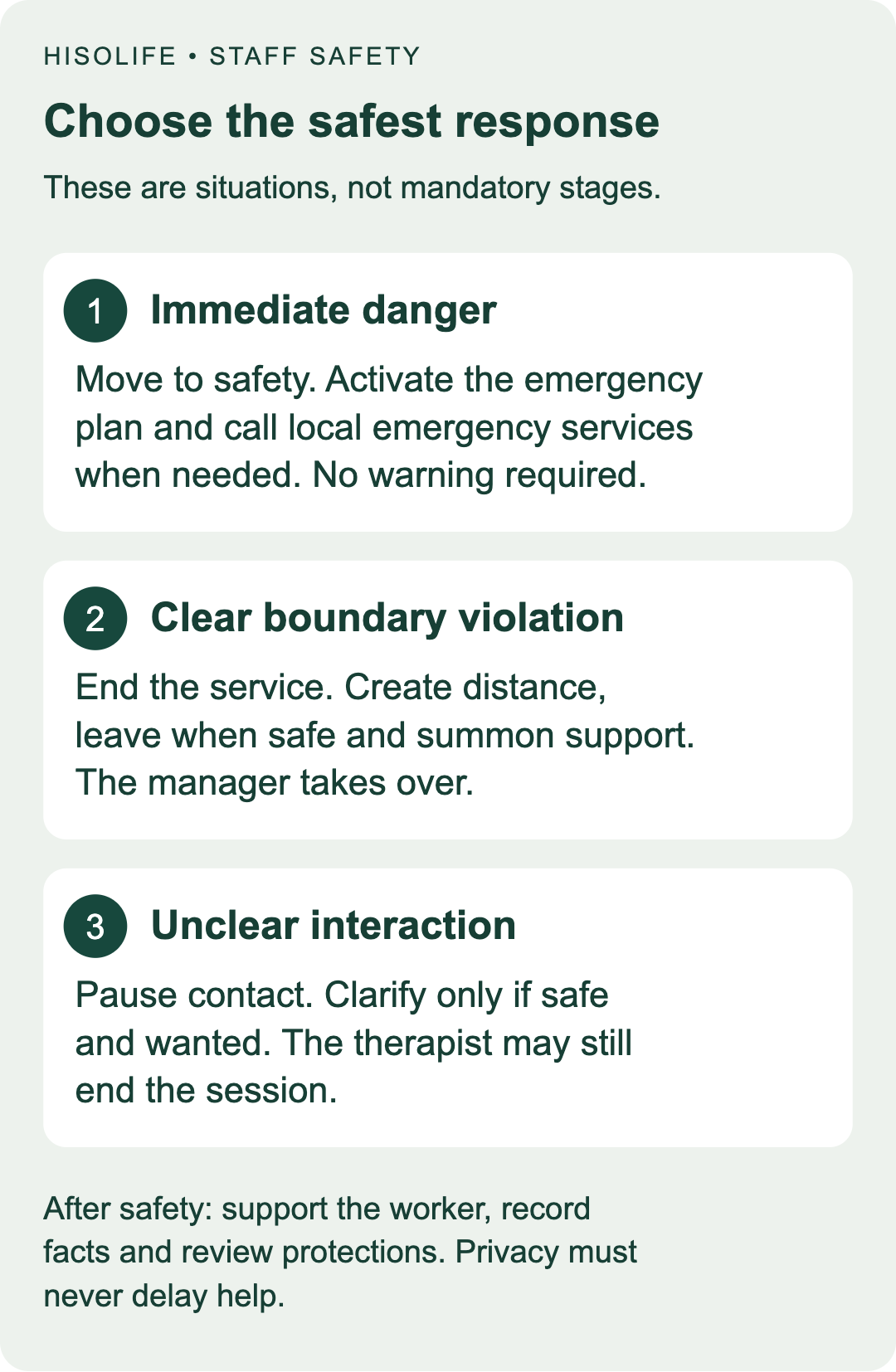
If someone is threatening violence, preventing an exit or assaulting a worker, prioritise escape and the spa’s emergency procedure. Contact local emergency services when immediate help is needed. A warning, explanation or management permission is never a prerequisite for getting to safety.
1. Establish the rules before an incident
State clearly that your services are professional and non-sexual. Therapists may stop a service when boundaries or safety are compromised. Management takes over the response; the affected worker is not responsible for recovering the booking, collecting payment or keeping the guest happy.
The American Massage Therapy Association’s guidance on client misconduct supports ending sessions when clients cross boundaries, appropriate reporting and protection from retaliation. It also makes clear that misconduct is not the victim’s fault.
The procedures below are editorial examples for adaptation to the business. U.S. and British sources explain their own professional or legal contexts; they do not establish identical obligations in Thailand or every other country. Check local rules on employment, professional practice, privacy, service refusal and reporting before adopting a formal policy.
2. Recognise the behaviour without profiling the client
Look at what someone says or does: requests for sexual services, sexual comments about an employee, unwanted touching, deliberate sexual exposure, threatening messages or attempts to pressure staff with money. A client’s gender, nationality, sexual orientation, appearance or spending power is not evidence of misconduct.
Acas explains that unwanted sexual behaviour can involve a single incident or a pattern, including conduct by customers and through digital channels. A spa can enforce professional boundaries before conduct reaches a particular legal threshold.
Separate uncertainty from an explicit violation
A genuine question about which muscles a treatment covers may need a clinical explanation. An apparently accidental movement may justify pausing contact and asking the client to reposition. Do not infer sexual intent from an involuntary bodily response alone. Ask about the observable behaviour if clarification is safe; the therapist need not continue if uncomfortable.
By contrast, an explicit sexual proposition, deliberate unwanted touch, threatening behaviour or repeated boundary violation should trigger the service-ending procedure. Do not require “three strikes”. Staff do not need to prove intent before taking an immediate protective step.
3. Refuse sexual requests before accepting a booking
Reception can prevent some incidents by making the scope of services unmistakable on the menu, website, booking confirmation and intake form. Use accurate treatment descriptions and professional photographs. Explain draping, covered areas and consent in language clients understand.
An original booking-policy example:
“Our treatments are professional and non-sexual. Sexual requests, unwanted touching, harassment and threatening behaviour are not accepted. We may decline or end a service to protect staff and guests.”
If a caller asks explicitly for sexual services, give a short refusal:
“We do not offer sexual services. We cannot accept this booking.”
If someone asks an unclear question about “extras”, explain the published menu once without making a suggestive joke. If they clarify that they want sexual activity, refuse. End abusive calls and retain relevant messages through the business system. Do not direct the person to another employee or suggest an alternative venue for sexual services.
4. Decline an in-person request calmly and firmly
Keep your voice clear and your wording brief. Stand where you can reach colleagues and a safe exit. Where circumstances permit, speak without announcing the details to other guests, but never move into a secluded room merely to make a confrontation private.
“That is not a service we provide. We will not proceed with your treatment. Our duty manager will speak with you here.”
Do not debate what other spas supposedly offer or let tips change the answer. Avoid qualifying the refusal with “not today”, “not with this therapist” or “maybe elsewhere”. Such wording can imply that the service is negotiable.
If the client becomes intimidating, end the conversation and activate the safety response. A manager should provide support rather than instructing the receptionist to keep explaining until the guest agrees.
5. Stop a massage when a boundary is crossed
Pause physical contact. Create distance and move toward a safe exit when possible. Use one direct sentence if it is safe to speak:
“This session is over. That request is inappropriate. I am stepping out and contacting my manager.”
For unwanted touching:
“Do not touch me. I am ending the treatment.”
A therapist who freezes, cannot speak or leaves without delivering a script has not failed. The scripts are optional tools, not a test of whether the worker deserves support. A booking confirmation or signed policy does not make an incident less serious.
If it can be done safely, ask the client to dress while you leave and summon assistance. Do not stay alone to watch them dress, physically adjust their draping during an unsafe interaction or resume hands-on treatment to finish the appointment. Do not lock the person in the room or obstruct their exit.
For ambiguous contact that appears accidental, a therapist may choose to say, “Please keep your hands on the table,” and reassess. That option never creates an obligation to tolerate another incident.

6. Make the help signal lead to a real response
A code phrase is useful only if someone hears it and knows what to do. Choose a neutral phrase, a reachable call button or another tested signal. Define who responds, who covers reception and who contacts security or emergency services. Include an alternative if the first contact is unavailable.
Rehearse the response in each room with its usual music volume, closed doors and realistic staffing. Check that staff can reach assistance without passing the client. Keep exits clear and ensure safety arrangements do not trap either person.
The UK Health and Safety Executive identifies increased vulnerability when nearby support is unavailable. For late shifts, off-site treatments and hotel-room bookings, assess how assistance would actually arrive. A phone number alone is not a workable response plan if nobody can intervene or call for help.
7. Have the manager take over safely
The manager’s first task is to separate the worker from the interaction and assess immediate danger. Arrange a colleague or trained security support where needed. Keep a clear exit, avoid crowding the client and use a calm statement:
“The treatment has ended. Please get dressed if needed, then leave with the duty manager’s guidance. Any booking or payment questions will be handled separately.”
If the person refuses to leave, threatens anyone, follows the worker or blocks movement, escalate according to the emergency plan. Staff should not improvise physical restraint, chase someone or attempt to confiscate their phone. Safety procedures must match staff training and local law.
HSE’s violence-prevention guidance combines staffing, layout, communication and training. It also recommends calm communication and personal space, with emergency procedures when a situation is unsafe. These techniques can help; they do not guarantee cooperation or make the employee responsible for another person’s behaviour.
8. Protect privacy without protecting misconduct
Give other guests a neutral explanation: “We are managing an operational matter. Thank you for your patience.” Discuss details with the affected worker in a safe staff area. Restrict incident information to people who need it for protection, investigation or lawful reporting.
Do not promise absolute secrecy: some information may need to be shared with responsible managers, authorities or an insurer. Explain what will be shared and why. Never ask staff to stay silent, withdraw a complaint or sign away reporting rights to preserve the spa’s reputation.
Discretion is not more important than being heard. If shouting for help or attracting attention is necessary to reach safety, staff should do so. A client’s celebrity status, room category or membership level does not change the safety response.
9. Separate payment decisions from personal safety
Do not ask the therapist to collect an unpaid bill, argue over a tip or return to the room to negotiate a refund. Move the worker to safety first. A designated manager can resolve commercial questions later through official channels.
Have local advisers review cancellation terms, deposits, refunds and disputed charges. Do not assume that ending a treatment automatically permits charging the full price everywhere. Equally, a refund must never depend on the worker withdrawing a report or meeting the client again.
As an employer practice, protect staff from financial pressure to continue unsafe sessions. Explain in advance how interrupted bookings affect pay, commissions and schedules. Record the operational interruption separately from the worker’s performance assessment.
10. Document facts promptly and preserve evidence
Once everyone is safe, offer the worker help to record what happened when they feel able. Avoid repeated questioning. Separate direct observations, the person’s account and any inference. Record uncertainty honestly rather than demanding a perfectly timed narrative.
A practical incident-record template
- Incident date, approximate time, location and booking reference.
- People involved and possible witnesses, using the minimum necessary identifiers.
- Observed conduct and the words reported, noting quotations only when recalled reliably.
- Steps taken to stop treatment, leave, call for help and protect others.
- Any reported injury or immediate support requested.
- Relevant messages, booking records or lawfully available corridor footage.
- Responsible manager, interim booking restrictions and follow-up owner.
HSE recommends supporting workers, recording incidents and reviewing protective measures. Preserve relevant evidence before normal systems overwrite it. Keep originals and an access record; do not circulate incident screenshots in informal group chats.
Do not install cameras in treatment or changing rooms to solve this problem. Any CCTV in appropriate public areas needs a separate lawful privacy assessment, notices, access controls and retention rules. Avoid collecting unnecessary intimate details or making covert personal recordings without understanding local law.
11. Support the worker without blame or pressure
A useful first response is: “Thank you for telling me. You did not cause this. Let’s make sure you are safe and discuss what support you want.” Offer a quiet space, a trusted colleague, a break from appointments and assistance arranging safe transport if needed.
Do not ask why they smiled, accepted the booking, failed to shout or waited to report. Do not insist that they immediately retell the incident to several managers. Let them choose whether they want someone present during discussions.
For injury or possible sexual assault, help them access prompt medical care and specialist support if they wish; urgent danger or medical need requires an emergency response. Explain available reporting routes, respect their choices where possible, and clearly describe any mandatory reporting obligation that applies locally. An internal review must not prevent access to police or independent advice.

12. Investigate fairly and prevent retaliation
Assign someone trained and sufficiently independent to review the facts. Provide an alternative reporting route if the complaint concerns the direct manager or owner. Put proportionate safeguards in place while reviewing the complaint, including restricting further bookings where justified.
Acas advises taking complaints seriously and handling them promptly, fairly and sensitively. Its guidance also warns against dismissing a complaint simply because there was no witness. Immediate protection does not require treating every disputed fact as already established.
Record the decision, reasons and follow-up, and communicate the outcome to the people who need to know within privacy limits. Monitor for reduced shifts, lost training opportunities, hostile messages or pressure to “move on”. Do not transfer the same client to another therapist as a way to avoid dealing with the reported behaviour.
13. Manage future bookings and online retaliation
Use the booking system to enforce any justified restriction across relevant branches, with authorised access and a review process. Keep notes factual and proportionate. Do not share public blacklists, circulate accusations to unrelated businesses or identify the worker unnecessarily.
If a client posts a hostile review, preserve it and respond without exposing confidential information: “We provide professional, non-sexual treatments and apply conduct standards to protect guests and staff. Please contact management through our official channel.” Do not argue about intimate details publicly.
Route repeated calls, private messages, stalking or threats to management and appropriate authorities or advisers. Preserve relevant communications, support staff in limiting personal contact and avoid asking them to engage directly with someone they fear.
14. Build prevention into everyday spa operations
The ABMP Code of Ethics sets professional expectations around boundaries, consent and confidentiality. Translate those principles into daily practice: clear treatment explanations, appropriate draping, permission before touching and an easy way for either person to stop the session.
Offer accessible policies and communication support without stereotyping clients who need an interpreter or have a disability. During intake, explain areas treated and excluded. A client should also know how to report misconduct by a therapist or manager through an independent route.
Discuss these expectations when recruiting and onboarding spa therapists. Build on the HiSoLife guide to professional client boundaries, then assess whether staff can apply the actual safety procedure.
15. Practise the response, including management decisions
Use brief, non-graphic scenarios: an explicit request by phone, an uncomfortable comment in a room, an unavailable supervisor or a guest refusing to leave. Let staff opt out of acting a distressing role; nobody needs to simulate assault or unwanted physical contact.
Check whether people can refuse clearly, leave safely, summon help and hand over the situation. Include reception, agency staff, cleaners, security and managers. Provide scripts in the working languages, validate translations with fluent speakers and keep emergency information accessible.
Review room layout, staffing and response arrangements after incidents and near misses. Do not judge success only by a low complaint count: it may reflect under-reporting. Ask whether staff feel able to stop a treatment without losing income or facing blame. This is also part of supporting therapist wellbeing and retention.
16. Give the policy a named owner
Document who maintains the procedure, who responds on every shift and who receives complaints outside the normal management line. Acas’s policy guidance provides a useful structure for scope, reporting and responsibilities, to be adapted to the jurisdiction.
Clients can be a source of workplace harassment: the U.S. EEOC’s harassment guidance explicitly includes non-employees among potential harassers. The ILO’s work on violence and harassment provides an international framework; check local law and applicable ratifications rather than treating a convention as automatically enforceable everywhere.
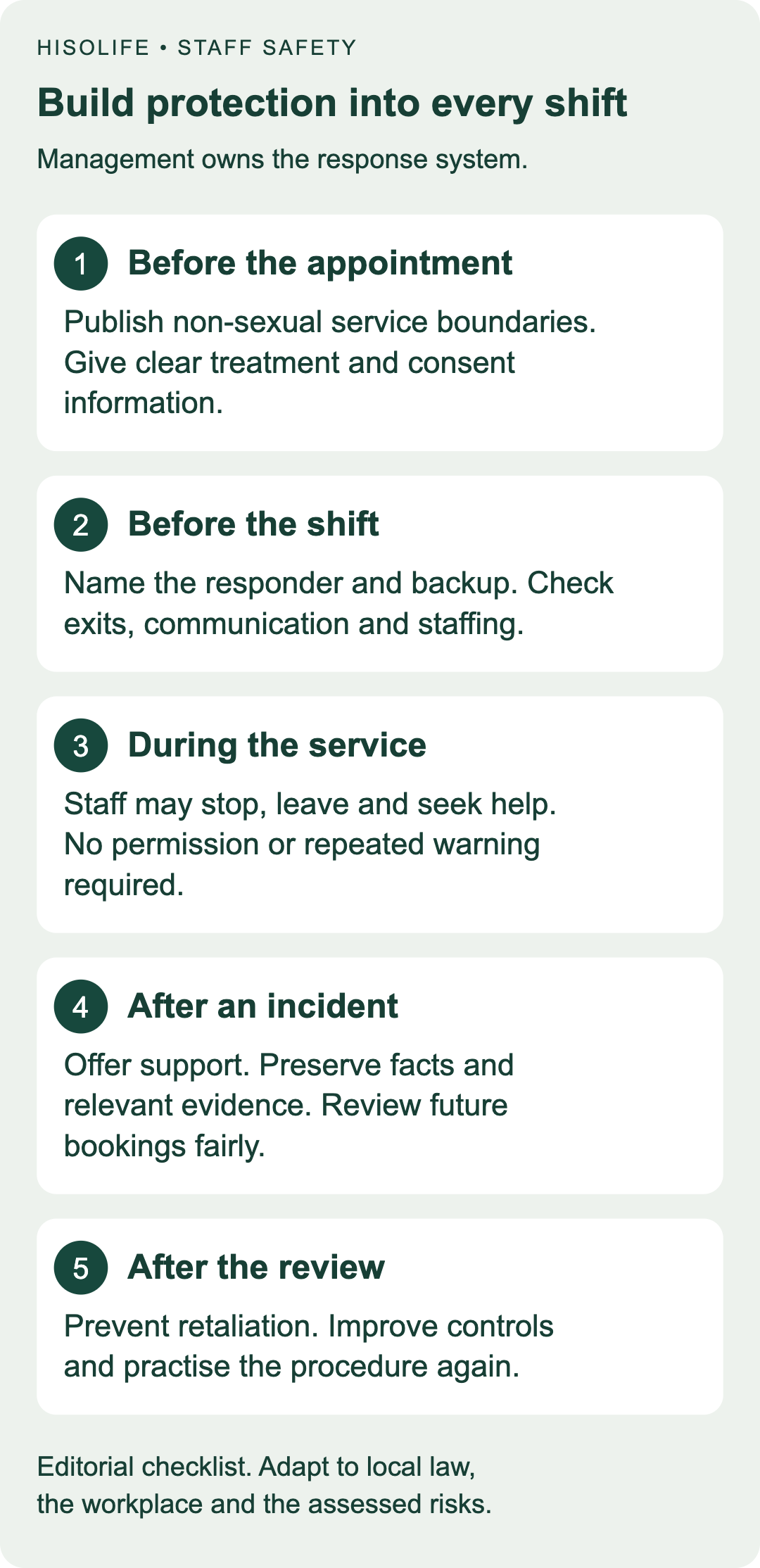
Make the commitment concrete: staff can stop unsafe interactions, management will respond, reports will receive a fair review and support will continue afterwards. Reinforce it through wellness recruitment and management practices, not simply a sign at reception.
Frequently asked questions
Must a therapist warn the client before stopping?
No warning should be required by the spa’s safety procedure before ending an unsafe interaction. A brief explanation may be useful when safe. Explicit sexual demands, unwanted touching or threats do not require repeated chances.
What if the client says it was a joke?
Do not debate humour during an unsafe situation. Maintain the boundary and act on the behaviour. Record the explanation as part of a fair review; it does not erase the worker’s experience or require resuming treatment.
What if the client is a VIP or the manager wants to continue?
Use the same safety standard. Give staff an escalation route beyond the duty manager and never require them to continue unwanted contact to protect revenue. Review any management pressure as a separate concern.
Can we handle everything discreetly?
Keep unnecessary details away from other guests and share records only as needed. Never let discretion delay emergency help, prevent reporting or require the affected person to stay silent.
Sources and editorial notes
Sources reviewed on 11 November 2026: AMTA; ABMP; Acas; the UK Health and Safety Executive; the U.S. Equal Employment Opportunity Commission; and the International Labour Organization. Direct source links appear beside the relevant statements. Scripts, response diagrams and checklists are original editorial examples, not statutory wording or a guarantee of safety. Local professional and legal requirements require separate verification.
All three photographs are AI-generated fictional workplace illustrations. They show prevention, assistance and support; they do not document an incident or identify an actual victim or client.