

Accessible Spa Hiring in 2026: A Reasonable-Adjustments Workflow
Accessible spa hiring is not about guessing what a candidate can or cannot do. It is about removing avoidable barriers so every applicant can show evidence against the real requirements of the job.
That distinction matters in wellness workplaces. A therapist role may involve sustained physical activity and verified technical competence. A receptionist may need to use booking software and handle private information. A spa manager may need to lead a busy handover. None of those outcomes automatically requires one standard application format, one interview environment or one way of communicating an answer.
A September 2026 evidence review commissioned by the UK Department for Work and Pensions recommends clear job-relevant criteria, consistent questions or tasks, objective scoring, accessible recruitment materials and human accountability when technology is used. The review describes its overall evidence as indicative to moderate, so employers should treat it as practical direction rather than a promise that one intervention will produce a particular hiring result.
The operating principle: keep the essential evidence standard stable, while changing a process feature that would otherwise prevent a candidate from demonstrating that evidence.
Why accessible hiring belongs in spa workforce practice
Recruitment can exclude capable people before an employer has seen their skills. A timed online form may be incompatible with assistive technology. A noisy interview room can make communication harder. A practical test may measure speed through an unfamiliar process instead of safe performance in the actual role. A vague advert may cause a candidate to assume that flexibility is unavailable.
The official UK government evidence review on recruiting disabled people and people with health conditions, updated on 17 September 2026, recommends accessible language, clear information about accommodations, structured selection and practical training for hiring managers. It also notes that larger employers are better represented in the evidence and are more likely to have formal systems and resources. Small spas therefore need a workflow that is rigorous without requiring a large HR department.
Accessibility also improves decision quality. When the advert states the actual outcome, the shortlist uses defined evidence and interviewers ask comparable questions, the employer is less likely to confuse familiarity, confidence or one preferred communication style with competence. HiSoLife’s spa skills-audit framework can help separate skills that are essential on day one from skills that can be developed after hiring.
Begin with the essential functions of the role
An accessible process starts before the vacancy is advertised. Describe what the job must achieve, the conditions in which it is performed and the standards that protect guests, colleagues and the business. Then ask which requirements are genuinely essential and which are simply inherited preferences.
For a massage therapist, essential evidence may include the credentials required in the location, safe technique, consultation boundaries, hygiene practice, documentation and the ability to manage the physical demands of booked work. “Energetic,” “young,” “able-bodied” or “always on your feet” are not useful substitutes for a task analysis. For a reception role, the outcome may be accurate booking, privacy, calm escalation and inclusive guest communication—not a particular voice, accent or way of making eye contact.
Write an evidence map before a person specification
For each responsibility, record four things: the required outcome, why it matters, acceptable evidence and the stage at which it will be assessed. This keeps a preferred trait from quietly becoming a rejection rule. It also shows where an adjustment can change the method without changing the standard.
- Outcome: prepare a treatment room to the spa’s documented hygiene and safety standard.
- Why it matters: guest safety, reliable operations and infection-control practice.
- Evidence: a job-relevant demonstration, explanation of sequence and recognition of a deliberately introduced error.
- Possible adjustment: written instructions in an accessible format, extra orientation to the test space or an alternative way to explain the reasoning.
Do not assume that an adjustment request proves inability to perform the role. It proves only that the unadjusted selection method may create a barrier. Employers should obtain local advice on essential-function analysis, occupational requirements and disability law because duties and terminology vary by jurisdiction.
Publish an advert candidates can use
Use direct language, a logical heading structure and a format that can be read on a phone and by common assistive technologies. State the location, schedule, base pay or pay range where appropriate, variable compensation, duties, essential qualifications, physical or sensory conditions that are genuinely relevant, and how the process will work.
Avoid inflated requirement lists. If a role can be learned with structured onboarding, do not demand years of experience merely to reduce applications. If a driver’s licence is not needed to perform the job, do not include it as a default criterion. The UK government guidance for employing disabled people recommends limiting a person specification to skills and experience that are vital to the job and providing a contact for discussing recruitment adjustments.
Make the adjustment route visible
Include one plain sentence such as: “We want every candidate to demonstrate their skills fairly; contact [role or address] if you need an adjustment at any stage.” Explain what will happen next, who will see the information and when the candidate should expect a response. Offer another contact method where practical.
The invitation must be operational, not decorative. A manager needs authority to respond, a simple record of the agreed change and time to put it in place. Employers ready to advertise can publish a spa or wellness job with accurate duties and a clear process rather than relying on informal messages that omit essential details.
Invite and handle adjustment requests safely
Ask what change would enable the candidate to participate, not for an unnecessary diagnosis or a detailed medical history. The current UK government recruitment guidance on reasonable adjustments says an employer can ask whether a candidate needs an adjustment to be considered and must make adjustments that are reasonable under UK law. It gives examples such as an accessible interview location and allowing a written test to be completed on a computer.
Common selection adjustments may include an accessible room, step-free route, quieter space, rest break, more processing time, accessible document format, captioning or communication support, an alternative input device, questions supplied in an agreed way, or a different method that still tests the same job-relevant outcome. This list is not exhaustive, and the correct response depends on the individual and the role.
Separate support information from scoring
Keep the minimum necessary adjustment information with the person coordinating the process. Interviewers need to know what arrangement to provide; they do not need unrelated health information. Do not add or subtract score because a candidate requested a change.
Confirm the arrangement in writing and invite the candidate to flag a problem before the assessment begins. If a planned adjustment fails—captions do not work, the lift is unavailable or the document is inaccessible—pause and repair the process. Do not score performance produced by a known barrier as though the agreed conditions were delivered.
Shortlist against evidence, not familiarity
Application volume does not guarantee a strong shortlist. The CIPD’s Resourcing and talent planning report 2026, published on 22 September, says 58% of surveyed employers experienced an increase in unsuitable candidates while 33% saw an increase in suitable candidates. A transparent scorecard helps a spa review the evidence it actually needs instead of adding arbitrary filters.
Build the scorecard before opening applications. Use a small number of weighted criteria drawn from the evidence map. Define what “no evidence,” “partial evidence,” “meets the requirement” and “strong evidence” mean for each criterion. Set any essential pass threshold in advance and document how ties or missing information will be handled.
A practical six-part spa shortlist scorecard
- Required eligibility or credentials: assess only what the location and role genuinely require.
- Guest safety and professional boundaries: look for specific evidence, not reassuring adjectives.
- Role-relevant technical foundation: distinguish verified competence from trainable gaps.
- Communication and escalation: assess outcomes across different valid communication styles.
- Reliability evidence: use examples and references appropriately, not assumptions about career gaps.
- Learning capacity: look for reflection, feedback use and transferable experience.
Where feasible, use two reviewers who score independently before discussing candidates. Acas guidance on choosing who to interview recommends a consistent decision process such as scoring and says that ideally two or more people should be involved, which can reduce the risk of personal bias or unintended discrimination. Record the evidence behind a score; “not a culture fit” is not an auditable reason.
Run a structured and adjustable interview
Ask every candidate the same core questions in the same order and score them against criteria agreed before the interviews. Follow-up questions can clarify an answer, but they should not give one applicant a hidden advantage. The CIPD’s September 2026 selection-methods guidance describes structured interviews this way and recommends that panel members score independently before group discussion.
Provide candidates with the format, approximate duration, participants, location or platform and types of assessment in advance. Tell them how to request an adjustment again, because a candidate may identify a barrier only after seeing the details. Build a short buffer into the schedule so extra time or breaks do not turn into pressure from the next appointment.
Keep questions connected to the work
Ask for evidence or a response to a realistic situation: “A guest discloses information outside your scope; what do you do next?” “You notice the room checklist and the physical setup conflict; how would you respond?” “A colleague gives you corrective feedback during a busy handover; how do you make sure the next task changes?”
Do not reward polished storytelling alone. Give candidates time to think, allow notes when that does not undermine the task, and score the relevant elements in the response. A communication adjustment changes access to the question; it does not eliminate the need to demonstrate safe judgement.
Design a job-relevant skills check
A skills check should resemble a meaningful part of the job without exposing a real guest, using confidential data or creating unpaid productive work. A therapist assessment might use a consented model and follow the local rules for credentials, touch and supervision. A reception assessment can use a fictional booking problem. A manager assessment can use a mock rota conflict or complaint handover.
Give the same brief, time expectations, available tools and scoring dimensions to every candidate, then apply agreed adjustments. If speed is not essential, do not make a short timer the dominant measure. If a candidate needs orientation to an unfamiliar space, provide it before the scored task. If a task cannot be adjusted without changing the essential outcome, document why and consider whether another valid method can test the same capability.
HiSoLife’s guide to candidate-safe spa hiring events offers a broader framework for truthful role information, skills stations, privacy and follow-up. Employers should also check local rules on work trials and pay before asking any candidate to perform tasks that create value for the business.
Use hiring technology with human accountability
An applicant-tracking system, video platform or AI-supported tool can create or remove barriers. Test whether a candidate can navigate it by keyboard, use a screen reader, access captions, enlarge content, pause where appropriate and reach a person when the tool fails. Provide an equivalent alternative when a platform feature is not accessible.
The DWP review recommends using AI only where it supports fair, transparent and accountable decisions, with job-relevant inclusive criteria, safeguards and human judgement. That means a hiring manager remains responsible for the decision. Do not treat an automated ranking, facial analysis, voice score or unexplained “fit” prediction as proof of suitability.
This is especially important when a model may interpret a disability-related difference, career gap, non-standard phrasing or use of assistive technology as a negative signal. HiSoLife’s human-oversight checklist for AI-assisted spa hiring can help teams document purpose, data, review and appeal routes.
Hand the offer into accessible onboarding
Selection adjustments do not automatically describe what a person will need at work. After an offer, use the lawful process in the relevant jurisdiction to discuss workplace support, equipment, schedules, communication and confidentiality. Confirm ownership and timing so the person is not asked to solve every operational detail alone before their first day.
Prepare the manager and workplace without circulating private information. A team may need to know that captions will be used, that a route must remain clear or that instructions should also be written; it does not need a diagnosis. Review support after the person has experienced the actual job, because needs and solutions can change.
Candidates can compare current wellness job opportunities and submit a wellness resume. Employers can review spa and wellness candidate profiles, while applying the same job-relevant and accessible process to every route into the vacancy.
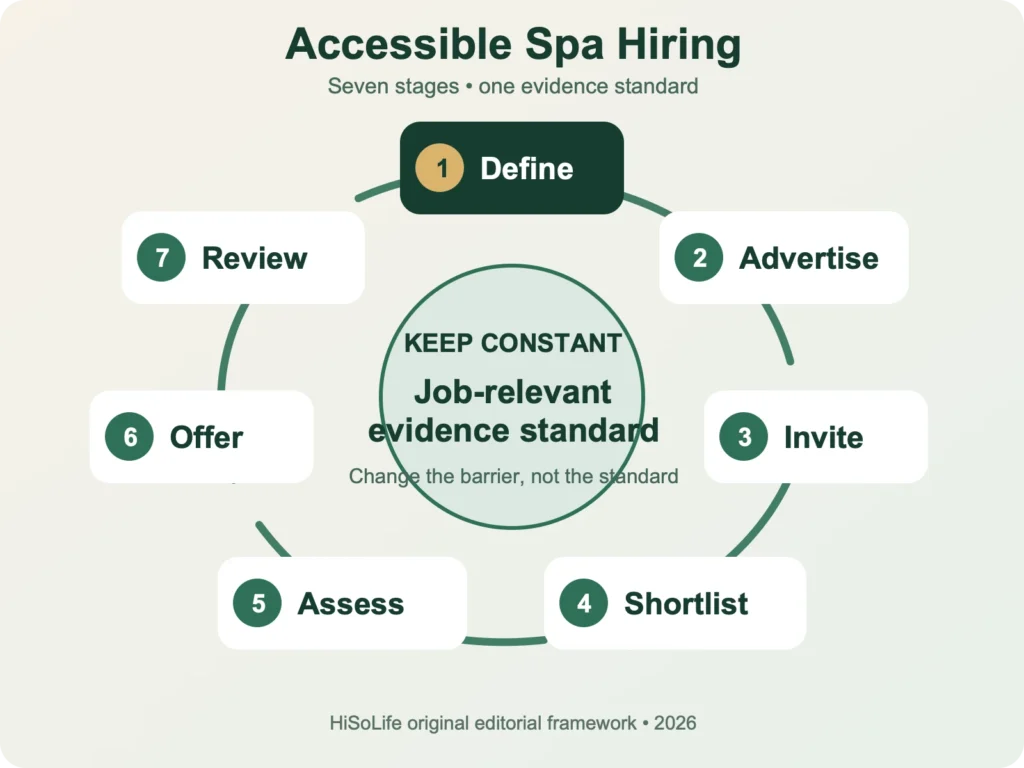
The seven-stage accessible spa hiring workflow
The workflow below is designed for a small or medium spa that may not have a specialist accessibility team. Assign one owner, use a standard decision record and seek qualified local advice where the law or an adjustment is unclear.
- Define: map the essential outcomes, evidence and safety standards before writing the advert.
- Advertise: use accessible materials, state the process and make the adjustment contact visible.
- Invite: ask what process change would enable participation and protect unnecessary health information.
- Shortlist: score job-relevant evidence against pre-agreed criteria, preferably with independent reviewers.
- Assess: use structured questions and realistic tasks, with adjustments that preserve the evidence standard.
- Offer: discuss workplace support through the lawful post-offer process and assign implementation owners.
- Review: measure barriers, candidate experience, decision consistency, adjustment delivery and early retention.
Do not measure success only by the number of adjustment requests. A low number can mean that few candidates need a change, but it can also mean the route is invisible or mistrusted. Track whether requests were acknowledged, delivered on time and effective, and invite candidates to report a barrier without harming their application.
Accessible spa hiring checklist
- Essential outcomes and credentials are separated from preferences.
- Every criterion has a defined evidence source and assessment stage.
- The advert works on mobile and uses clear, accessible structure.
- Pay, schedule, location, duties and process are stated accurately.
- A named contact can agree and deliver recruitment adjustments.
- Adjustment information is limited, confidential and excluded from scoring.
- Shortlist and interview criteria are fixed before applications are reviewed.
- Assessors score independently before group discussion where feasible.
- Practical tasks are safe, relevant, non-productive and consistently scored.
- Technology has an accessible alternative and a human escalation route.
- Offer-stage workplace support has an owner and delivery date.
- Candidate experience and barriers are reviewed alongside hiring outcomes.
Frequently asked questions
Does an adjustment lower the hiring standard?
No. A well-designed adjustment changes a process barrier while preserving the job-relevant evidence standard. For example, extra processing time may change the interview conditions without changing the requirement to explain a safe escalation decision. Employers should define essential outcomes before meeting candidates.
When should a spa ask about recruitment adjustments?
Make the invitation visible in the advert and repeat it when explaining each assessment stage. Ask what change would enable participation and avoid collecting unnecessary health information. The lawful timing and questions vary by jurisdiction, so employers should verify local requirements.
Can every spa skills test be adjusted?
Many process features can be changed, but an adjustment should not remove an essential safety or competence outcome. If the proposed method creates a barrier, consider whether another valid method can test the same capability. Document the reasoning and seek qualified advice where the answer is unclear.
Should interviewers know a candidate’s diagnosis?
They normally need to know the arrangement they must provide, not unrelated medical details. Keep information to the minimum necessary, limit access and follow the privacy and employment rules in the relevant jurisdiction.
Build one process that lets evidence surface
Accessible recruitment is not a separate charitable track. It is disciplined hiring: accurate role analysis, usable information, comparable evidence, documented judgement and prompt correction when the process creates a barrier.
Start with the next vacancy rather than a company-wide redesign. Test the advert, define the scorecard, name the adjustment contact and rehearse one accessible alternative before applications open. Spa employers that need help structuring a real vacancy can use HiSoLife’s wellness recruitment support. The goal is simple: let the strongest job-relevant evidence—not the most familiar way of presenting it—drive the decision.