
Decent Work in Spa Hospitality: A 2026 Employer Checklist
Decent work in spa hospitality is not a slogan or a staff perk. It is the everyday result of clear terms, realistic workloads, safe systems, useful training and a credible worker voice. This employer checklist translates new International Labour Organization training material into practical decisions for spa and wellness teams.
The ILO training package on decent work and socially responsible tourism, published on 20 August 2026, was designed as a flexible, modular resource for people involved in tourism. Spa employers can use its direction without pretending that one template fits every country, contract or workplace.
This guide is an editorial planning tool, not legal advice. Employment, wage, licensing, immigration, safety and social-protection rules differ by jurisdiction. Use the framework to find questions, assign owners and document improvements; use qualified local advisers and worker representatives to determine what the law or an agreement requires.

Why decent work belongs on the spa manager’s agenda
Spa hospitality combines guest expectations, appointment pressure and physically demanding service. The atmosphere may feel calm to a customer while the team manages late changes, room turnover, emotional labour and repeated hands-on work. That gap makes operating design more useful than a promise to “look after people.”
The ILO’s tourism, hotel and food-service sector overview says tourism accounted directly and indirectly for one in ten jobs worldwide and 10.4% of global GDP in 2019. It also identifies persistent decent-work deficits in the sector, including informality, variable or long hours, low wages, limited social protection, discrimination and weak occupational safety practices. Those are global observations, not a diagnosis of every spa.
Current spa evidence makes the staffing connection concrete. The August 2026 ISPA study summary reported an estimated 376,900 U.S. spa workers in January 2026 and said 61% of spas were trying to fill unstaffed service-provider positions. The report argues that staffing affects revenue, guest experience and team energy—not only HR administration.
A decent-work review therefore belongs beside capacity planning. If a spa advertises faster than it can supervise, adds appointments without recovery time or hides variable earnings behind an attractive headline, the recruitment problem may be an operating problem in disguise.
Start with five workplace checks
The ILO’s 2017 guidelines on decent work and socially responsible tourism are aimed at stakeholders from enterprise to national level. For one spa, the most useful first move is smaller: examine voice, terms, capacity, safety and growth as parts of the same system.
Voice: can people raise an issue safely?
A suggestion box is not enough if employees believe that questioning a booking, commission calculation or treatment assignment will damage their schedule. Define at least two reporting routes, identify who receives each concern and state when the person can expect an acknowledgement. Explain how urgent safety concerns differ from ordinary feedback.
Terms: can a candidate understand the offer?
Write guaranteed pay, variable pay, hours, probation terms, benefits and deductions separately. If tips or commissions vary, explain the calculation and timing without presenting an ideal month as a guarantee. Compare the proposed offer with the role and local market using a source such as HiSoLife’s wellness salary guide, then verify the final terms locally.
Capacity: does the rota match the work?
Count more than treatment minutes. Include consultation, cleaning, documentation, set-up, movement between rooms, training and predictable late-running time. Track where breaks disappear and where one absence turns a normal shift into continuous back-to-back service. A realistic rota is evidence that the business understands the job it is recruiting for.
Safety and growth: can people work and develop?
Safety covers equipment, products, hygiene, client behaviour, privacy, physical demands and psychological conditions. Growth means that staff can practise, receive feedback and build capability without training being the first item cancelled when bookings rise. These checks should be reviewed together because rushed work can undermine both learning and safety.
Run a listening session that produces decisions
The 2026 ILO package emphasizes discussion and participation, while the ILO’s social dialogue overview includes consultation and information exchange among workplace stakeholders. A small spa does not need a conference to begin, but it does need a process workers can trust.
Invite people by role and shift pattern, not only seniority. Ask where workload, handovers or instructions fail in real work. Use neutral prompts: Which task is repeatedly rushed? Which rule is unclear? Where do you rely on unpaid preparation or informal cover? Which incident is most likely to repeat?
Do not ask for personal medical details or force someone to disclose a private experience in a group. Offer a confidential route and explain its limits. If worker representatives or formal consultation structures exist, involve them in the way required locally rather than replacing them with an informal meeting.
Close the loop in writing. List what the employer heard, what will change, who owns the change and when the team will receive an update. Also record what is still being investigated. Silence after a listening exercise teaches people that participation consumes time without changing work.
Make employment terms readable before hiring
A clear offer reduces avoidable disputes and helps candidates compare jobs honestly. Put the job title, location, expected duties, schedule pattern, guaranteed compensation, variable elements, benefits, training and reporting line in one consistent document. Avoid moving important conditions into a verbal explanation after the candidate has accepted.
Where accommodation, transport, uniforms, tools or recruitment services are connected to the job, state who pays and whether any deduction may apply. Have the arrangement checked against local requirements. Never suggest that a fee, deposit or passport handover is a normal condition simply because a recruiter or intermediary requested it.
Use descriptive language for duties. “Deliver treatments and support room turnover” is more useful when it also explains the service types, expected preparation and cleaning tasks, supervision, and which responsibilities require demonstrated competence. Do not promise a particular number of clients, tips or promotion dates unless the business can actually guarantee them.
Once the role is verified, employers can publish a clearly specified spa vacancy. If the operating model is not yet stable, fix the brief first; a polished advert cannot compensate for unresolved pay, scheduling or supervision.
Design workloads around human capacity
Appointment capacity should not be calculated as opening hours divided by treatment length. Build a service-time map that includes preparation, consultation, the service itself, cleaning, notes, breaks and transition time. Review it with the people who perform the work, then compare the plan with actual shift data.
Look for patterns rather than blaming one difficult day. Denied breaks, repeated overtime, late room turnover, staff swapping assignments to protect a colleague, and missed training can all indicate that capacity is set too tightly. Add context such as treatment mix, room constraints and experience level before deciding what caused the gap.
Set local guardrails for physically demanding work. The right limits will depend on service type, individual capability, equipment and applicable rules; this article does not prescribe a universal number of treatments. Useful guardrails might cover consecutive hands-on sessions, recovery time after a demanding modality, lifting support and how to stop an unsafe assignment.
Give the duty manager authority to protect the rota. A written break policy has little value if the person controlling the diary cannot block time, move a booking or call for cover. Review lost revenue and guest communication alongside worker impact so leadership sees the full cost of chronic overload.
Connect safety to everyday spa operations
Begin with the work as performed, not the work as imagined in a manual. Observe room set-up, product handling, laundry, wet areas, storage, treatment posture, lone work and closing routines. Ask staff what they change unofficially to make a task possible; those workarounds often reveal an equipment, layout or staffing issue.
Create a simple route for reporting hazards, near misses and inappropriate client behaviour. State who can stop a service, who contacts security or management, and how the spa will support the worker after an incident. Do not make revenue targets or guest status part of the decision about whether conduct is acceptable.
Training should match assigned work. A certificate title alone may not show that a person is ready for every service, product or client situation. Verify competence, local professional requirements and insurer conditions before booking. Record any supervision boundary so reception, managers and practitioners apply the same rule.
Review housekeeping and treatment teams together where their work overlaps. A room that turns over quickly may shift time pressure or exposure onto another role. Decent work improves when the whole service chain is visible, including people whose contribution is less visible to guests.
Turn development into a retention system
The beauty and wellness sector is asking for clearer career pathways. In research published on 15 September 2026, the Beauty Changes Lives Industry Leader Roundtable ranked recruitment and retention as the force most likely to shape the industry’s future. Participants highlighted standards, career narratives, mentorship and long-term professional growth.
For a spa employer, a pathway should show what changes between levels. Describe the skills, service quality, client communication, reliability, coaching or leadership evidence expected for each step. Separate development from sales alone; high retail revenue does not automatically demonstrate safe technique, mentoring ability or readiness to manage people.
Protect learning time in the rota and name a mentor with capacity. Use observation and specific feedback rather than vague labels such as “not confident enough.” If the mentor is fully booked, reduce another responsibility or provide cover. Training promised in an advert but repeatedly cancelled is not a credible benefit.
Make internal opportunity visible. Tell staff how specialist assignments, additional modalities and supervisory roles are offered. When external hiring is necessary, employers can review available wellness candidates while keeping the same transparent criteria for internal and external applicants.
Use a four-stage employer cycle
The Global Wellness Institute released a new workplace wellbeing framework on 7 September 2026. It describes eight pillars, including work design and capacity, financial wellbeing, growth, safety and environment, and proposes four implementation stages: assess, align, activate and advance. The cycle below is HiSoLife’s spa-specific adaptation, not a reproduction or certification of that framework.
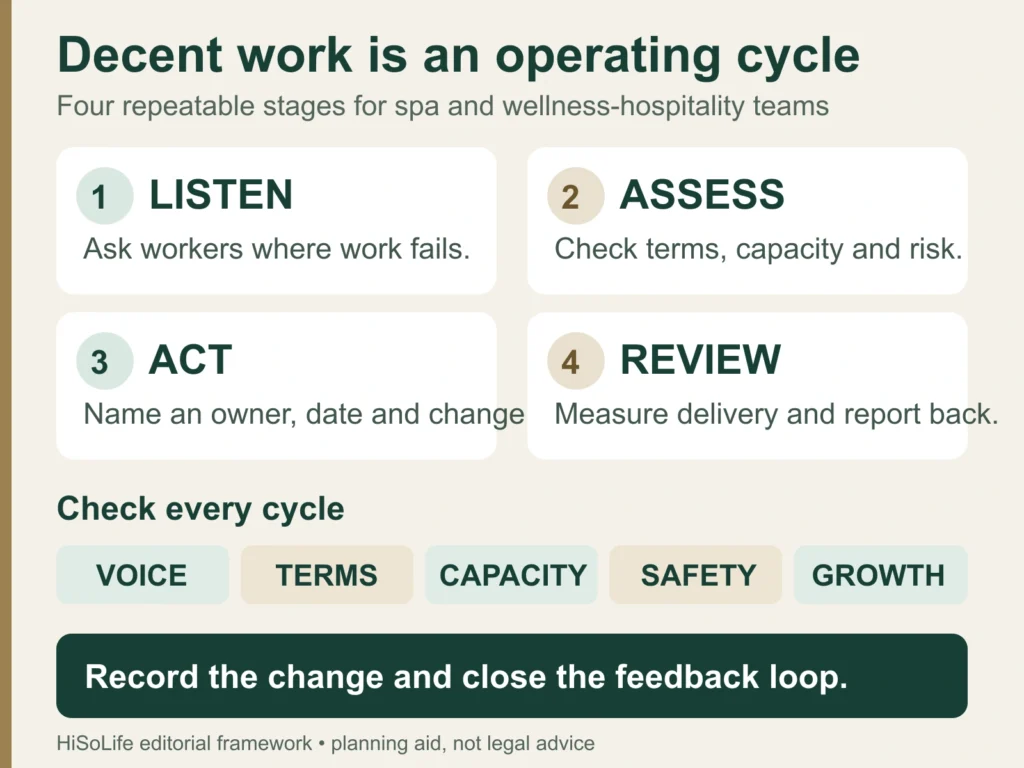
1. Listen
Collect evidence from workers, schedules, incident records, exit themes, training delivery and candidate questions. Include different contract types and shifts. Distinguish an isolated preference from a repeated system failure without dismissing either.
2. Assess
Review the five workplace checks: voice, terms, capacity, safety and growth. Note the affected roles, the evidence available and what must be verified locally. Prioritize immediate risk and repeated failure over the easiest cosmetic change.
3. Act
Give each action an owner, a date and a visible result. “Improve communication” is not an action. “Publish the revised break escalation route, brief all shift leads and test it for four weeks” can be checked.
4. Review
Measure whether the change happened and whether it helped. Ask workers what remained difficult. Keep, revise or stop the intervention based on evidence, then explain the decision. Review is where trust is either strengthened or lost.
A practical decent-work checklist for spa employers
- Worker voice: reporting routes, response times and escalation contacts are clear.
- Terms: guaranteed and variable compensation, hours, benefits and deductions are separated.
- Workload: the rota includes preparation, cleaning, notes, breaks and transition time.
- Safety: staff can stop unsafe work and know how inappropriate client behaviour is handled.
- Competence: assigned services match verified skills, supervision and local requirements.
- Learning: protected training time and mentor capacity appear in the schedule.
- Fair opportunity: progression criteria and access to specialist work are visible.
- Action ownership: every unresolved issue has an owner, date and feedback route.
Use the checklist as a discussion aid, not a pass/fail legal test. An item may need evidence from payroll, a safety adviser, the booking system, a worker representative or a training provider. Record the source and avoid marking an issue complete because a policy exists.
For a first review, choose one service team and four weeks of evidence. Fix urgent risks immediately, then select two or three system changes that can be implemented and reviewed properly. A smaller completed cycle is more credible than a large action plan with no owners.
What candidates should verify
Ask for the written compensation structure, expected schedule and principal duties. Clarify which parts of pay are guaranteed, how variable amounts are calculated and when they are paid. Ask about training, supervision, breaks, client-conduct procedures and the process for raising a concern.
For an international role, verify the employer, workplace, recruiter, contract, immigration route and local professional requirements independently. Do not rely on a message that promises guaranteed approval or asks you to conceal the real job. Keep copies of the advert, offer and material correspondence.
Compare roles using the conditions behind the headline. HiSoLife’s current wellness job listings can help candidates explore options, but every candidate should confirm the final terms directly. Similar titles can hide very different schedules, variable-pay rules and support.
A credible employer should be able to explain who supervises the role and what happens when capacity is exceeded. An answer does not need to describe a perfect workplace; it should show a real process. Evasiveness about pay, deductions, documents or the actual work is a reason to pause and verify.
Measure practice, not promises
Choose a small set of operating measures that managers and workers can interpret. Examples include planned breaks delivered, overtime patterns, training hours completed, unresolved safety actions, response time to concerns, early turnover and the share of vacancies with complete pay information. These are suggested measures, not published universal benchmarks.
Segment the data carefully. One average may conceal that weekend staff, contractors or one treatment team experience a different system. Protect privacy and avoid publishing tiny groups that make individuals identifiable. Pair numerical trends with structured worker feedback.
Do not reward managers for lower incident or complaint counts without checking reporting confidence. A sudden drop can mean improvement, under-reporting or both. Review the process: did workers know where to report, did the employer respond, and did a repeated risk change?
Report back to the team in plain language. State what was measured, what changed and what will happen next. Where a proposal was rejected, explain the operational or legal reason rather than leaving people to assume that feedback disappeared.
Keep a global framework locally accountable
The ILO materials are global resources designed for adaptation. A spa group can use the same five checks across countries while keeping local decisions local. Each property should verify its employment rules, worker-representation structures, professional requirements, insurance, safety obligations and available remedies.
A central office can define evidence standards and minimum questions without inventing one universal contract or treatment limit. Local teams can document which rule, agreement or operational condition shaped the answer. That creates comparability without erasing important differences.
If a spa needs recruitment support after fixing the role design, HiSoLife’s wellness recruitment services can help frame the hiring requirement. Recruitment should follow the operating review, not substitute for it. A vacancy is easier to fill honestly when the employer can explain workload, terms, support and progression.
Frequently asked questions
What does decent work mean for a spa?
In practical employer terms, it means designing work so people receive clear terms, can perform within realistic capacity, have credible safety and reporting routes, can develop their skills and have a voice in improvements. The exact legal requirements must be checked in the workplace’s jurisdiction.
Is this checklist a legal compliance audit?
No. It is an editorial planning framework based on international and sector sources. Use it to organize evidence and questions, then involve qualified local advisers, worker representatives and relevant authorities where a legal or contractual determination is needed.
How often should a spa review decent-work practices?
There is no universal interval in this guide. Review after material changes such as a new compensation model, service menu, booking system or recruitment channel, and set a regular cycle that the business can complete. Urgent safety or conduct concerns should not wait for the scheduled review.
Can better workplace practices solve every staffing shortage?
No. Labour supply, location, qualifications and market conditions also matter. Better work design can remove avoidable friction, improve the credibility of an offer and help an employer understand whether the shortage is partly caused by workload, terms, supervision or progression.
Next step: choose one spa team, run the five checks with workers and assign two evidence-backed changes. Employers should be able to show what happened after feedback—not only that a policy was written.