

Spa Apprenticeships in England: A 2026 Funding and Supervision Plan
A spa apprenticeship needs more than a vacancy and a willing learner. It needs a real training role, a supervisor with time to teach, and a budget that survives the first quiet month. England’s updated funding policy makes this a useful moment to review those foundations before advertising.
This guide is for spa owners, beauty employers and candidates considering an apprenticeship in England. The funding information is specific to England; the planning framework can inform conversations elsewhere, but it does not establish eligibility, licensing or employment rights in another country. The operational examples below are HiSoLife’s suggested practices, not measured industry results.

Why review spa apprenticeships now?
The government’s apprenticeship funding policy, updated on 29 July 2026, covers new starts from 1 August 2026. Eligible training and assessment costs, within the funding cap, are fully funded for apprentices aged 16–24 at non-levy employers and levy employers with insufficient funds. For those aged 25 or over, the respective government contributions are 95% and 75%. Eligibility conditions still apply.
That is a reason to investigate a training route, not a reason to promise a subsidised vacancy immediately. Start with the job you can teach. A hotel spa, neighbourhood beauty salon and standalone massage business may need different skills, different supervision arrangements and different training partners.
A useful first question is: what should this person be able to do safely and reliably after completing the programme? Write the answer as observable work. Avoid vague outcomes such as becoming more confident or understanding luxury service. Describe the consultation, preparation, communication and technical responsibilities the role actually involves.
Separate training funding from the employment budget
Build two cost lists
Put the provider’s training and assessment quotation in one column. Put wages, paid learning time, supervision, equipment, uniforms and any travel support you offer in another. Ask your provider and payroll adviser which items belong where. Do not treat a training-funding announcement as confirmation that the employment budget has been covered.
The government’s guide to employing an apprentice in England says employers must pay wages, including apprenticeship training time, and provide learning time within the working week. An apprenticeship agreement and a training plan are required. The applicable minimum wage depends on age and apprenticeship stage; check the current rate when preparing the offer.
For a broader compensation conversation, use HiSoLife’s wellness salary guide as context, then establish a locally appropriate offer. Experienced therapist pay is not an apprentice wage benchmark. State guaranteed pay separately from any variable payment, and have payroll check the proposed arrangement before it reaches a candidate.
Test the budget against ordinary disruption
Run a planning exercise with the apprentice away for scheduled learning while the mentor is unavailable for part of a shift. Could you still deliver existing appointments without cancelling training or leaving the learner unsupported? If the answer depends on every employee being present every day, revise the timetable before recruiting.
Keep the first budget conservative about revenue from apprentice-delivered services. Add a named reserve for supervision cover. This is a management suggestion, not a prescribed accounting method: its purpose is to make the commitment visible to the person who approves staffing and to the manager expected to honour it.
Choose a programme that matches the actual job
A spa job title is not enough to identify the right apprenticeship. List the work separately: reception, client consultation, room preparation, beauty services, massage, product advice and booking administration. Then ask a training provider to map the proposed duties to a currently approved programme and its assessment requirements.
Use the government’s apprenticeship training search for employers to investigate available courses and providers. Confirm current availability, delivery location and start dates directly. A page describing an occupation does not by itself establish that a suitable provider can deliver the programme at your workplace.
Request an explanation of any mismatch. For example, a position dominated by reception work may provide too little opportunity to learn the technical skills expected from a treatment-focused route. Equally, a specialist service menu may be narrower than the programme. Resolve the gap through planned experience, a suitable partnership or a different role.
Do not confuse enthusiasm with permission to practise
Before assigning any service, check the programme, competence evidence, insurer’s conditions and applicable local requirements. Ask the provider to clarify uncertainties in writing. Do not assume that enrolment, a previous short course or a general hospitality qualification authorises every treatment on your menu. This guide is not a licensing determination.
Keep a simple list of permitted activities, activities requiring supervision and activities not yet assigned. Make it available to the reception team as well as the learner. A booking decision should follow that list rather than an empty appointment slot or an enthusiastic client request.
Give the mentor time, authority and backup
Choose a mentor who can explain their work and give specific feedback, not simply the therapist with the highest sales. Before accepting the assignment, the mentor should see the proposed timetable, learning objectives and escalation route. Ask what must come off their existing workload to make the arrangement practical.
The Health and Safety Executive’s guidance on training and supervising young workers recommends clear instruction, checking understanding and supervision appropriate to the learner’s needs. It notes that young workers may need closer supervision and regular progress checks. These are British workplace-safety references, not a substitute for local advice elsewhere.
Our suggested spa application is to name a primary mentor and a backup for each learning shift. Give both permission to pause a task when they are unsure about readiness. Agree who can resolve a disagreement between the training plan and the treatment schedule, so the learner is not left negotiating between senior colleagues.
Protect feedback time in the rota. A short, private conversation after a supervised task can focus on what happened, what the learner understood and what to practise next. Record the next action. Avoid turning the conversation into a judgement about personality, confidence or whether someone looks like a typical spa employee.
Advertise a learning role with clear expectations
An apprentice advert should help an inexperienced applicant understand the opportunity. Specify location, working pattern, pay basis, training arrangements, entry criteria confirmed with the provider and how applications are assessed. Explain which abilities are expected at entry and which the programme is designed to develop.
The CIPD’s tools for recruiting young people, published on 8 May 2026, include resources for recruiting school and college leavers and challenging assumptions about young workers. Their relevance here is practical: design an application process that lets a newcomer demonstrate potential without pretending to have an experienced therapist’s history.
For example, invite applicants to describe a time they followed instructions, helped someone or responded to feedback. Accept examples from study, volunteering or previous work where appropriate. Describe the interview format in advance and provide a contact for access needs. Keep scoring tied to the role rather than polish or familiarity with spa terminology.
When the role and provider arrangements are ready, publish a clearly specified wellness vacancy. Avoid describing an opportunity as a confirmed apprenticeship until its arrangements are established. Candidates should be able to distinguish a funded training role from an ordinary junior vacancy with informal coaching.
Use a first-month learning map
The following sequence is an illustrative onboarding framework, not a legal timetable or a promise of treatment readiness. Adapt it with the provider and learner. Progress should depend on demonstrated ability and the agreed programme; reaching the next calendar week should not automatically unlock more complex tasks.
Begin with orientation and boundaries
Introduce the workplace, people and reporting routes. Walk through room preparation, privacy expectations, cleaning instructions and how to ask for help. Explain who makes booking decisions and what the learner should do if a client requests something outside the assigned task. Ask the learner to explain the process back in their own words.
Move from observation to supported practice
Choose a small set of appropriate tasks and demonstrate them clearly. Let the learner practise in the agreed setting with the required supervision. Make feedback specific: the order of preparation, a missed check or the wording used to explain a delay. Correct the process without humiliating the person.
Review readiness before expanding responsibility
At the review, compare evidence with the agreed learning objectives. What can the learner repeat reliably? Where do they still need prompts? What has not been observed? Set the next practice opportunity and supervision level. Keep uncertain activities unassigned until the relevant questions are resolved.
Ask the learner whether the timetable allows them to complete both work and learning commitments. Ask the mentor whether support is taking more time than expected. Adjust capacity when necessary. A revised learning plan is more useful than a positive progress label that conceals cancelled training.
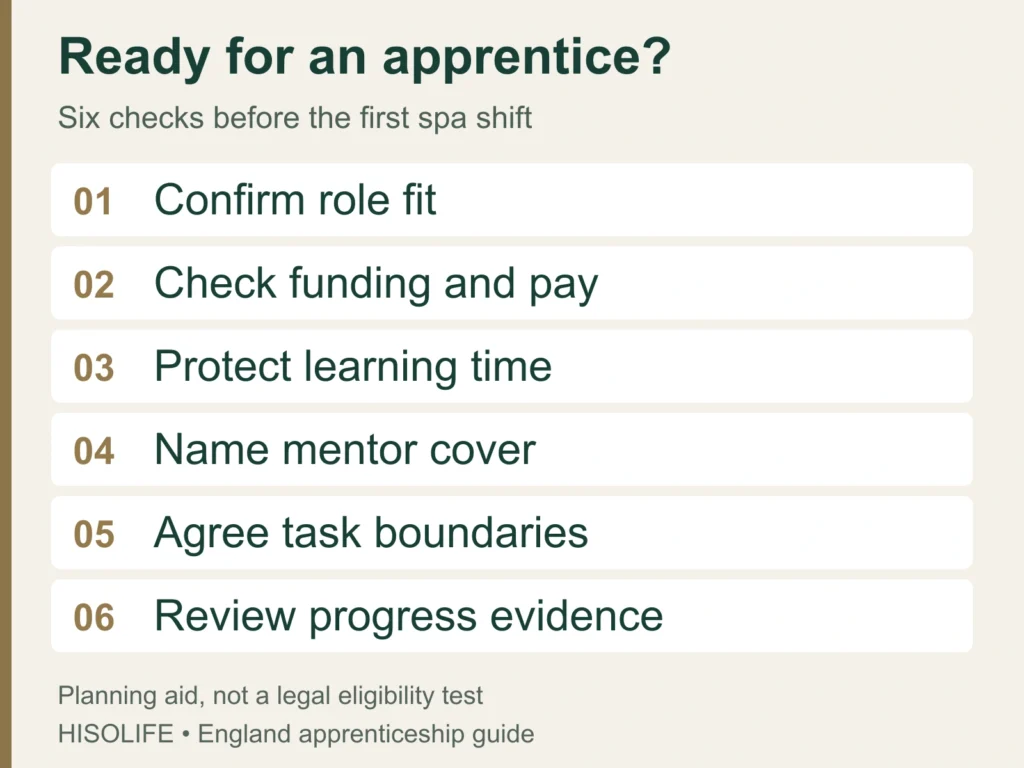
Use a readiness checklist before the first shift
- Role: the actual duties and learning outcomes have been mapped with the provider.
- Funding: eligibility, start date, provider charges and employer contributions have been checked.
- Pay: the offer states pay and hours clearly and has been checked by payroll.
- Time: learning sessions and mentor capacity appear in the working rota.
- Boundaries: permitted tasks, supervision requirements and escalation contacts are documented.
- Support: the learner knows how to ask questions, raise concerns and contact the provider.
- Review: the employer, mentor and learner know when progress will be discussed.
Treat an unanswered checklist item as a task with an owner, not as an administrative inconvenience. The manager might own rota capacity, payroll the wage check, and the provider the programme mapping. Agree a completion date and review the evidence together before making promises about the first shift.
If the business cannot supply a suitable mentor or a workable training schedule, reconsider the start date. It may be more appropriate to recruit an experienced practitioner for the immediate vacancy while developing training capacity separately. HiSoLife’s wellness recruitment services can be a starting point for discussing the hiring requirement; confirm any apprenticeship-provider role separately.
What candidates should ask before accepting
Ask which apprenticeship you will follow, who the provider is and what the normal week looks like. Request a clear explanation of your pay, working hours and learning time. Ask who will supervise you and what happens when that person is absent. Written answers give everyone something concrete to review.
Ask how you will know you are ready for a new task. A useful answer describes demonstration, supervised practice and feedback. A vague promise that you will learn by watching everyone should prompt more questions about the actual training plan, especially where client-facing work is expected early.
Be honest about your experience and support needs without sharing unnecessary personal information. You can prepare a short record of relevant study, work and practical learning before you submit your wellness career resume. Label incomplete training accurately and distinguish observed tasks from tasks you have performed.
When comparing offers, examine the support around the wage as well as the headline amount. Consider travel feasibility, the clarity of the timetable and access to a mentor. Use current wellness job listings to explore alternatives, checking each vacancy’s terms directly rather than assuming similar titles mean similar opportunities.
A planning example: when the mentor is fully booked
Consider a hypothetical boutique spa that wants an apprentice to learn room preparation, guest communication and suitable beauty services. Its proposed mentor already has a full treatment schedule. The owner has identified a provider but has not reserved any time for the mentor to demonstrate tasks or review practice.
In this situation, approving the hire without changing the rota leaves a gap between the advertised opportunity and the support available. A useful planning response is to identify which mentor appointments can be reassigned, which learning activities need direct observation and who provides cover during absence. Ask the provider to check the resulting schedule.
If that arrangement is unaffordable, reduce the planned intake or reconsider when the programme can begin. Do not solve the capacity problem by assuming the apprentice will become independent earlier. Nor should reception quietly book the learner into services that have not been agreed.
The decision record can stay brief: the learning objective, the person supporting it, the time reserved and the evidence needed before responsibilities change. Share it with everyone controlling the diary. This is an illustrative management scenario, not a report about a real spa or a claim that one schedule guarantees retention.
Measure learning without creating a paperwork burden
Start with a short learning record that captures the task, date, supervision and next action. Keep it separate from client-identifying information. The point is to support the next conversation, not to duplicate every provider form or create a second assessment system that nobody has time to maintain.
Our suggested review measures are planned learning delivered, tasks observed successfully, unresolved support needs and mentor capacity. These are local management measures, not published spa-sector benchmarks. Define them consistently and discuss the reasons behind missed sessions instead of converting every exception into a negative score for the apprentice.
Include the mentor’s perspective. Repeated interruptions, absent cover or unclear task boundaries may signal a programme-design problem. Do not judge the learner on outcomes that depended on support the business did not provide. Conversely, discuss attendance and agreed responsibilities directly when support was available but commitments were missed.
Keep England’s rules separate from international hiring
The English funding policy is not an international recruitment or visa scheme. Employers in Thailand or elsewhere should investigate their own training, employment and professional requirements. A UK-linked course description does not establish funding access for an overseas workplace or recognition of a qualification in a different jurisdiction.
For an international spa group, create a separate approval record for each workplace. Ask the local team to confirm the relevant provider, employment terms and permitted activities. Share the operational ideas that travel well, such as protected mentoring time, while keeping jurisdiction-specific eligibility decisions with the people qualified to check them.
Keep the discussion proportionate. You do not need to solve every future career possibility before offering a useful learning role. You do need to describe the current opportunity accurately and avoid promising automatic transfer, overseas recognition or a guaranteed senior position after completion.
Frequently asked questions
Does training funding make an apprentice free to employ?
No. Training support and the employer’s wage responsibilities are separate. Build a complete employment budget, including supervision and learning time, before deciding what the business can afford. Confirm the applicable funding and payroll rules with the provider and payroll adviser.
Can a spa apprenticeship be used to fill an urgent therapist vacancy?
Plan it as a learning role. If the immediate job requires independent skills the learner has not demonstrated, arrange suitable experienced cover. Do not expand assigned duties simply because the appointment book is full.
How quickly should an apprentice work independently?
There is no timetable in this guide. Agree progression with the provider and relevant supervisors, using evidence of competence and the requirements applying to each task. A completed calendar month alone does not demonstrate readiness.
Can a spa outside England rely on this funding information?
No. Treat the England section as jurisdiction-specific information. Elsewhere, verify local funding, employment and professional requirements separately. The suggested checklist can help structure those questions, but it does not determine eligibility.
Next step: employers can turn the readiness checklist into an internal hiring brief; candidates can use it to compare the answers behind an offer. A workable apprenticeship begins when the job, learning plan and support commitments agree.