

Spa Therapist Burnout in 2026: A Practical Retention Playbook
Spa therapist burnout is not solved by asking people to become more resilient while keeping the same overloaded diary. New 2026 industry evidence points spa leaders toward a more practical retention system: design sustainable workloads, protect recovery time, train managers for difficult conversations, clarify professional boundaries and make pay and progression easier to understand.

The need is timely. A July 2026 exploratory survey reported high levels of physical exhaustion, emotional fatigue and burnout or overwhelm among 159 spa, beauty, wellness and therapeutic professionals. It is a small, self-selected sample rather than a global prevalence study, but its signals deserve attention because they map closely to the physical demands and variable schedules documented for massage therapy by official labour data.
This guide translates those signals into actions for spa owners, resort leaders, clinic managers and wellness recruiters. It is an employment and management framework, not medical advice, and it should be adapted to local occupational-safety, employment and licensing requirements.
What the 2026 therapist wellbeing evidence says
The Therapist Well-Being Report coverage describes an anonymous survey of 159 professionals working across spa, beauty, wellness and therapeutic settings in the United Kingdom and international markets. Sixty percent were self-employed or independent practitioners, and more than three quarters had over six years of industry experience.
Among respondents, 89.3% had experienced physical exhaustion from work, 86.8% had experienced emotional fatigue and 72.3% had experienced burnout or overwhelm. At the same time, 99.4% said they had felt fulfilled by their work. That combination matters: the retention risk is not simply that therapists dislike the profession. Many may value the purpose and client connection while finding the way the work is organised difficult to sustain.
The study is best treated as a diagnostic prompt. It does not prove that the same percentages apply to every spa, country or employment model. Managers should use it to ask better questions of their own teams, then compare answers with actual schedule, absence, turnover and exit data.
Four evidence-led questions for spa leaders
- Are treatment volume and physical intensity sustainable across a full week, not just a busy day?
- Do therapists have predictable breaks and enough reset time between demanding appointments?
- Can staff discuss emotional load, inappropriate client behaviour and boundary concerns without being blamed?
- Can every therapist explain how pay, incentives, skills and progression connect?
Why therapist retention is an operating-system issue
Turnover is often discussed as a recruitment problem: advertise more widely, shorten time to hire or build a larger candidate pool. Those actions can help, but repeated vacancies may also be evidence that the job design itself needs attention. A spa can improve sourcing and still lose good people if the daily operating model rewards maximum bookings at the expense of recovery, quality and trust.
The World Health Organization’s mental-health-at-work guidance identifies excessive workloads, understaffing, inflexible hours, low control, limited support, inadequate pay and weak career development as psychosocial risks. WHO recommends organisational interventions that change working conditions, alongside manager training and worker participation. The useful sequence is therefore: assess the work, change avoidable risks, equip managers and then support individuals.
This distinction prevents a common mistake. A meditation app, massage allowance or team social can be welcome, but it cannot compensate for chronic overbooking or unsafe behaviour from clients. Benefits should complement sound work design, not hide its absence.
Design treatment schedules around human capacity
Massage and bodywork are physically demanding. The U.S. Bureau of Labor Statistics occupation profile notes risks from repetitive motion and prolonged standing, recommends good body mechanics and appropriate spacing of sessions, and explains that many therapists cannot perform massage services for eight hours a day, five days a week. That is a strong reason to manage capacity by treatment intensity rather than by room availability alone.
Set volume guardrails by treatment type
Start with a simple intensity map. Ask experienced therapists to rate services by physical load, emotional load, turnaround work and documentation. A 90-minute deep-tissue session should not consume the same capacity allowance as a lighter service simply because both occupy one booking slot. Establish daily and weekly guardrails, then require a manager decision when the diary would exceed them.
Protect transition time and breaks
Build reset time into the service model. Therapists need time to clean and prepare the room, document relevant notes, hydrate, use the bathroom and mentally close one interaction before the next. If every minute between bookings is treated as saleable inventory, delays accumulate and recovery disappears. Track how often breaks are missed, shortened or moved rather than assuming the template works as designed.
Rotate load instead of rewarding endurance
Where skills allow, rotate physically intense treatments with lighter services, consultations, retail education, training or administrative duties. Avoid celebrating the person who repeatedly accepts an unsustainable diary; that can create a silent standard others feel pressured to match. Sustainable productivity is consistent quality over months, not the highest treatment count on one weekend.
Manage emotional labour and professional boundaries
Therapists often listen to clients who are stressed, anxious, in pain or seeking emotional reassurance. Compassion is part of excellent service, but a therapist is not automatically trained or authorised to provide mental-health counselling, medical diagnosis or crisis support. Role clarity protects the client as well as the professional.
Create approved phrases for redirecting conversations, declining requests outside scope and pausing a service when conduct becomes inappropriate. Train reception and managers to support the same boundary so the therapist is not left to defend it alone. Escalation routes should cover harassment, sexualised requests, threats, discrimination, suspected medical risk and acute emotional distress.
The UK Health and Safety Executive’s Management Standards offer a useful, non-diagnostic structure: demands, control, support, relationships, role and change. An international spa can use those six headings to review work design while separately checking the law and guidance that apply in its own jurisdiction.
A boundary-support checklist
- Publish a client conduct policy and explain it before treatment where appropriate.
- Give therapists clear authority to stop a service without losing pay when safety or conduct requires it.
- Provide a discreet way to summon support during a treatment.
- Record incidents consistently and review patterns, not rumours.
- Debrief difficult interactions without demanding personal disclosures.
- Refer clinical or crisis needs to qualified services rather than extending the therapist’s role.
Turn manager check-ins into an early-warning system
A useful check-in is short, regular and connected to action. Ask about workload, recovery, difficult interactions, role clarity, team support and development. Do not ask only “Are you okay?” in a setting where the safest answer feels like “yes.” Use consistent questions and look for changes over time.
Managers should be trained to listen, document agreed workplace actions, preserve confidentiality and know when to involve human resources, occupational health or an emergency service. They should not diagnose. Their immediate responsibility is to respond to work-related risks they can influence and connect the person with qualified support when needed.
Operational signals can reinforce the conversation: missed breaks, repeated late finishes, sudden schedule swaps, treatment-quality complaints, incident reports, absence, overtime, declining training participation and voluntary turnover. None proves burnout on its own. Together, they can show where a closer review is warranted.
Make pay, recognition and career growth visible
Wellbeing cannot be separated from economic security. Pay should reflect the role, local market, skills, schedule and employment model, and incentive formulas should be understandable before a person accepts the job. Employers can use the HiSoLife Wellness Salary Guide 2026 as a starting point for benchmarking, then validate the result against local law and current market evidence.
Publish how commission, tips, service charges, overtime, cancellations, no-shows, training time and product sales are handled. Explain benefits and deductions. A high headline rate can be misleading when unpaid gaps, unpredictable bookings or required costs reduce real earnings. Transparent total compensation helps candidates compare offers and reduces disappointment after joining.
Recognition should be specific and connected to professional value: safe practice, excellent consultation, client retention, mentoring, quality improvement and new competencies. Create visible routes from therapist to senior therapist, trainer, treatment lead, wellness sales specialist or spa manager. The 2026 wellness careers guide can help teams see adjacent roles rather than treating hands-on delivery as the only path forward.
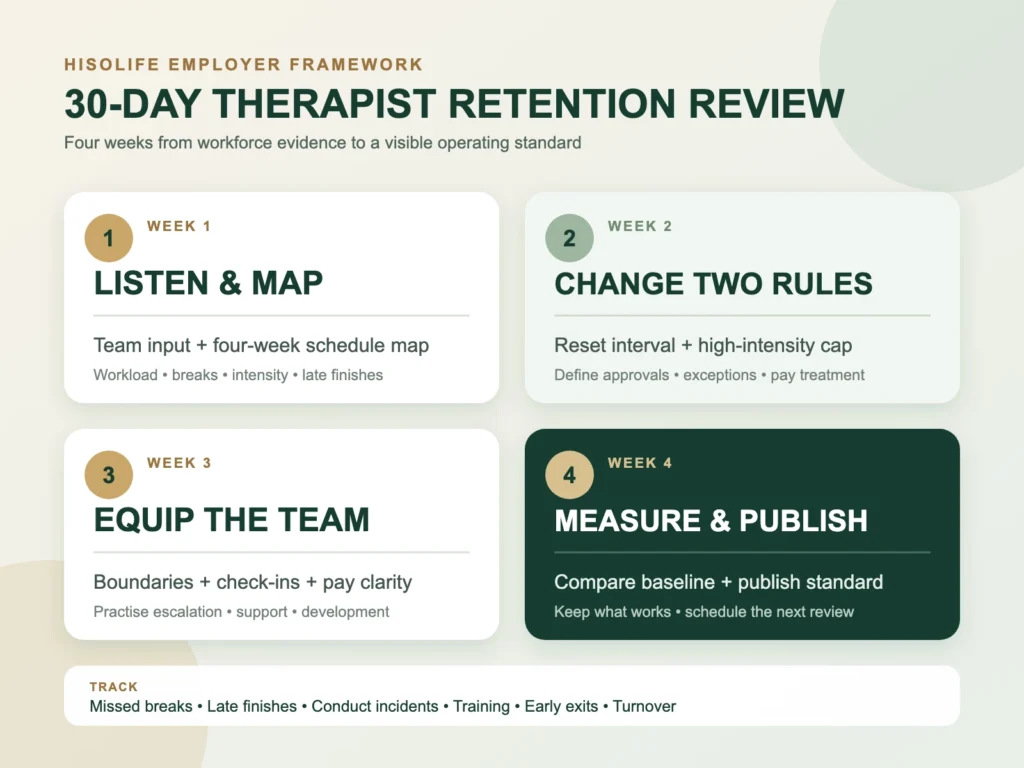
A 30-day therapist retention framework
Do not begin with a large wellbeing campaign. Begin with a controlled review that produces measurable changes. The following four-week sequence is designed for one location or department and can later be expanded.
Week 1: listen and map the work
Invite anonymous and direct feedback using the same six headings: demands, control, support, relationships, role and change. Export four weeks of schedules and identify consecutive treatments, high-intensity clusters, missed breaks, late finishes and short turnarounds. Segment the analysis by shift and treatment type, but protect individual confidentiality.
Week 2: agree two operating changes
Choose no more than two changes that can be implemented reliably: for example, a minimum reset interval and a daily cap on high-intensity treatments. Define exceptions, who approves them and what happens to therapist pay if management blocks a booking for safety or recovery. Communicate the trial to reception, reservations and revenue teams so commercial pressure is not simply shifted elsewhere.
Week 3: equip managers and therapists
Run practical scenarios on client boundaries, scope, incident escalation and supportive check-ins. Review body mechanics and room setup with a qualified trainer. Show staff how compensation, leave, scheduling requests and development opportunities work. If the review reveals a skills gap, use a structured plan rather than assuming the individual lacks commitment.
Week 4: measure, adjust and publish the standard
Compare missed breaks, late finishes, staff feedback and service disruption with the baseline. Keep what improved both therapist sustainability and guest delivery; revise what created unintended bottlenecks. Publish the agreed operating standard and schedule the next review. A one-month trial becomes credible only when the final rules remain visible and managers follow them consistently.
Minimum retention dashboard
- Voluntary turnover and early exits within 90 days.
- Absence, overtime and repeated late finishes.
- Missed-break rate and high-intensity treatments per shift.
- Boundary or conduct incidents and response time.
- Training participation and internal progression.
- Quarterly pulse scores for workload, control, support and intention to stay.
Measure retention without turning wellbeing into surveillance
A retention dashboard is useful only when people trust how it is used. Tell therapists what information is collected, why it matters, who can see it and how long it is kept. Aggregate pulse results whenever possible, restrict access to individual employment or health information and avoid asking managers to collect personal details they do not need. Local privacy and employment rules should shape the final process.
Combine leading and lagging indicators
Turnover is a lagging indicator: by the time it rises, the conditions behind it may have existed for months. Pair it with earlier operational signals such as missed breaks, repeated diary exceptions, incident response time, late finishes and access to development. Add a small number of anonymous questions on workload, control, support and intention to stay. The goal is not to create a perfect wellbeing score; it is to see whether agreed working standards are actually experienced.
Interpret measures together. A drop in treatment volume might reduce overload, but it could also reflect weak demand. A rise in incident reports might indicate worsening behaviour, or it might show that staff finally trust the reporting process. Managers should discuss patterns with therapists before drawing conclusions and record the operating change they intend to test.
Keep health information separate from performance management
Do not infer a diagnosis from a schedule pattern, survey answer or absence record. If a therapist asks for support or an adjustment, follow the applicable confidential process and involve qualified human-resources, occupational-health or clinical professionals as appropriate. A workload review can improve the job for everyone without requiring individuals to disclose private medical information.
Close the feedback loop. Within a set period, publish what the team said in aggregate, what management will change, what it will not change and why, plus the date of the next review. Even a modest change gains credibility when the reasoning is visible. Silence after a survey teaches employees that participation has no practical value.
What candidates should ask before accepting a spa role
Retention begins before the first shift. Candidates should ask how many treatments are normally scheduled per day, how physical intensity is managed, whether breaks are protected, how cancellations affect pay and what happens after an inappropriate client interaction. Request the complete compensation structure and clarify whether training, setup and administrative time are paid.
Ask to meet the direct manager and, where possible, a current team member. Look for specific answers rather than broad claims about being “a family.” Candidates can browse current wellness jobs and compare role descriptions, then submit a professional profile to HiSoLife when ready to be considered for suitable opportunities.
How to recruit without repeating the same retention problem
A vacancy is an opportunity to redesign the role. Before posting, compare the job description with what the previous person actually did, how the diary operated and why they left. Use the complete spa therapist hiring checklist to assess technical ability, consultation, safety and service judgement, then explain workload and boundaries with the same care used to explain guest standards.
Employers ready to hire can publish a clear wellness vacancy or discuss a structured search through HiSoLife’s wellness recruitment service. The strongest offer is not the one with the most wellbeing language. It is the one whose schedule, management and compensation make that language believable.
Conclusion: retain the purpose, redesign the pressure
The 2026 survey is a warning signal, not a universal diagnosis. Its most useful message is that fulfilment and strain can exist together. Spa leaders do not need to remove every difficult day, but they should stop treating avoidable overload as proof of professionalism.
Start with the work itself: treatment intensity, reset time, control, support, boundaries, pay and progression. Measure whether the changes are followed. When therapists can deliver excellent care without sacrificing their own sustainability, retention becomes a property of the operating model rather than a last-minute recruitment target.
Frequently asked questions
Does the 2026 survey prove that most spa therapists are burned out?
No. It was an exploratory, anonymous survey of 159 respondents and was not presented as a representative global prevalence study. Its findings are useful signals that employers should test against their own workforce data.
What should a spa manager change first?
Review actual schedules. Measure missed breaks, turnaround time and clusters of physically intense treatments, then trial one or two clear workload guardrails with therapist input.
Are resilience and self-care programmes enough?
No. They may support individuals, but WHO recommends organisational interventions that assess and change workplace risks. Sustainable schedules, role clarity, support and safe conduct procedures come first.
How can a candidate assess therapist wellbeing before accepting a job?
Ask for normal treatment volume, break rules, compensation details, schedule predictability, boundary procedures and examples of staff development. Specific operational answers are more useful than generic culture claims.
Principal sources
This article synthesises the July 2026 therapist wellbeing coverage, the World Health Organization’s workplace guidance, the U.S. Bureau of Labor Statistics massage-therapist profile and the International SPA Association’s 2026 U.S. spa employment benchmark. Statistics are attributed to their original scope and should not be generalised beyond it.