
How to Run a Spa Hiring Event: A Candidate-Safe 2026 Checklist
A spa hiring event can shorten the distance between a vacancy and a useful conversation. It can also magnify every weak point in a recruitment process. If roles are vague, assessors improvise, applicants wait without information or documents are collected casually, moving faster simply creates faster confusion.
A current employer example shows what candidates increasingly expect to know before they arrive. A Disneyland Resort spa hiring-event listing published on 29 September 2026 names the roles in scope, gives two event dates and times, welcomes qualified walk-ins, encourages advance applications and offers a virtual-interview route for people who cannot attend. That is a useful design signal, not a universal template or endorsement of one employer.
This guide turns that signal into a candidate-safe system for spas of different sizes. The aim is not to hire in one room at any cost. It is to create a transparent route from invitation to evidence, decision and follow-up while protecting service standards, privacy and fairness.
Why spa hiring events need a stronger operating plan in 2026
Workforce pressure remains real. In its August 2026 U.S. spa staffing summary, the International SPA Association reported that 61% of surveyed spas were trying to fill unstaffed service-provider positions, including 64% of resort and hotel spas and 56% of day spas. The same source advises leaders to connect staffing decisions with utilization, denied bookings, peak-period gaps, retention and team energy.
Those figures describe participating U.S. businesses; they are not a global vacancy rate. They do, however, illustrate why a crowded hiring day cannot be judged only by attendance or offers. A spa still needs to know which work is uncovered, what evidence predicts safe performance and whether the job itself is attractive and sustainable.
The broader hospitality lesson is similar. A September 2026 ILO analysis of tourism jobs and skills notes that shortages may reflect working conditions, seasonal or temporary work, career prospects and access to training, not merely too few available people. Before advertising an event, review the role, schedule, pay logic and development path. HiSoLife’s decent-work checklist for spa hospitality is a practical companion for that review.
First decide whether an event is the right hiring format
A hiring event is a delivery format, not a workforce strategy. Use it when several genuine openings share a location, timing or assessment pathway; when qualified assessors can be present; and when the business can give candidates a clear next step soon afterward. It can work for massage therapists, estheticians, nail technicians, fitness staff, reception teams or a mixed opening, provided each role remains distinct.
Good reasons to use an event
- You have approved vacancies, defined working patterns and a realistic start window.
- Candidates benefit from meeting both recruitment and operational leaders.
- A short, job-related work sample can be observed safely and consistently.
- The event removes delays without removing review, reference or qualification checks.
Reasons to pause or choose another route
Do not stage an event to “build a database” when there is no clear opportunity, to create artificial urgency, or to replace an unresolved decision about headcount. If only one specialist vacancy exists, a scheduled interview may be more respectful. If managers disagree about duties, pay or supervision, resolve that before inviting applicants.
Start with demand evidence: unfilled appointment hours, waiting lists, denied bookings, recurring overtime, seasonal peaks and skills that the current team cannot safely cover. Then compare recruitment with scheduling, service-menu and retention options. HiSoLife’s spa skills-audit framework helps separate a true hiring need from a training, process or job-design issue.
Create one role card as the source of truth
Every public message, recruiter briefing and scoring sheet should come from the same role card. Record the job title, employment or contractor status, location, reporting line, working pattern, essential duties, physical and interpersonal demands, required credentials, language needs, pay information where available, benefits, probation or onboarding process and realistic start date.
Separate “required on day one” from “can be learned with support.” A massage qualification, legally required registration or demonstrated hygiene practice may be essential. Familiarity with one booking system may be trainable. Treating every preference as mandatory shrinks the pool and makes scoring inconsistent.
Publish enough detail for applicants to self-select. Employers can compare the offer with the 2026 wellness salary guide, then use descriptive language when they publish a spa or wellness vacancy. Never promise earnings, visas, accommodation, licensing outcomes or promotion unless the organization can substantiate the exact commitment.
Design the candidate journey before promoting the event
Map the journey from the first advert to the final retention or deletion of records. A simple event may have seven stages: information, application, eligibility review, invitation, check-in, assessment and decision. Assign an owner, an expected duration and a communication for each stage.
Before arrival
Tell candidates which roles are open, whether an appointment is required, what the day can and cannot include, how long attendance may take, what documents to bring, whether copies are needed, how to request an adjustment, what travel or parking information matters and whether a remote alternative exists. If walk-ins are accepted, explain that attendance does not guarantee an interview or offer.
The current Tenaya Stone Spa listing is specific on these points: it identifies part-time role families, encourages advance applications, says computers will be available on site, warns that attendance may take up to three hours and offers a virtual route for people who cannot attend. A smaller spa can adopt the clarity without copying the scale or branding.
During the event
Use a visible welcome point, a private place for interviews, a separate waiting area and a secure document process. Give each candidate the same short orientation: sequence, approximate wait, people involved, assessment method, data handling and next step. Provide water, restrooms and a named contact for practical problems.
After the event
State when candidates will hear back and through which channel. Send a closure message even when there is no offer. If further checks are required, describe them rather than implying that an on-site conversation completed the hiring process. Keep reserve-list consent separate from the current application.
Make the application path accessible and usable
A candidate-safe event begins online. The World Wide Web Consortium’s practical web-accessibility checks emphasize keyboard access, associated labels, clear required-field instructions and specific, findable error messages for forms. Test the event page and application without a mouse, at high zoom and on a phone. Make sure a candidate does not lose completed fields after one error.
Offer a contact route for applicants who need an alternative format or adjustment. Do not require people to disclose a diagnosis in a public queue. The practical question is what enables participation in the application or assessment. Local requirements differ, so employers should obtain jurisdiction-specific advice rather than treating this article as legal guidance.
Accessibility also means operational choice. An applicant may be qualified but unable to attend one five-hour window because of work, caring responsibilities, disability, distance or religious observance. A scheduled interview, video call or later assessment preserves access without lowering the role standard.
Use structured evidence instead of speed hiring
Prepare one scoring rubric per role before reviewing candidates. Limit it to evidence that matters: verified eligibility where appropriate, role-relevant technical knowledge, hygiene and safety judgment, communication, ethical boundaries, teamwork, service recovery and learning readiness. Weight only what the job actually requires.
Build a proportionate work sample
A receptionist might prioritize a fictional booking conflict. A supervisor candidate might allocate a short peak-period rota. A therapist could explain consultation, contraindication and escalation steps using a written scenario. Avoid asking applicants to provide unpaid services to guests or to perform an invasive, undignified or unsafe demonstration. Use trained models only when a lawful, necessary practical assessment is designed with consent, hygiene, privacy and insurance in place.
Give the same core prompt, time and evaluation criteria to candidates for the same role. Assessors should record observed evidence, not personality labels such as “good energy” or “not our type.” HiSoLife’s human-oversight checklist for AI-assisted hiring also applies if software helps sort applications or summarize notes: people remain accountable for the decision.
Protect privacy and keep questions proportionate
Collect only the information needed at each stage. A greeter normally needs a name, role and appointment status—not a full identity file. Store qualification, identity and work-permission evidence away from public sign-in sheets. Restrict access, define a retention period and record who can export or delete candidate data.
Interview questions should test the work, not invite unrelated personal disclosure. As one jurisdiction-specific example, the U.S. Equal Employment Opportunity Commission’s pre-employment guidance says employers generally cannot ask disability-related questions or require medical examinations before a conditional offer, while limited accommodation questions may be permitted in defined circumstances. Employers elsewhere must apply their own laws and obtain advice when needed.
Create an escalation route for a candidate who experiences harassment, pressure, a privacy breach or an unsafe assessment. The ILO’s August 2026 hospitality due-diligence initiative groups fair recruitment with non-discrimination, occupational safety and health, working conditions, prevention of violence and harassment, and effective grievance mechanisms. That is a useful control map even though the initiative is being developed for Uganda and does not replace local law.
Put fair-recruitment boundaries in writing
No candidate should have to buy access to the event or an offer. The ILO’s fair-recruitment principles and operational guidance state that workers should not be charged, directly or indirectly, recruitment fees or related costs. Check how national law applies, especially when agencies, training providers, travel, migration or document services are involved.
Tell external recruiters in writing which roles they may represent, which statements they may make, who pays authorized costs and which subcontractors are prohibited. Require candidates to receive accurate job and working-condition information. For international recruitment, use the skills-recognition and candidate-safety checklist before requesting travel or original documents.
Do not hold passports, certificates or personal devices as security. Inspect originals only when necessary, document the check and return them promptly. If an applicant reports a fee or misleading promise, pause that pathway, preserve evidence and investigate before progressing more candidates through it.
Train the event team and control the flow
Name an event lead, candidate-care contact, check-in owner, document verifier, assessors and a final decision owner. One person should monitor waits and move resources before queues become pressure. Another should be free to handle adjustments or complaints without forcing the applicant to explain the issue to every station.
Brief assessors on the role card, rubric, permitted questions, conflicts of interest, note quality and decision process. Run a calibration example together. If two assessors interpret one criterion differently, resolve that before candidates arrive. A short rehearsal often reveals missing rooms, ambiguous instructions, insecure paperwork or an unrealistic schedule.
Build a timed run sheet with recovery space
Estimate the capacity of each station rather than the capacity of the venue. Twenty people can check in quickly, but two assessors may still create a long interview queue. Model booked candidates, expected walk-ins, breaks, room changes and time to reset any practical-assessment space. Add a stop rule for the point at which new arrivals must be offered another appointment.
The run sheet should include short recovery blocks. They give assessors time to finish evidence notes before meeting the next person and reduce the temptation to score from memory at the end of the day. If the event falls behind, communicate the revised wait honestly, let candidates step out without losing their place where feasible, and record the bottleneck for the next event. Candidate care is part of operational quality, not a decorative hospitality gesture.
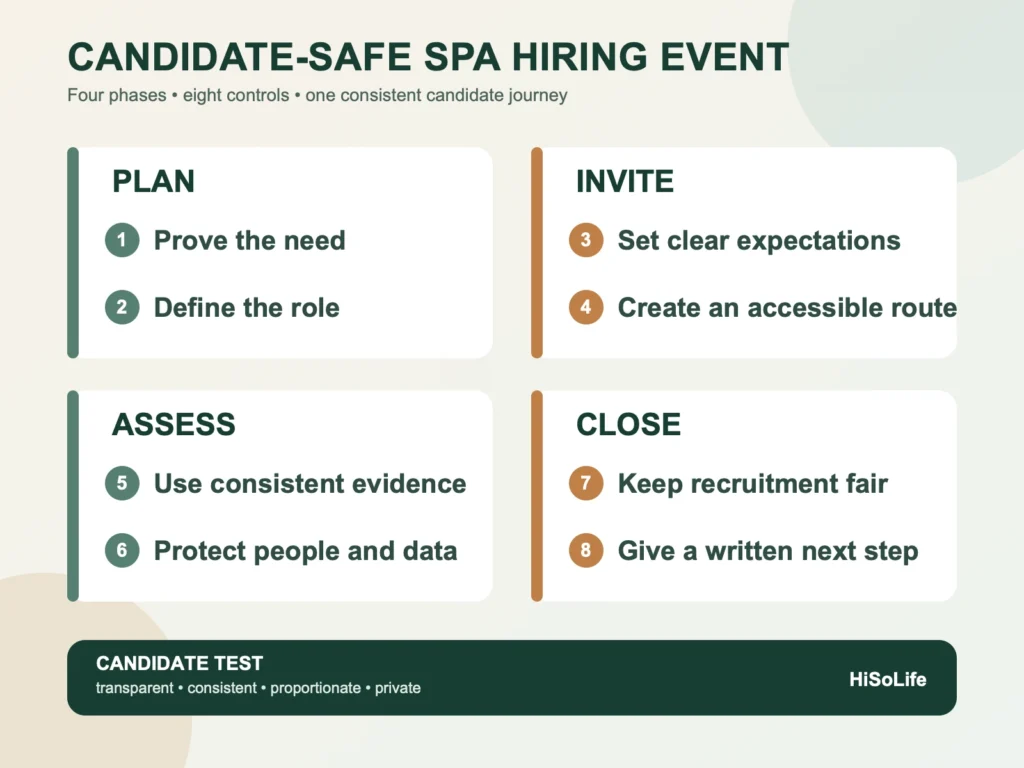
Candidate-safe spa hiring event checklist
- Need: approved openings are tied to demand, workload and supervision evidence.
- Role: duties, status, schedule, location, pay logic and required credentials are consistent.
- Invitation: eligibility, duration, documents, access, costs and next steps are clear.
- Access: the form works by keyboard and phone; an adjustment contact and alternative route exist.
- Assessment: one role-based rubric and proportionate work sample are ready.
- People: trained assessors, candidate care and final decision ownership are assigned.
- Privacy: check-in data, interview notes and verification documents are separated and secured.
- Fairness: no candidate-paid recruitment fee, document retention or unverified promise is allowed.
- Safety: demonstrations, equipment, consent, hygiene and incident escalation are controlled.
- Closure: every attendee receives the promised next step or rejection update.
The visual below groups the checklist into four event phases so the team can brief, run and review the same candidate journey.
Close the loop with disciplined decisions
Run a same-day evidence review
Assessors should submit scores before a group discussion so a confident voice does not rewrite everyone’s memory. Compare evidence against the pre-agreed standard. Investigate large scoring differences, document any follow-up and separate “not yet verified” from “failed.” References, licences, work permission and other checks still need their proper process.
Send conditional language when the decision is conditional. Include role, location, schedule, pay, conditions, expected start process and a real contact. Give candidates reasonable time to review. For unsuccessful applicants, a concise and respectful message is better than silence; provide specific feedback only when the organization can do so consistently and safely.
Measure event quality, not just offer volume
Track registrations, attendance, qualified interviews, completed assessments, time spent waiting, adjustment requests fulfilled, offers, acceptances and starts. Also review early withdrawals, candidate questions, complaints, source quality and new-hire retention at locally chosen intervals. Do not copy another employer’s target without understanding its roles and market.
Segment carefully. A low conversion rate may mean broad promotion reached the wrong audience; it may also mean the event gave people enough information to decline an unsuitable job. A high on-the-day offer rate is not automatically good if later checks fail or new hires leave quickly. Look for a credible chain from accurate invitation to sustainable start.
Employers ready to widen a properly defined search can review available spa and wellness candidates or request specialist wellness recruitment support. Candidates can compare opportunities through current wellness job listings and submit a wellness resume without treating attendance at one event as their only route.
Frequently asked questions
Should a spa make offers during the hiring event?
Only when the role, assessment and approval process genuinely support it. A conditional offer may be appropriate after consistent evidence review, but it should clearly state outstanding checks. Never use an expiring same-day offer to prevent a candidate from reading the terms or asking questions.
Can walk-ins and pre-booked candidates be assessed together?
Yes, if both groups receive the same role information, core assessment, privacy protections and decision standard. Use separate queue logic rather than lowering the rubric for one group. Tell walk-ins when capacity is limited and offer a later or remote route when possible.
What documents should candidates bring?
Ask only for what is necessary at that stage and explain whether originals or copies are needed. Requirements may include a resume, portfolio or role-relevant qualification evidence. Identity, licensing and work-permission checks depend on the role and jurisdiction; do not collect documents casually or retain originals.
How soon should candidates receive an update?
Set a deadline the team can meet and state it before the interview. Faster is helpful, but reliability matters more than an invented universal number. If the decision is delayed, send a short update with the revised date rather than leaving candidates to guess.