
Spa Skills Audits in 2026: A Training-Needs Framework
A spa can have a full rota and still have a skills problem. A therapist may be technically strong but uncertain with consultation records. A receptionist may be excellent with guests but unable to resolve a booking-system exception. A supervisor may know every service yet lack a consistent way to coach a new employee. These are different gaps, and each needs a different response.
New hospitality workforce evidence gives spa leaders a useful reason to review how they diagnose those gaps. An International Labour Organization assessment of Kosovo’s hospitality training system, published in August 2026 and discussed publicly in September, found that qualifications and programmes did not always reflect evolving industry needs. The report highlighted customer service, digital, green and entrepreneurial skills, work-based learning, employer involvement and better labour-market information. It is a country-specific study, not a universal scorecard, but its questions travel well.
This guide turns those questions into a practical spa skills audit. The aim is not to rate people for the sake of producing a spreadsheet. It is to identify the capabilities the operation needs, compare them with observable evidence, choose between training, redesign and recruitment, and then check whether the response improved work. Used well, an audit can strengthen hiring, internal mobility and retention without turning development into surveillance.
Why spa skills audits matter in 2026
Spa work now sits at the intersection of hands-on technique, hospitality, safety, digital administration and resource management. A guest journey can involve an online booking, a consultation, service adaptation, room preparation, a treatment, retail advice, payment and follow-up. The service feels seamless only when people can handle both their own tasks and the handovers between roles.
The ILO’s September 2026 account of hospitality skills needs in Kosovo calls for more flexible qualifications and curricula, greater attention to customer service, digital, green and entrepreneurial capabilities, and stronger employer participation. It also notes uneven work-based learning and weak graduate tracking. A spa cannot solve a national training-system problem, but it can avoid reproducing the same weaknesses inside one workplace.
A separate ILO article on tourism jobs and skills across the Mediterranean, published on 25 September 2026, links recruitment pressure not only to worker supply but also to working conditions, seasonal or temporary employment, career prospects and training access. That distinction matters. If the root problem is workload or an unattractive schedule, labelling it a “skills shortage” may lead to unnecessary recruitment while the real cause remains.
Start by separating four different workforce problems
Before collecting scores, define the problem. A skill gap exists when a person in a role does not yet demonstrate a capability required for current work. A skill shortage exists when the organisation cannot recruit enough people with a required capability. A process gap exists when tools, instructions, staffing or handovers make good performance difficult. A job-quality problem exists when pay, hours, workload, supervision or progression make a role hard to fill or keep.
These categories overlap, but they are not interchangeable. A therapist who misses a room reset step may need coaching; the same error across the whole team may point to an unrealistic turnaround time. Repeated booking mistakes may indicate training, or they may reflect unclear system permissions. High turnover among capable staff is not evidence that the remaining team needs more training.
Write the operating question in neutral terms: “Which capabilities are required for safe, consistent delivery of this service?” is more useful than “Who is underperforming?” Review the related decent-work checklist for spa hospitality when evidence points to job design rather than competence.
Build a spa skills map before evaluating anyone
A skills map connects capabilities to real work. Begin with services and guest journeys, not generic traits such as “good attitude.” List the moments where quality, safety, revenue or trust can fail. Then describe what a trained person should be able to do and what acceptable evidence would look like.
Technical and service-delivery capabilities
Map only the techniques that belong to the person’s assigned role and local scope of practice. Evidence might include a supervised demonstration, a case discussion, a consultation-record review or a documented qualification check. Do not treat one certificate as proof of every technique, and do not ask a person to demonstrate on a guest without the appropriate consent, supervision and safeguards.
Guest, communication and inclusion capabilities
Include consultation, expectation-setting, language support, privacy, boundaries, complaint recovery and communication across cultures. These are observable behaviours, not personality labels. A useful standard describes the action: for example, “explains the service and confirms informed agreement in clear language” rather than “has natural warmth.”
Digital, commercial and operational capabilities
Booking platforms, client records, stock controls, scheduling and payment workflows are part of modern service delivery. Test the actual task in a safe training environment: reschedule without losing notes, identify a stock exception, record an approved service adjustment, or hand over a maintenance issue. Avoid collecting live guest data merely to run an assessment.
Green and resource-management capabilities
The ILO’s July 2026 green-skills programme note frames skills as part of a just transition that should support productivity and decent work. For a spa, translate that broad direction into relevant practices: correct linen loads, product portioning, waste separation, energy-aware room routines and accurate reporting of leaks or equipment faults. Do not add environmental duties that conflict with hygiene, manufacturer instructions or local rules.
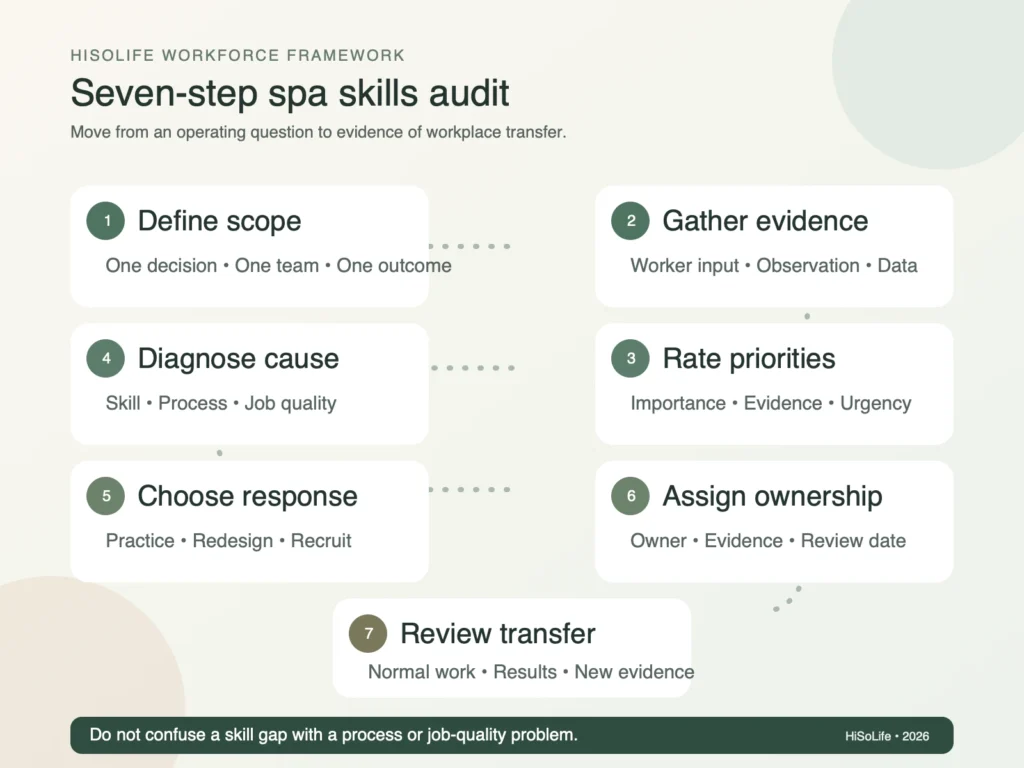
Use the seven-step HiSoLife skills-audit framework
1. Define the decision and scope
Choose one decision: redesign induction, plan quarterly training, specify a vacancy, prepare a new service or build a supervisor pipeline. Limit the first audit to a team, role family or guest journey. A small, well-evidenced audit is more actionable than a property-wide survey that mixes unrelated jobs.
2. Gather evidence from more than one viewpoint
Combine manager observations with worker self-assessment, service data, guest-feedback themes and process records. The ILO’s guide to establishment skills surveys explains that recurring employer surveys can identify skills needs and potential bottlenecks and can inform training, career guidance and human-resource strategy. At workplace scale, the same principle means asking consistently and repeating the exercise, not copying a national survey.
Invite workers to identify where they lack practice, feedback or equipment. Ask supervisors which errors repeat and which tasks depend on one expert. Review complaints for patterns, but do not infer a training need from a single emotional comment. When possible, confirm an issue through at least two evidence types.
3. Rate importance, evidence and urgency separately
Use a simple one-to-four scale for each dimension. Importance measures the consequence if the capability is absent. Evidence measures how confidently the current level is known. Urgency measures how soon the capability will be used. Keeping these dimensions separate prevents a low-evidence assumption from becoming an emergency.
A high-importance, low-evidence item calls for verification first. A high-importance, well-evidenced gap may justify supervised practice before independent work. A lower-importance future skill may fit a development plan. Record the reason for each rating in plain language so another manager can understand it.
4. Diagnose the cause before choosing training
Ask five questions: Was the expectation clear? Was there a chance to learn and practise? Were the tools and time adequate? Was feedback specific and timely? Does the job reward the desired behaviour? If the answer to any of these is no, training alone may not fix the result.
The ILO’s September 2026 Kenya tourism skills assessment used employer surveys, interviews, focus groups, institutional engagement and workplace observation. It found that constraints differed by place and included weak training-industry links and poorly supervised placements. For spa leaders, the transferable lesson is methodological: triangulate evidence and expect different causes across teams or locations.
5. Choose the smallest effective response
Match the intervention to the cause. Options include a demonstration and observed practice, a buddy shift, a clearer procedure, different system permissions, a job aid, schedule redesign, external certification, recruitment or a role boundary. Do not default to a long course when a ten-minute process correction is enough. Conversely, do not use a checklist where competence requires supervised practice and judgement.
6. Assign an owner, evidence standard and review date
Every action needs a responsible person, a realistic completion date and an agreed form of evidence. “Attend product training” records participation; “selects the correct approved product and explains the choice in three supervised scenarios” tests application. Keep evidence proportionate and avoid collecting personal information that is not necessary.
7. Recheck performance and update the map
Review whether people can use the skill during normal work and whether the operating result changed. A successful session with no workplace transfer is not a closed gap. Update the skills map when services, systems, equipment, staffing or regulations change. Quarterly review is a useful management rhythm, but high-risk or rapidly changing tasks may need earlier checks.
Turn audit evidence into better recruitment
A skills audit should improve the vacancy, not create an impossible wish list. Separate capabilities required on day one from those that can be learned during induction and those needed only for progression. This widens the credible candidate pool and prevents employers from rejecting people who could become effective quickly with structured support.
Use descriptive requirements: “complete a consultation and document agreed adjustments” is stronger than “excellent communication.” State the expected schedule, service mix, supervision and development offer. If evidence shows a genuine gap that cannot be built internally in time, publish a clearly specified wellness vacancy or review available spa and wellness candidates. Verification of qualifications, identity, work rights and references remains a separate hiring control.
For international hiring, compare training content and observed competence instead of relying on a familiar certificate name. HiSoLife’s skills-recognition and candidate-safety checklist offers a complementary workflow. Never promise licensing, immigration or job outcomes on the basis of a skills audit.
Make work-based learning safe and useful
Work-based learning is not simply putting a new person on the rota beside an experienced colleague. Define the learning objective, select a competent supervisor, protect the guest experience, provide practice time and agree how feedback will be recorded. The Kosovo assessment specifically examines the availability and effectiveness of work-based learning and the quality of practical training infrastructure.
Use a progression such as observe, explain, practise in a controlled setting, perform under direct supervision, then demonstrate consistent independent performance. A learner should know who can stop the activity and how to raise a concern. Supervisors also need time and recognition; otherwise coaching becomes invisible extra work and quality varies by shift.
For apprentices, interns or early-career staff, connect each placement activity to a defined outcome. The existing HiSoLife spa apprenticeship supervision plan shows how structured duties, supervisor capacity and evidence can be planned. Adapt the principle to local employment, education and safeguarding requirements.
A lightweight audit for a small spa
A small operation does not need specialist software. Use one table with rows for ten to fifteen essential capabilities and columns for role, required level, current evidence, gap cause, action, owner and review date. Keep individual results access-controlled. Share team-level priorities openly, but do not expose personal ratings.
Run a 45-minute evidence meeting. Spend ten minutes confirming upcoming operational changes, fifteen reviewing recurring service and process signals, ten hearing worker development needs and ten agreeing no more than three priorities. Capture unresolved assumptions as questions, not deficits.
Choose one quick correction, one supervised learning action and one longer-term workforce action. For example: clarify a room-reset visual guide this week, schedule two coached booking-system scenarios this month, and rewrite the next vacancy around the genuinely scarce capability. This balance keeps the audit connected to work.
Protect fairness, privacy and worker voice
Tell staff why the audit is happening, which information will be collected, who will see it and how decisions will be reviewed. Give people a chance to correct inaccurate evidence and describe barriers. Do not use customer ratings alone, because they can reflect factors outside a worker’s control and may contain bias.
Assess the same role against the same standard, while providing reasonable ways to demonstrate competence. Keep health information, immigration information and unrelated personal details outside the skills matrix. Where a capability is regulated, sensitive or safety-critical, use qualified assessors and local professional advice rather than an improvised internal score.
Worker voice makes the audit more accurate. Frontline employees often see friction that management reports miss: a treatment protocol that conflicts with room timing, an inaccessible interface, a recurring translation need or stock packaging that encourages waste. Treat these observations as operational evidence, not resistance to training.
Measure whether the response worked
Use a small set of measures tied to the original decision. Possible indicators include time to independent competence, observed first-pass accuracy, reduction in a defined process error, internal progression, training completion plus demonstrated application, and retention at a relevant interval. Add a balancing measure so improvement in speed does not reduce safety or guest care.
Avoid claiming that training caused every change. Seasonality, staffing levels, service mix and system updates can affect results. Compare the period before and after, document other changes, and look for consistent patterns. If the result does not improve, revisit the diagnosis before buying more training.
Thirty-day spa skills-audit checklist
- Days 1–3: choose one operational decision, define the roles in scope and name the audit owner.
- Days 4–7: map ten to fifteen observable capabilities across technical, guest, digital, operational and green work.
- Days 8–12: gather manager, worker and process evidence; separate facts from assumptions.
- Days 13–15: rate importance, evidence and urgency; identify process and job-quality causes.
- Days 16–20: agree no more than three priority actions, with owners and evidence standards.
- Days 21–27: deliver a quick correction and begin supervised practice or recruitment action.
- Days 28–30: review early evidence, correct the skills map and schedule the next performance check.
Employers that need support translating verified gaps into a realistic search can review HiSoLife’s wellness recruitment support. Candidates can use the same framework to describe demonstrated capabilities and development goals before they submit a wellness resume.
Frequently asked questions
How often should a spa run a skills audit?
A focused review each quarter is a practical starting rhythm, with additional checks before a new service, system or major staffing change. The timing is a management choice, not a universal rule. Review safety-critical or fast-changing capabilities sooner when risk or local requirements justify it.
Should employees score themselves?
Yes, as one source of evidence. Self-assessment can reveal confidence, practice needs and hidden capability, but it should be discussed alongside observation, work samples and process data. It should not be the sole basis for promotion, discipline or independent practice.
Can a skills audit replace qualification checks?
No. An internal audit helps compare workplace capabilities with role needs. Employers must separately verify qualifications, references, licensing or registration, insurance, identity and work permission where relevant. A good demonstration does not override legal or professional requirements.
What if the audit shows too many gaps to fix at once?
Prioritise by consequence, evidence and urgency. Address safety-critical and high-impact current work first, verify uncertain ratings, and defer lower-risk future skills into a development plan. Also test whether workload, tools or job design are creating the apparent gaps.
From a skills list to a workforce system
The most useful audit is not the most complicated. It makes required capabilities visible, respects the people doing the work and produces a small number of evidence-led decisions. Recent ILO hospitality assessments reinforce the value of employer engagement, practical learning, current labour-market information and skills that span service, digital and environmental change.
For spa leaders, the practical move is to start narrow: one guest journey, one team and one decision. Map observable work, listen to employees, distinguish training from process or job-quality problems, and recheck the result. That turns a static competency sheet into a living system for hiring, development and retention.