
AI-Assisted Spa Hiring in 2026: A Human-Oversight Checklist
AI can help a spa sort applications, draft interview questions or organise candidate notes. It can also hide weak criteria behind a polished score. The practical goal for 2026 is not “automate hiring.” It is to decide which tasks are safe to assist, keep a qualified human accountable, explain the process to candidates and preserve evidence that the decision was job-related.

This matters now. On 2 August 2026, European Union enforcement and new transparency requirements under the AI Act entered a new phase. However, the rules for certain high-risk systems in employment are on a later timetable. Spa employers should therefore separate what applies now from what is still coming, while also checking national employment, equality and data-protection rules.
This guide is an operational checklist for spa owners, resort human-resources teams, wellness recruiters and candidates. It is not legal advice, and it does not assume that every applicant-tracking feature, chatbot or writing assistant is a high-risk AI system.
Why AI-assisted hiring needs a spa-specific approach
Spa recruitment combines technical credentials, client communication, professional boundaries, physical capability, language skills and service judgement. Those factors are difficult to reduce to a single score. A system trained on past hiring decisions may reproduce yesterday’s preferences, while a generic résumé ranker may mistake a different job title, country or training pathway for weak experience.
AI can still be useful. It may remove duplicate applications, suggest a structured interview template, translate candidate-provided text for review or flag missing information. The risk rises when an output starts influencing who sees the vacancy, who is screened out, who receives an interview or how a person is ranked.
The distinction is task and purpose, not the vendor’s marketing label. A tool described as “productivity software” can affect an employment decision, while a system advertised as “AI recruitment” may perform only a narrow administrative step. Map the actual workflow before deciding how much oversight is needed.
What changed on 2 August 2026—and what did not
The European Commission announced that its AI Office and national authorities would begin enforcing AI Act rules from 2 August 2026, alongside transparency requirements for certain interactive and synthetic-content systems. The Commission’s 31 July 2026 enforcement update is the clearest current starting point.
That date does not mean every obligation for employment systems became enforceable at once. The Commission’s current high-risk AI guidance page says rules for systems in areas including employment are scheduled to apply from 2 December 2027 following the political agreement on the AI Omnibus. The page also describes its classification guidelines as draft, non-binding and subject to revision after consultation.
AI literacy is already an operating responsibility
Article 4 entered application on 2 February 2025 and was amended in mid-July 2026. The Commission’s AI literacy guidance says providers and deployers must support the AI literacy of staff and others who operate AI on their behalf, taking account of their knowledge, training, context and the people affected. It does not prescribe one universal proficiency level.
For a spa, a proportionate response is role-based. A recruiter who uses a screening tool needs more than a general awareness session. They should understand what information enters the system, what the output means, where it can fail, when to stop using it and how a candidate can reach a human.
Keep the timetable in the policy
Record the source and review date beside every regulatory statement in your internal policy. Do not turn a 2026 draft or political agreement into a permanent claim. Assign someone to recheck the EU timeline, final guidance and the law of each hiring location before procurement, launch and major renewal.
Which recruitment uses may attract higher risk
The official AI Act text and the Commission’s explanatory material identify employment uses such as targeted job advertising, analysing or filtering applications and evaluating candidates. Other sensitive work-related uses include decisions affecting employment terms, task allocation, monitoring and performance evaluation.
Classification is more nuanced than matching a feature to a list. Article 6 provides circumstances in which an Annex III system may not be high-risk because it performs a narrow procedural or preparatory task, improves a previously completed human activity, or detects patterns without replacing or influencing a properly reviewed human assessment. Profiling receives different treatment. Providers considering an Annex III use non-high-risk must document that assessment.
A spa employer is often the deployer rather than the provider: it buys or uses a system created by someone else. That does not make vendor assurance sufficient. The employer still chooses the purpose, configures criteria, supplies input, assigns reviewers and acts on the output. Those choices determine the real candidate experience.
Start with a use-case inventory
- Where does software target or place the vacancy?
- Does it parse, infer, score, rank, recommend or reject?
- Does it analyse voice, video, facial movement or other biometric signals?
- Does it create interview questions or evaluate answers?
- Does it translate, summarise or rewrite candidate-provided information?
- Can a person progress without accepting the automated step?
- Who can override the output, and is that review meaningful?
Build the decision before buying the tool
A reliable selection process begins with a current job analysis. Define the essential responsibilities, licences or credentials, job-relevant skills and observable behaviours before asking software to assist. Use HiSoLife’s complete spa therapist hiring checklist to structure technical, consultation, safety and service assessment.
Separate minimum evidence from preferences
Minimum evidence might include an applicable licence, verified training, availability for declared shifts and the ability to perform essential duties with any applicable accommodation. Preferences might include experience with a particular luxury brand, résumé style, accent, school or local job title. Mixing the two encourages arbitrary filtering and can shrink the candidate pool without improving quality.
Write a rubric with anchored examples. “Excellent communication” is too vague; “explains contraindication and aftercare boundaries clearly in a structured scenario” is observable. Test whether each criterion predicts safe, effective performance in this role. Remove any proxy whose relevance depends mainly on how previous hires looked or wrote.
Decide where automation must stop
For each stage, label the system as administrative, advisory or decisive. Administrative tools organise work. Advisory tools influence judgement and need an accountable reviewer. Decisive tools trigger or effectively determine an outcome. A nominal human click is not meaningful oversight if the reviewer lacks time, information or authority to disagree.
Keep irreversible decisions out of an unreviewed flow. A rejection, blacklisting flag or high-stakes ranking should be traceable to job-related evidence and a named person. If the organisation cannot explain why the output was reasonable, it should not rely on it.
Ask vendors for evidence, not “bias-free” promises
A procurement demo often shows speed and ease of use. It may not reveal the training data, failure modes, subgroup performance, accessibility limits or changes made after an update. Ask for documentation before sending real applications through the system.
The UK Information Commissioner’s Office conducted audits of AI-powered sourcing, screening and selection tools and concluded that these tools can benefit employers while creating risks to privacy and information rights. Its AI recruitment audit overview is useful even outside the United Kingdom as a due-diligence prompt, but local law still governs.
Ten questions for a recruitment-technology vendor
- What exact decisions or recommendations is the system designed to support?
- Which data fields, inferred attributes and external sources influence an output?
- What evidence connects the output to performance in the advertised role?
- How was accuracy tested, for which populations and under what conditions?
- Which error rates or subgroup differences were found, and how were they mitigated?
- Can we disable features that are irrelevant, intrusive or insufficiently supported?
- What notices, consent choices and access routes are available to candidates?
- What logs, version history and reasons can we export for an individual decision?
- How are updates communicated, tested and rolled back?
- What assistance, audit rights and deletion commitments survive contract termination?
Reject vague claims that the tool “eliminates bias” or reads personality from appearance, voice or emotion without credible evidence and lawful justification. A 2025 International Labour Organization working paper on AI in human-resource management cautions that flawed objectives, biased data and opaque programming can undermine recruitment, pay, scheduling and performance applications.
Make human oversight real
The Commission describes high-risk deployer duties as including use according to instructions, monitoring, action on risks or incidents and assignment of human oversight to people who are equipped and enabled to exercise it. Although the employment high-risk timetable is later, those principles form a sensible operating standard now.
Name an accountable reviewer for every AI-assisted stage. Give that person the original application, the relevant rubric, the system output, known limitations and enough time to disagree. Require a reason when the reviewer accepts an adverse recommendation and when they override it. Review patterns across decisions, not only individual complaints.
Keep a compact decision record: tool and version, role, criteria applied, recommendation, reviewer, final outcome and reason. Do not turn the log into an unnecessary store of sensitive candidate information. Its purpose is to show how the process worked, investigate inconsistencies and compare outcomes after a configuration or vendor update.
Set review triggers rather than relying only on an annual audit. Recheck the system when the job changes, the candidate market shifts, the vendor releases a significant update, completion or override rates move unexpectedly, or a candidate reports a plausible problem. Suspend the affected feature when evidence is missing or the result cannot be explained; speed is not a reason to continue a process the employer cannot defend.
Test the whole hiring funnel
A model can appear accurate after applications arrive while the funnel remains unfair. Check who receives targeted ads, who can access the application, who abandons a timed or video step, who is filtered, who receives interviews and who is hired. Compare results by relevant groups only where lawful, necessary and appropriately protected.
Run a controlled test before launch. Use synthetic or appropriately governed sample cases that include different résumé formats, legitimate career gaps, overseas credentials, assistive-technology needs and varied job titles. Confirm that a qualified candidate is not penalised because their pathway differs from the majority in the historical data.
Give candidates notice, access and a human route
Candidates should not have to guess whether an automated system shaped their application. A useful notice explains which stage uses AI, what it does, the types of information considered, who is responsible and how to request help, accommodation or human review. It should appear before the affected step, in plain language and in accessible formats.
Do not collect information merely because the tool can. Define a purpose and retention period for each field. Restrict access, protect exports and delete information according to the applicable policy and law. If a vendor reuses applications to train other systems, the employer should understand and control that arrangement before launch.
Design an alternative path
A candidate who cannot complete a video assessment, chatbot or timed test should be able to contact a person without being silently downgraded. Explain how to request an accommodation for the selection process. The alternative should assess the same essential criteria rather than becoming an easier or harder test.
Candidates can also protect themselves by saving the vacancy, instructions and notices; asking which tools influence screening; checking that a recruiter uses an official company channel; and requesting clarification when a result appears inconsistent. They can compare current wellness vacancies and submit a professional profile to HiSoLife when ready for suitable opportunities.
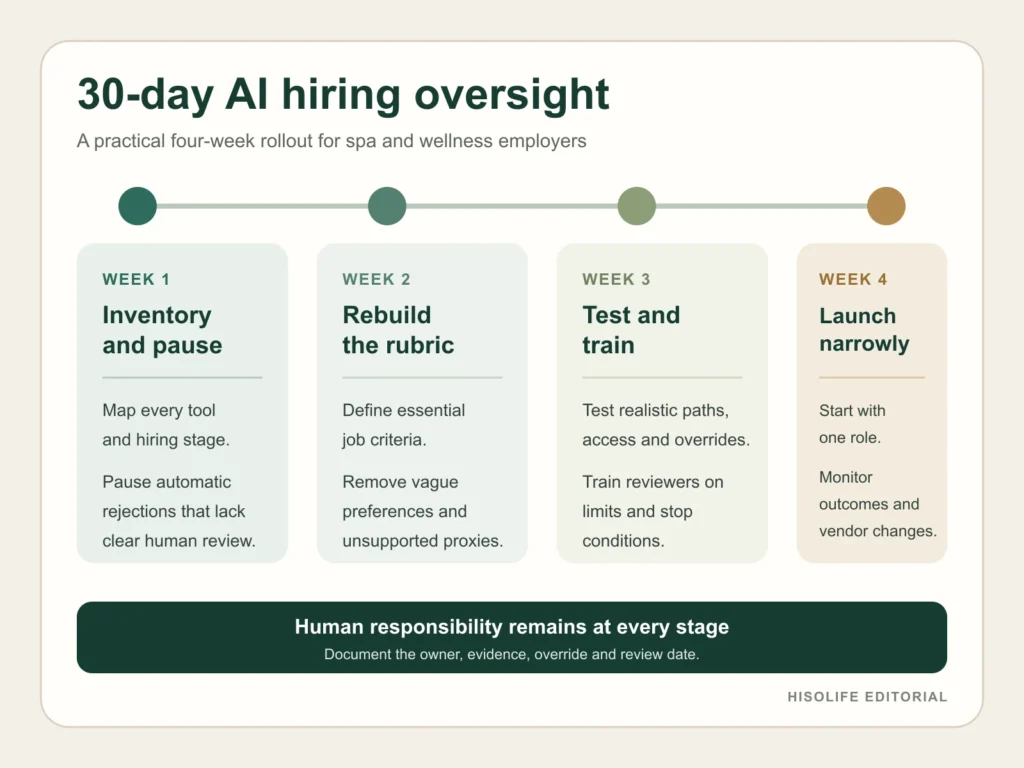
A 30-day human-oversight rollout
Small spa businesses do not need a large governance department to improve control. They do need a named owner, a written use case and evidence that the process works as intended.
Week 1: inventory and pause
List every tool used to advertise, source, communicate, translate, summarise, rank, test or select. Include features built into job boards and office software, not only products purchased as AI. Pause any automatic rejection or biometric-style inference that cannot be clearly justified and reviewed.
Week 2: rebuild the rubric
Confirm essential duties and lawful minimum criteria. Convert vague preferences into observable evidence or delete them. Compare the rubric with compensation and scope using the HiSoLife Wellness Salary Guide 2026, then validate pay and requirements against the current local market.
Week 3: test and train
Test realistic candidate paths, accessibility, notices, overrides, logs and data deletion. Train recruiters on the tool’s purpose, limitations and stop conditions. Give reviewers scenarios in which the AI recommendation is wrong, so override becomes a practiced responsibility rather than a theoretical permission.
Week 4: launch narrowly and monitor
Begin with one role or one low-impact use. Track completion, filtering, overrides, complaints, time saved and hiring quality. Review vendor changes before enabling them. Set a recurring date for legal, privacy, accessibility and performance review, with authority to suspend the system.
What spa employers should publish in a vacancy
A clear vacancy reduces the temptation to infer candidate suitability from weak proxies. State the duties, required credentials, working pattern, physical requirements in functional language, location, compensation structure and selection steps. Explain any assessment and give a contact for accessibility or process questions.
Employers can publish a detailed wellness vacancy or discuss a structured search through HiSoLife’s wellness recruitment service. If AI supports the process, describe the human safeguards with the same clarity used for qualifications and pay.
Conclusion: automate preparation, preserve judgement
The most defensible AI-assisted hiring process is not the one with the highest automation rate. It is the one in which every criterion is job-related, every recommendation can be challenged, every candidate has a human route and every reviewer understands the limits of the tool.
Start small. Inventory the systems already in use, rebuild the role rubric, ask vendors for evidence, test the complete funnel and document who remains accountable. The technology may help a spa move faster, but responsibility for a fair and explainable decision stays with the employer.
Frequently asked questions
Is every AI tool used in spa recruitment high-risk under the EU AI Act?
No. Classification depends on the system’s intended purpose and actual use. Employment uses such as filtering applications or evaluating candidates may fall within sensitive categories, while narrow procedural or preparatory tasks may be treated differently. Obtain current advice for the specific tool and jurisdiction.
Did all EU employment AI obligations start on 2 August 2026?
No. Some AI Act enforcement and transparency requirements entered a new phase on that date, but the Commission’s current timeline says rules for certain high-risk employment systems apply from 2 December 2027. The timetable and final guidance should be rechecked.
What is meaningful human oversight in hiring?
A trained reviewer sees the original evidence and system output, understands known limitations, has time and authority to disagree, records reasons for consequential decisions and monitors patterns across applicants.
What should a candidate do if an automated step is inaccessible?
Use the stated contact to request an accessible alternative or human assistance before the deadline. Save the vacancy and instructions, describe the barrier without sharing unnecessary sensitive information, and ask how the alternative will assess the same job criteria.
Principal sources and scope
This article synthesises European Commission and EUR-Lex materials, the UK Information Commissioner’s Office recruitment audit overview and an International Labour Organization working paper. EU dates reflect official pages checked on 3 August 2026 and may change as final guidance and national implementation develop. Organisations should verify the current rules where they hire.