
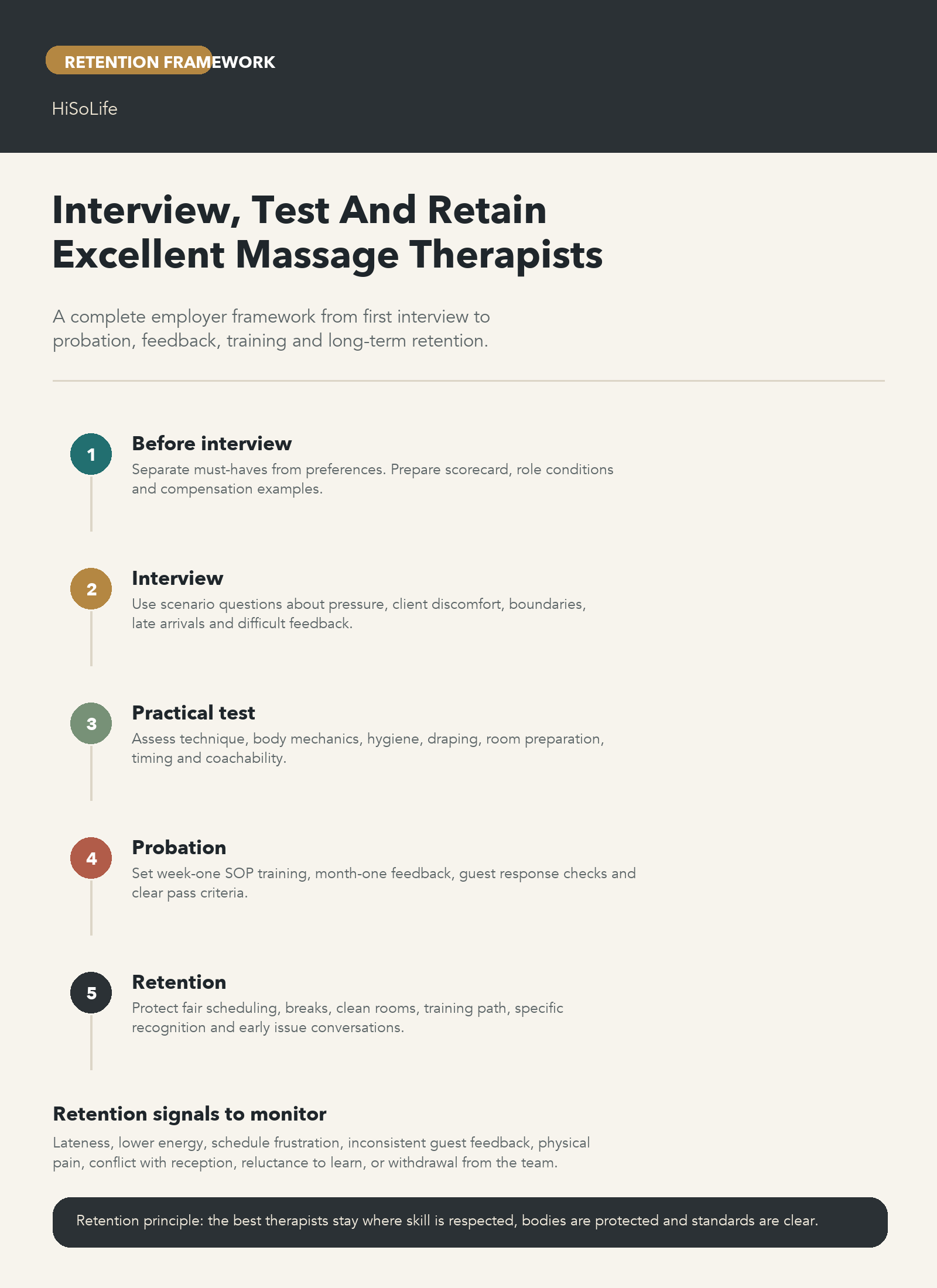
How to Interview, Test and Retain Excellent Massage Therapists
Hiring a massage therapist is not finished when a CV looks good. The real decision happens across the interview, the practical test and the first weeks of work. A therapist can have attractive experience on paper but still be a poor fit for the service style, guest expectations or team rhythm. Another candidate may be quieter on a CV but excellent in hands-on delivery, client care and reliability. Employers need a process that can reveal the difference.

The best spa teams are built through three connected habits: interview carefully, test practically and retain intentionally. If any of these habits is weak, recruitment becomes expensive. A spa may hire the wrong person, lose a good therapist to poor onboarding or watch standards decline because training and feedback are inconsistent. Strong hiring is not about asking clever questions. It is about understanding what excellent massage work looks like in your business and designing a process that identifies and supports it.
Prepare Before The Interview
A good interview starts before the candidate arrives. The employer should already know the essential requirements of the role, the treatments that must be performed, the working schedule, compensation structure, probation expectations and onboarding plan. If the manager is unclear, the candidate will feel uncertainty. Strong therapists often avoid unclear employers because unclear hiring usually leads to unclear management.
Prepare a simple scorecard. Include technique match, service attitude, communication, reliability, availability, hygiene awareness, learning mindset and team fit. This scorecard does not need to be complex, but it should be used consistently. Without a scorecard, managers may rely too much on personality or first impressions. A friendly candidate is not always a reliable therapist. A nervous candidate is not always weak. Structure helps reveal evidence.
Separate Must-Haves From Preferences
Before meeting candidates, separate true requirements from preferences. Must-haves might include legal work eligibility, ability to perform the core treatment, weekend availability, hygiene discipline and professional boundaries. Preferences might include extra techniques, hotel experience, retail confidence or a second language. This separation prevents managers from rejecting a strong candidate because one optional detail is missing.
It also helps retention because the employer can build a training plan around preferences. If the candidate has the right attitude and core technique but lacks one signature protocol, that gap can be trained. If the candidate lacks reliability or respect for boundaries, training may not solve the issue. Knowing the difference makes hiring decisions calmer and more accurate.
Ask Questions That Reveal Real Experience
Interview questions should invite practical answers. Instead of asking “Are you good with clients?” ask the candidate to describe a difficult client situation and how they handled it. Instead of asking “Can you do deep tissue?” ask how they adjust pressure for different body types and guest preferences. Instead of asking “Are you punctual?” ask what schedule they have maintained in previous roles and what commute they expect for this location.
Useful questions include: Which treatments do you perform most confidently? How do you begin a first-time client consultation? How do you respond when a client says the pressure is too strong? What do you do if a guest reports pain during a session? What part of massage work is physically hardest for you? What kind of manager helps you perform well? These questions reveal judgment, self-awareness and professional language.
Listen For Service Thinking
Massage technique is only one part of the guest experience. Excellent therapists think about the complete service: greeting, consultation, room atmosphere, pressure adjustment, draping, timing, hygiene, transitions, closing advice and client comfort. During the interview, listen for whether the candidate naturally includes these details. A therapist who talks only about strong pressure may not yet understand premium service. A therapist who mentions client comfort, rhythm and feedback may have stronger service maturity.
Service thinking also includes boundaries. Ask how the candidate handles inappropriate requests, late arrivals, clients who want medical advice or guests who keep changing the treatment focus. The answer should show professionalism without panic. The therapist should know when to manage the situation directly and when to involve reception or management. Clear boundaries protect the guest, the therapist and the business.
Design A Fair Practical Test
A practical test should be fair, consistent and relevant to the actual job. Do not ask a candidate to perform a random sequence that has nothing to do with your menu. Choose one or two core treatments, define the time and explain what will be assessed. For example, a spa hiring for Thai massage might test body mechanics, pressure control, assisted stretching, flow and client communication. A hotel spa hiring for oil massage might test draping, rhythm, pressure adjustment and relaxation flow.
The test model should be someone who can give useful feedback, not just a person filling time. The evaluator should observe quietly and take notes. Score technique, posture, pressure, transitions, hygiene, communication, timing and confidence. If the candidate makes a small mistake but responds well to correction, that may be a positive sign. Coachability matters. A therapist who refuses feedback can be difficult to develop even if their current technique is strong.
Check Body Mechanics And Sustainability
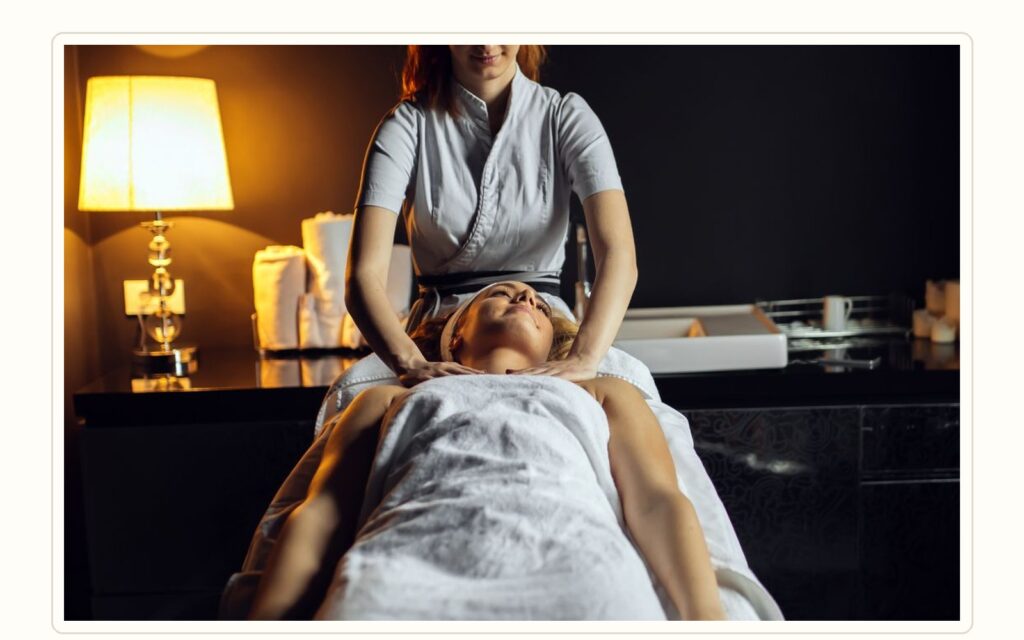
Massage is physical work. A therapist with poor body mechanics may become tired, inconsistent or injured. During the practical test, watch how the candidate uses body weight, stance, hands, forearms and breathing. Strong therapists do not rely only on hand strength. They use efficient posture and controlled movement. This matters for service consistency and long-term retention.
Ask the candidate how they care for their body during busy weeks. Do they stretch, pace treatments, adjust posture or communicate when a schedule is unrealistic? A therapist who understands sustainability is more likely to last. Employers also have responsibility here. Back-to-back bookings without proper breaks may create burnout no matter how skilled the therapist is. Retention begins with realistic operations.
Verify Hygiene And Safety Habits
Hygiene and safety should be evaluated explicitly. A therapist should understand handwashing, linen handling, room preparation, contraindications, product cleanliness and respectful draping. In some businesses, managers assume these habits are obvious. They are not always obvious, especially when candidates come from different training backgrounds. It is better to ask and observe.
During the interview, ask what information the therapist wants before starting a massage. Listen for injuries, pregnancy, recent surgery, skin conditions, pain areas, allergies and pressure preference. During the practical test, observe whether the candidate checks comfort and adjusts appropriately. Safety is not about creating fear. It is about showing that the therapist understands responsibility.
Explain The Role Honestly
Retention improves when the job matches what was promised. If the schedule includes weekends, say so. If the spa has high tourist volume, say so. If the therapist will sometimes support reception, product sales or room reset, say so. If training is required before performing signature treatments, explain the timeline. Candidates can accept demanding roles when expectations are clear. They leave faster when they feel surprised.
Honesty also applies to compensation. Explain the base salary, commissions, service charge, tips, overtime, probation terms and payment dates. Give examples of typical monthly earnings rather than only best-case earnings. Good therapists often prefer predictable clarity over exaggerated promises. A transparent offer builds trust before the first day.
Use Probation As A Development Period
Probation should not be a silent waiting period where the employer watches for failure. It should be a structured development period. In the first week, review the treatment menu, service sequence, hygiene protocol and booking flow. In the second and third weeks, observe real treatments where appropriate, collect guest feedback and correct details. By the end of the first month, the therapist should know exactly what is going well and what needs improvement.
Set measurable probation criteria. These might include punctuality, treatment consistency, guest feedback, ability to follow SOPs, communication with reception, room reset discipline and teamwork. Share these criteria with the therapist. When expectations are visible, feedback feels less personal and more professional. This makes it easier for good therapists to adapt.
Retain Through Respectful Management
Excellent massage therapists leave when they feel disrespected, overworked, underpaid, physically exhausted or ignored. Retention is not solved by one bonus. It is built through daily management. Therapists need clean rooms, reliable supplies, organized bookings, fair breaks, clear communication and managers who understand the physical nature of the work. If management treats therapists as interchangeable, the best ones will look elsewhere.
Respectful management includes listening to treatment-room feedback. Therapists know when a product is not working, when a room setup slows service, when clients keep asking for a missing treatment or when scheduling creates fatigue. Their insight can improve operations. Inviting feedback does not mean accepting every request. It means treating therapists as professionals who understand the service from the inside.
Create A Training Path
Many therapists want to grow. If the only future is repeating the same treatments forever, strong team members may become bored. A training path can include advanced massage techniques, facial support, body scrub protocols, product knowledge, client consultation, senior therapist responsibilities or trainer roles. Growth does not always require promotion to management. It can also mean becoming more expert and more valued in the treatment room.
Training should be practical and scheduled, not only promised. Short monthly workshops, peer practice sessions and treatment audits can keep standards fresh. When a new signature treatment is launched, therapists should be trained properly before clients book it. Training protects the guest experience and shows therapists that the business invests in their craft.
Recognize Performance With Specific Feedback
Recognition matters, but vague praise has limited effect. Instead of saying “good job,” tell the therapist what was good: consistent guest rebooking, excellent pressure adjustment, strong room reset discipline, positive feedback from a difficult client or helpful support for a new colleague. Specific recognition reinforces the behaviors the business wants to keep.
Corrective feedback should also be specific. If a therapist is running late, explain the timing issue and expected fix. If pressure feedback is inconsistent, arrange a practice session. If room setup is incomplete, review the checklist. Avoid public criticism. Feedback delivered respectfully is more likely to improve performance and preserve trust. A therapist who feels humiliated may comply briefly but disengage emotionally.
Watch Early Warning Signs
Retention problems often appear before a resignation. Warning signs include increased lateness, lower energy, more schedule complaints, reduced guest feedback, conflict with reception, physical pain, reluctance to accept bookings or withdrawal from the team. Managers should not ignore these signals. A short conversation can reveal whether the issue is workload, misunderstanding, personal stress, pay confusion or lack of growth.
Not every therapist can or should be retained. Sometimes the fit is wrong. But many good people leave because no one asked what was happening early enough. A retention conversation should be calm and practical: What is working? What is difficult? What support would help? What expectations need to be clarified? Small adjustments can save a strong hire.
Use Exit Feedback To Improve Future Hiring
When a therapist leaves, the employer should learn from it. Exit feedback can reveal whether the job offer was unclear, the schedule was too heavy, pay expectations were misunderstood, training was weak or the manager missed early signs of burnout. Even when the departure is unavoidable, the information can improve future recruitment. Patterns matter more than one isolated complaint.
Keep the exit conversation professional and non-defensive. Ask what attracted the therapist to the role, what was different from expectation, what support was helpful and what would make the workplace stronger. Then compare that feedback with interview notes and probation records. Over time, the spa will understand which hiring promises are working, which screening questions need improvement and which parts of the job need better explanation before candidates accept.
Conclusion
Interviewing, testing and retaining massage therapists requires a complete system. The interview reveals motivation, judgment and communication. The practical test reveals technique, service habits and coachability. Probation and onboarding turn a new hire into a consistent team member. Retention keeps skilled therapists from leaving just when they become most valuable.
Spa employers who take this process seriously build stronger teams and more stable service quality. They ask better questions, test the work directly, explain the role honestly, train with intention and manage therapists with respect. Excellent massage therapists are not only found. They are selected carefully, supported properly and given reasons to stay.
2026 SEO update: How to Interview, Test and Retain Excellent Massage Therapists
Updated for 2026, this guide on How to Interview, Test and Retain Excellent Massage Therapists should be read against a faster-moving wellness market. Recent industry data shows that skills-based hiring is becoming central to quality hiring and talent gap management, while related research notes that tourism businesses continue to face labour shortages, skills gaps and retention pressure. For spa owners, hotel wellness directors and recruitment teams, that means the topic is no longer just an editorial trend; it affects hiring, training, client trust, pricing and how people choose premium wellness experiences in Thailand and beyond. The practical takeaway is to connect the article’s original advice with sharper evidence: define the skill or service clearly, explain how it improves guest outcomes, and make the next step easy through spa and wellness recruitment support, browse qualified wellness candidates and Wellness Salary Guide 2026. Thailand is also receiving more wellness attention, with current tourism and wellness news showing that the global wellness economy reached $6.8 trillion in 2024 and is projected to keep growing toward 2029. A stronger SEO-friendly version of this article therefore needs useful internal links, credible references, and clear answers to the questions readers are likely to search before they apply, hire, book or compare options.
HiSoLife internal update
HiSoLife update: employers can now move from reading about massage therapist recruitment and retention directly into action. Use browse qualified wellness candidates to review talent, post a spa or wellness job to publish a role, and Wellness Salary Guide 2026 to benchmark compensation before making an offer. This internal pathway is important for SEO because it connects informational content with commercial intent: a reader who searched for hiring advice can continue to a relevant employer page instead of leaving the site.
Related HiSoLife resources
- spa and wellness recruitment support
- browse qualified wellness candidates
- post a spa or wellness job
- Wellness Salary Guide 2026
- browse spa and wellness jobs
References and further reading
- LinkedIn, Future of Recruiting 2025 — skills-based hiring is becoming central to quality hiring and talent gap management.
- OECD, strengthening the tourism workforce — tourism businesses continue to face labour shortages, skills gaps and retention pressure.
- Global Wellness Institute, 2025 Global Wellness Economy Monitor — the global wellness economy reached $6.8 trillion in 2024 and is projected to keep growing toward 2029.
- U.S. Bureau of Labor Statistics, Massage Therapists outlook — massage therapist employment is projected to grow 15 percent from 2024 to 2034.
Mini FAQ: How to Interview, Test and Retain Excellent Massage Therapists
What should employers update first for massage therapist recruitment and retention in 2026?
The first update is to turn massage therapist recruitment and retention from a broad idea into a clear decision framework. For this article, that means reading How to Interview, Test and Retain Excellent Massage Therapists as practical guidance for what a reader should do next. The 2026 context matters because wellness is no longer a narrow luxury category: LinkedIn, Future of Recruiting 2025 notes that skills-based hiring is becoming central to quality hiring and talent gap management; OECD, strengthening the tourism workforce notes that tourism businesses continue to face labour shortages, skills gaps and retention pressure. A reader should therefore ask what outcome the topic supports: better hiring, stronger guest retention, safer treatment choices, clearer compensation, or a more credible career path. The SEO-friendly answer is to make that outcome explicit. Instead of saying that wellness is important, the article should explain how this topic affects consultation, service standards, skill proof, job descriptions, client communication and follow-up. On HiSoLife, the next step should also be visible. A candidate can use spa and wellness recruitment support or browse qualified wellness candidates; an employer can move toward post a spa or wellness job; and both sides can use Wellness Salary Guide 2026 to make expectations more concrete.
How can a spa avoid weak hires when recruiting around massage therapist recruitment and retention?
The main risk is treating massage therapist recruitment and retention as a phrase instead of a capability. Search readers usually arrive with a problem: they want to hire someone, get hired, compare a service, understand a skill, or decide whether an experience is worth their time. A weak article answers that problem with generic claims. A stronger article gives criteria. For a spa employer, that may mean checking hands-on technique, consultation language, punctuality, hygiene habits, retail ethics, rebooking behavior and the ability to match a service to a guest’s real needs. For a candidate, it may mean showing certificates, before-and-after case notes where appropriate, training logs, client communication examples and evidence of reliability. Current references support the wider point: LinkedIn, Future of Recruiting 2025 notes that skills-based hiring is becoming central to quality hiring and talent gap management; Global Wellness Institute, 2025 Global Wellness Economy Monitor notes that the global wellness economy reached $6.8 trillion in 2024 and is projected to keep growing toward 2029. HiSoLife can support that decision path with spa and wellness recruitment support, post a spa or wellness job and browse spa and wellness jobs. The practical SEO gain is that the page becomes useful for long-tail searches rather than only repeating the title.
Which skills should be checked before making an offer?
The most important skills depend on the angle of massage therapist recruitment and retention, but the same principle applies across spa, beauty, massage, facial therapy, wellness sales and management: the reader needs proof. Technical knowledge is only one layer. A strong professional also needs consultation skills, client boundaries, product or modality literacy, hygiene discipline, time management and the ability to explain recommendations without pressure. For management and recruitment topics, employers should add structured interviews, practical tests, reference checks and onboarding milestones. For skincare or wellness experience topics, readers should look for credible training, transparent claims and realistic aftercare guidance. This matters in 2026 because OECD, strengthening the tourism workforce notes that tourism businesses continue to face labour shortages, skills gaps and retention pressure, and because LinkedIn, Future of Recruiting 2025 notes that skills-based hiring is becoming central to quality hiring and talent gap management. Inside HiSoLife, the article should guide readers toward concrete pages: spa and wellness recruitment support for opportunity discovery, Wellness Salary Guide 2026 for compensation or expectation checks, and browse spa and wellness jobs for deeper exploration. That internal structure helps users and search engines understand the topic cluster. For search intent, the useful angle is not only the definition of massage therapist recruitment and retention; it is the practical decision a reader needs to make next. A candidate may need to compare roles, update a profile, or understand which training signals credibility. An employer may need to separate a polished CV from a reliable service professional who can protect guest trust over time. That is why this answer connects the topic to measurable actions rather than broad lifestyle language.
How does HiSoLife help employers turn massage therapist recruitment and retention into a shortlist?
HiSoLife helps by connecting the informational part of massage therapist recruitment and retention with the marketplace action that usually follows. A blog article can explain the concept, but the reader often needs somewhere to go next. If the reader is a candidate, the useful path is to review open roles, prepare a stronger resume, compare salary expectations and return to the article’s checklist before applying. If the reader is an employer, the useful path is to define the role, publish the job, compare candidates and keep the article as a standard for interviews or onboarding. The internal links in this refresh are designed for that behavior. They point to pages such as spa and wellness recruitment support, browse qualified wellness candidates, post a spa or wellness job and Wellness Salary Guide 2026 with descriptive anchors rather than vague words like “here” or “learn more.” That is better for SEO and for people. It also keeps older articles useful by connecting them to current site assets, including the salary guide and recruitment pages. References such as LinkedIn, Future of Recruiting 2025 and OECD, strengthening the tourism workforce give the article external context, while the internal pathway gives it commercial relevance. For search intent, the useful angle is not only the definition of massage therapist recruitment and retention; it is the practical decision a reader needs to make next. A candidate may need to compare roles, update a profile, or understand which training signals credibility. An employer may need to separate a polished CV from a reliable service professional who can protect guest trust over time. That is why this answer connects the topic to measurable actions rather than broad lifestyle language.
What metrics show that a massage therapist recruitment and retention strategy is working?
Success should be measured by whether the article helps a reader make a better decision after searching for massage therapist recruitment and retention. For an employer, useful metrics include higher-quality applicants, fewer unsuitable interviews, faster shortlist creation, better retention after onboarding and clearer compensation conversations. For a candidate, useful metrics include profile completeness, applications to better-matched roles, interview readiness and confidence explaining skills. For a wellness or skincare reader, useful metrics include safer expectations, better questions during consultation and a clearer understanding of what evidence supports a treatment or service. The article should therefore avoid exaggerated promises and focus on practical outcomes. It should link to references like LinkedIn, Future of Recruiting 2025 and Global Wellness Institute, 2025 Global Wellness Economy Monitor when discussing market trends, and it should link internally to spa and wellness recruitment support, Wellness Salary Guide 2026 and browse spa and wellness jobs when guiding the next step. That combination is what makes the refresh SEO friendly: it improves topical relevance, adds authority signals, creates descriptive internal links and gives the reader enough depth to stay on the page longer. For search intent, the useful angle is not only the definition of massage therapist recruitment and retention; it is the practical decision a reader needs to make next. A candidate may need to compare roles, update a profile, or understand which training signals credibility. An employer may need to separate a polished CV from a reliable service professional who can protect guest trust over time. That is why this answer connects the topic to measurable actions rather than broad lifestyle language.