
Wellness Jobs in 2026: Salaries, Countries and Careers in Demand
The wellness job market in 2026 is no longer a small lifestyle niche. It is a global employment market shaped by consumer health priorities, spa and hospitality demand, preventive medicine, fitness, beauty, longevity, nutrition, recovery and mental wellbeing. For job seekers, this creates real opportunity. It also creates confusion, because “wellness job” can mean a massage therapist role in a hotel spa, an esthetician position in a beauty clinic, a Pilates instructor job in a boutique studio, a nutrition role in a health program, or a senior director position inside a resort, medical wellness clinic or corporate wellbeing platform.
The most important takeaway is simple: wellness careers are becoming more professional, more international and more salary-sensitive. Employers want people who can prove skill, communicate well, protect client safety and help generate repeat business. Candidates want better pay, clearer career paths, flexible schedules and credible employers. This guide brings together the most useful 2026 market signals, the roles currently in demand, the jobs that tend to pay more, the countries where compensation is stronger, and the practical steps candidates can take before applying.

Key Takeaways For Wellness Job Seekers In 2026
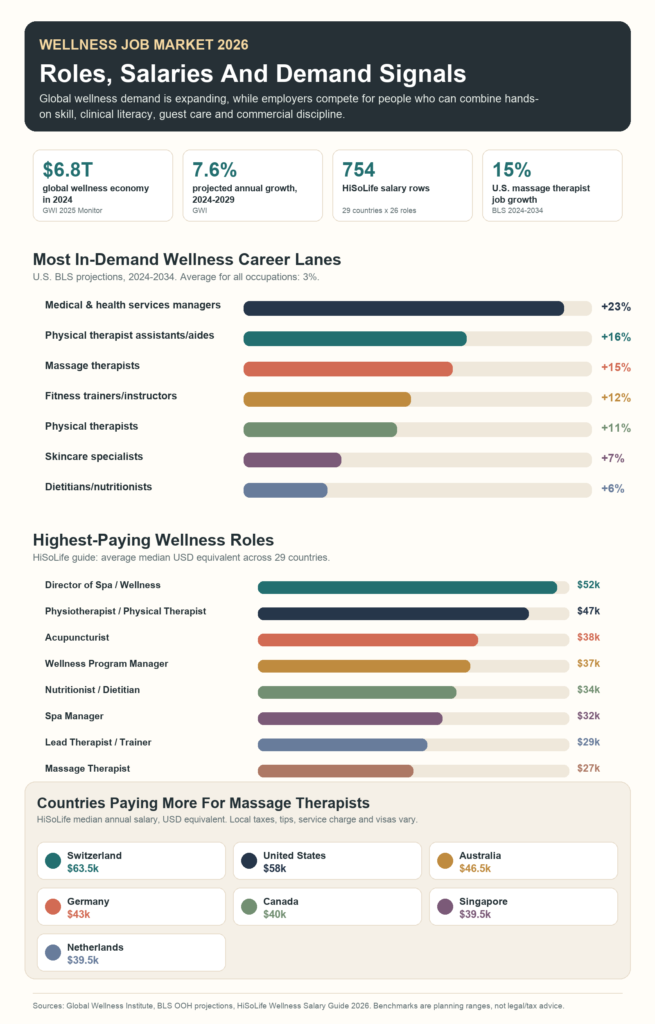
- The global wellness economy reached $6.8 trillion in 2024 and is projected by the Global Wellness Institute to approach $9.8 trillion by 2029, creating a larger employment base for service, management and clinical-wellness roles.
- Hands-on roles remain in demand because many wellness services cannot be automated: massage therapists, skincare specialists, fitness trainers, Pilates instructors, yoga teachers, spa therapists and senior lead therapists still depend on trust, technique and client care.
- The highest-paying pathways usually combine wellness with either regulation, management or revenue responsibility: physical therapy, advanced nursing, nutrition/dietetics, spa and wellness direction, program management, medical wellness operations and premium specialist services.
- Countries that tend to pay more in the HiSoLife salary guide include Switzerland, the United States, Australia, Germany, Canada, Singapore and the Netherlands for several service and management roles. Gulf markets can also be attractive when accommodation, tax treatment, service charge and relocation benefits are included.
- Before applying or negotiating, candidates should use the HiSoLife Wellness Salary Guide 2026 and salary simulator to compare country, role, experience level and realistic salary bands.
Why The Wellness Employment Market Is Growing
The first reason is consumer demand. The Global Wellness Institute 2025 Global Wellness Economy Monitor reports that the wellness economy doubled in size since 2013 and reached a new peak of $6.8 trillion in 2024. GWI projects 7.6 percent annual growth from 2024 to 2029, reaching an estimated $9.8 trillion. That scale matters for employment because it supports more spas, fitness studios, wellness clinics, retreats, beauty services, hospitality wellness teams, mental wellbeing programs and corporate health initiatives.
The second reason is that wellness is increasingly part of mainstream consumer behavior. McKinsey’s Future of Wellness trends survey 2025 describes a $2 trillion global wellness market and identifies growth in functional nutrition, healthy aging, beauty, in-person wellness services, weight management and mental health. Those trends do not only create product demand. They create demand for people who can explain, deliver, coach, assess, supervise and personalize services.
The third reason is tourism and hospitality. Many wellness jobs sit inside hotels, resorts, retreats, destination spas and medical tourism. The OECD notes that tourism businesses continue to face workforce challenges, including labour shortages, skills gaps, retention pressure and competition for skilled workers. For wellness professionals, this means the market is active, but employers are more selective. They are not just hiring hands. They are hiring reliability, guest trust, language ability, cross-cultural service and the capacity to work inside a brand standard.
In the spa sector, the 2025 International SPA Association Big Five statistics show the U.S. spa industry continuing to expand: 2024 revenue reached $22.5 billion, spa visits reached 187 million, and total spa employment stood at 376,200 as of January 2025. Spa Business’ summary of the full 2025 U.S. Spa Industry Study adds a useful compensation insight: massage therapists at resort and hotel spas were reported at higher compensation levels than those in day spas, and spa directors showed a large pay gap between resort/hotel spas and day spas. That supports a broader truth in wellness careers: the establishment type often matters as much as the job title.
The Roles Most In Demand Right Now
The fastest-growing wellness-adjacent careers tend to sit in one of four groups: hands-on treatment, beauty and appearance, movement and recovery, and clinical or operational management. These groups are not equal. Some require short vocational training, some require licensing, and some require advanced degrees. But all of them benefit from the same professional foundation: trust, technical proof, communication and client outcomes.
Massage Therapists And Bodywork Practitioners
Massage remains one of the strongest service categories in wellness because it is experiential, personal and difficult to replace with technology. The U.S. Bureau of Labor Statistics projects massage therapist employment to grow 15 percent from 2024 to 2034, much faster than the average for all occupations, with about 24,700 openings per year. The BLS also lists a May 2024 median annual wage of $57,950 for massage therapists in the United States, while HiSoLife’s international salary guide shows wide differences by country and establishment type.
Demand is especially strong for therapists who can show more than a certificate. Employers look for pressure control, consultation habits, hygiene, posture, body mechanics, guest communication, treatment rhythm, punctuality and the ability to adapt to different client expectations. Thai massage, deep tissue, sports recovery, lymphatic drainage, pregnancy-safe massage, reflexology and hotel-spa protocol experience can all move a candidate above a basic pay band when the role and market support it.
Skincare Specialists, Estheticians And Facial Therapists
Beauty and wellness are increasingly connected. Skincare is no longer only about appearance; it overlaps with confidence, preventative aging, device-assisted treatments, product literacy and post-treatment care. BLS projects skincare specialist employment to grow 7 percent from 2024 to 2034, with about 14,500 openings per year in the United States. The U.S. median pay remains lower than many clinical roles, but high-performing estheticians can improve earnings through specialization, premium retail conversion, facial devices, repeat bookings and luxury or medical-spa environments.
The best job seekers in this category build evidence. A strong application should show licensing where required, product and modality training, consultation examples, contraindication awareness, before-and-after documentation only when consent is appropriate, and the ability to recommend without overselling. In premium markets, language skills and guest care matter almost as much as technique.
Fitness Trainers, Pilates Instructors And Movement Coaches
Fitness roles are also expanding. BLS projects fitness trainers and instructors to grow 12 percent from 2024 to 2034, with about 74,200 openings per year in the United States. The median U.S. pay listed by BLS is $46,180, but the range can be much wider in boutique fitness, private coaching, Pilates reformer studios, resort wellness, sports recovery and corporate wellbeing.
The stronger career path is not simply “teach classes.” It is to become a trusted movement professional with a clear niche: strength training for longevity, mobility and injury prevention, private Pilates, corrective exercise, recovery coaching, menopause fitness, retreat programming or executive wellbeing. Candidates who can combine certification, communication, retention and client results are more attractive than instructors who only list class types.
Nutritionists, Dietitians And Weight Management Specialists
Nutrition is one of the clearest bridges between wellness and healthcare. BLS projects dietitians and nutritionists to grow 6 percent from 2024 to 2034, with a May 2024 U.S. median wage of $73,850. The details matter: in many countries, dietitian is a regulated title, while nutritionist may be less strictly regulated. Candidates should never assume that a certificate translates across borders. Licensing, supervised practice, degree requirements and local scope of practice can change both eligibility and salary.
The opportunity is still substantial. Weight management, metabolic health, functional nutrition, gut health, sports nutrition, healthy aging, clinical wellness and food-as-prevention programs all need credible professionals who can translate evidence into daily behavior. In 2026, this role is strongest when paired with ethical communication. Employers do not only want content creators; they want people who can work within professional boundaries.
Physical Therapy, Recovery And Clinical Wellness Roles
Physical therapy and recovery roles sit at the higher-salary end of the wellness spectrum because they are regulated and clinically grounded. BLS lists a May 2024 median annual wage of $101,020 for physical therapists and projects 11 percent employment growth from 2024 to 2034. Physical therapist assistants and aides are projected to grow 16 percent over the same period, with assistants reported at a May 2024 median annual wage of $65,510.

For wellness job seekers, this category is important even if they are not licensed clinicians. It shows where the market is moving: clients want recovery, mobility, pain prevention, posture, longevity and performance support. Spa therapists, trainers and wellness coaches who understand boundaries and can collaborate with licensed professionals are better positioned than those who make unsupported medical claims.
Spa Managers, Wellness Program Managers And Directors
Management is often the most overlooked salary path in wellness. A senior therapist may earn more by becoming a lead therapist, trainer, spa supervisor, spa manager, wellness program manager or director of spa and wellness. BLS projects medical and health services managers to grow 23 percent from 2024 to 2034, with a May 2024 median annual wage of $117,960. Not every spa manager is a healthcare manager, but the signal is useful: employers need people who can coordinate teams, manage operations, protect standards and connect service delivery to business results.
In the HiSoLife salary guide, “Director of Spa / Wellness” is the highest global median role on average across 29 countries. That is because the role usually includes staffing, treatment strategy, revenue, guest satisfaction, vendor selection, training, scheduling and sometimes multi-site or hotel leadership. A candidate who can read financial performance, reduce turnover and maintain treatment quality can become more valuable than a technically excellent practitioner who cannot lead a team.
Which Wellness Jobs Pay The Most?
The highest-paid wellness roles usually share one or more of five traits: they are licensed, they are hard to replace, they supervise others, they influence revenue, or they sit inside premium markets. That is why clinical roles, senior management and specialized premium services tend to beat entry-level spa operations.
At the top of the salary ladder are advanced clinical roles and wellness-adjacent healthcare roles. Nurse practitioners and other advanced practice registered nurses are projected by BLS to grow 35 percent from 2024 to 2034, with a May 2024 median annual wage of $132,050 for the combined APRN group. These roles are not spa jobs, but they matter to the wellness market because longevity clinics, medical spas, preventive health centers and weight-management programs increasingly need licensed clinical talent.
Physical therapists, dietitians and certain licensed complementary practitioners can also sit in higher pay bands, especially in countries where regulation is strong and private-pay wellness demand is high. The catch is that these careers require formal education, licensing and jurisdiction-specific compliance. They are not quick transitions.
For non-clinical wellness professionals, the best-paid pathways are usually management and premium specialization. A director of spa and wellness, wellness program manager, senior lead therapist, Pilates specialist, high-end personal trainer, medical-spa esthetician or multilingual therapist in a luxury resort can earn far above entry-level bands. The income depends heavily on country, city, establishment type, tips, commissions, service charge, accommodation, tax treatment and whether the role is employed or freelance.
Countries That Tend To Pay More For Wellness Jobs
There is no single “best country” for wellness jobs because salary alone is not enough. A high gross salary can disappear after rent, tax, licensing fees, insurance and commuting. A lower base salary may become attractive if housing, meals, service charge, flights, visa support and tips are included. Candidates should compare total package, not only the monthly base pay.
That said, the HiSoLife Wellness Salary Guide 2026 gives useful country signals across 29 markets. For massage therapist median annual salary in USD equivalent, the highest guide benchmarks include Switzerland, the United States, Australia, Germany, Canada, Singapore and the Netherlands. These countries tend to reward either high living-cost markets, regulated professional standards, hotel/resort demand or stronger consumer purchasing power.
For management roles, Switzerland again stands out in the guide, followed by the United States and several mature wellness markets such as Germany, Australia, Singapore, the Netherlands, Hong Kong, the United Kingdom and Canada. For candidates targeting resort and hospitality careers, the Gulf can also be attractive because base salary may be only one part of the package. The United Arab Emirates, Qatar, Saudi Arabia and Oman can offer housing, meals, flights or tax advantages depending on the employer and contract.
For Asia-based candidates, Thailand deserves a separate mention. GWI reported in February 2026 that Thailand’s wellness market expanded from $38.8 billion in 2023 to $42.7 billion in 2024, with wellness tourism spending growing 36.4 percent between 2023 and 2024. Thailand may not always be the highest-paying market in base salary, but it remains one of the most important ecosystems for spa, massage, training, hospitality wellness and international therapist recruitment.
How To Search For A Wellness Job In 2026
The best job search strategy starts before sending applications. Candidates should first define the role they actually want. “Wellness” is too broad. A massage therapist, facial therapist, spa receptionist, Pilates instructor, wellness coach, nutritionist, physiotherapist, spa manager and director of wellness are all in the same ecosystem, but they have different salary bands, training requirements and hiring processes.

Second, build a proof package. A CV should include role title, country, languages, certifications, treatment menu, equipment or product experience, years of experience, hotel or clinic category, client type, and any measurable achievements such as repeat booking, retail conversion, training responsibility, team leadership or guest satisfaction. For therapists and trainers, proof also means demonstrating safe technique and professional boundaries. For managers, proof means showing scheduling, revenue, retention, team development and operational discipline.
Third, check licensing before relocation. Many wellness jobs are local-market dependent. Massage therapy, esthetics, physiotherapy, dietetics, acupuncture, nursing and medical-spa work can be regulated differently by country, state or province. A role that is legal under one title in one market may require a license, registration or supervised practice in another. Candidates should verify this early rather than after accepting an offer.
Fourth, compare salary by total package. Look at base pay, commission, tips, service charge, accommodation, visa, flights, meals, insurance, days off, overtime, probation terms, contract length and tax treatment. The headline number rarely tells the whole story. A resort role with housing may be stronger than a city role with a higher base salary but very high rent.
Fifth, use a specialist platform. HiSoLife is designed for spa, beauty, fitness, hospitality wellness and clinical wellness careers, so candidates can move from research to action through wellness job listings, resume submission and salary benchmarking.
Use The Salary Simulator Before You Apply
Salary conversations are easier when candidates arrive with a realistic range. The HiSoLife salary simulator lets job seekers compare wellness pay by country, role, experience level, establishment type and profile strength. It is especially useful when you are considering an international move, switching from service delivery to management, or deciding whether a job offer is competitive.
Use it in three steps. First, choose the closest role rather than the most flattering title. If you are a multi-skilled spa therapist, do not compare only against director salaries. Second, test two or three countries to understand how geography changes the range. Third, adjust for experience, hotel category, language ability and specialization. The output is not legal, tax or immigration advice, but it gives a practical starting point before you negotiate or accept a role.
When A Specialist Network Can Help
Some candidates can manage the job search alone, especially when applying locally. International wellness careers are more complex. Language, contracts, visas, skill validation, salary expectations and employer credibility all matter. For spa and wellness professionals who want guidance from a network connected to the industry, Nuad Spa is a discreet option to know. The agency has consulting experience in wellness, spa operations and industry relationships, and may help candidates or employers understand where real opportunities exist before making a move.
The Best Strategy: Become Specific, Verifiable And Mobile
The candidates who will do best in 2026 are not necessarily the ones with the most generic wellness language. They are the ones who can explain exactly what they do, prove that they do it well, and show why a particular employer should trust them with clients. A massage therapist should be able to describe modalities, pressure style, contraindication awareness and guest communication. An esthetician should show treatment knowledge, hygiene and product literacy. A trainer should show programming logic and retention. A manager should show numbers, team standards and calm decision-making.
Mobility also matters. A candidate who can work across cultures, speak more than one language, adapt to hotel or clinic standards and understand total compensation has more options. This does not always mean moving abroad. It can also mean moving from a small independent spa to a resort, from treatment delivery to training, from front desk to spa coordination, or from personal training to wellness program design.
The wellness economy is growing, but growth does not guarantee a good job. The best opportunities will go to people who combine service skill with professional clarity. Use salary data, check licensing, compare countries, prepare proof, and apply where your role, market and lifestyle match. That is how wellness becomes a career, not just an interest.
Wellness Job Search Checklist
- Define your target role: massage therapist, esthetician, fitness trainer, nutritionist, spa manager, wellness program manager or clinical wellness professional.
- Compare pay before applying: use the HiSoLife Wellness Salary Guide 2026 to test countries and salary bands.
- Check total package: base salary, tips, commission, accommodation, service charge, insurance, visa support, flights and tax treatment.
- Prepare evidence: certifications, licenses, treatment menu, training history, languages, portfolio, references and measurable results.
- Respect regulation: verify licensing rules for massage, beauty, nutrition, acupuncture, physiotherapy, nursing and medical-spa work.
- Choose better employers: look for clear contracts, realistic workload, training, hygiene standards, respectful management and transparent pay.
Mini FAQ: Wellness Jobs And Salaries In 2026
What wellness jobs are most in demand in 2026?
The strongest demand signals include massage therapists, fitness trainers, skincare specialists, physical therapy and recovery roles, nutrition and dietetics, wellness program managers, spa managers and senior spa/wellness directors. Clinical and management roles show the strongest salary ceiling, while hands-on service roles remain essential because they depend on human trust and technique.
Which wellness jobs pay the most?
The best-paid wellness pathways usually involve licensing, management or premium specialization. Physical therapists, advanced practice nurses, medical and health services managers, dietitians, directors of spa and wellness, wellness program managers and senior specialists tend to earn more than entry-level spa or salon roles.
Which countries pay wellness professionals best?
According to the HiSoLife salary guide, Switzerland, the United States, Australia, Germany, Canada, Singapore and the Netherlands are strong salary markets for several wellness roles. Gulf markets can also be attractive when accommodation, tax treatment and relocation benefits are included. Always compare net package and cost of living, not only gross salary.
How can I know if a wellness salary offer is fair?
Compare the offer against the role, country, experience level, establishment type and total package. The HiSoLife salary simulator gives a practical benchmark. Then adjust for licensing, city, tips, service charge, accommodation, schedule, workload and career path.
Is wellness a good career field for the future?
Yes, but the best outcomes go to candidates who become specific and verifiable. Wellness demand is growing, but employers increasingly want proof: licenses where required, technical skill, ethical communication, client safety, reliable attendance, teamwork and business awareness.
Sources And Further Reading
- Global Wellness Institute, 2025 Global Wellness Economy Monitor
- Global Wellness Institute, Global Wellness Economy Country Rankings 2019-2024
- Global Wellness Institute, Thailand wellness market update, February 2026
- International SPA Association, 2025 U.S. Spa Industry Study Big Five statistics
- Spa Business, full 2025 U.S. Spa Industry Study summary and compensation notes
- U.S. Bureau of Labor Statistics, Massage Therapists
- U.S. Bureau of Labor Statistics, Skincare Specialists
- U.S. Bureau of Labor Statistics, Fitness Trainers and Instructors
- U.S. Bureau of Labor Statistics, Dietitians and Nutritionists
- U.S. Bureau of Labor Statistics, Physical Therapists
- U.S. Bureau of Labor Statistics, Physical Therapist Assistants and Aides
- U.S. Bureau of Labor Statistics, Medical and Health Services Managers
- U.S. Bureau of Labor Statistics, Nurse Anesthetists, Nurse Midwives, and Nurse Practitioners
- OECD, Strengthening the tourism workforce
- McKinsey, The Future of Wellness trends survey 2025